Dental Hygienist Salary: What to Expect by Experience and Location
How dental hygienist earnings are built, what the federal percentile ranges show, and which employer and location factors move the number up or down.
Quick answer
- The median annual wage for dental hygienists was $98,100, or $47.16 per hour (U.S. Bureau of Labor Statistics, 2025).
- Federal percentile estimates run from $65,110 at the 10th percentile to $118,400 at the 90th, so experienced earners sit far above new entrants (U.S. Bureau of Labor Statistics, Occupational Employment and Wage Statistics, 2023).
- Many hygienists work part time (U.S. Bureau of Labor Statistics, 2025), so annual totals often fall below the published full-time figures.
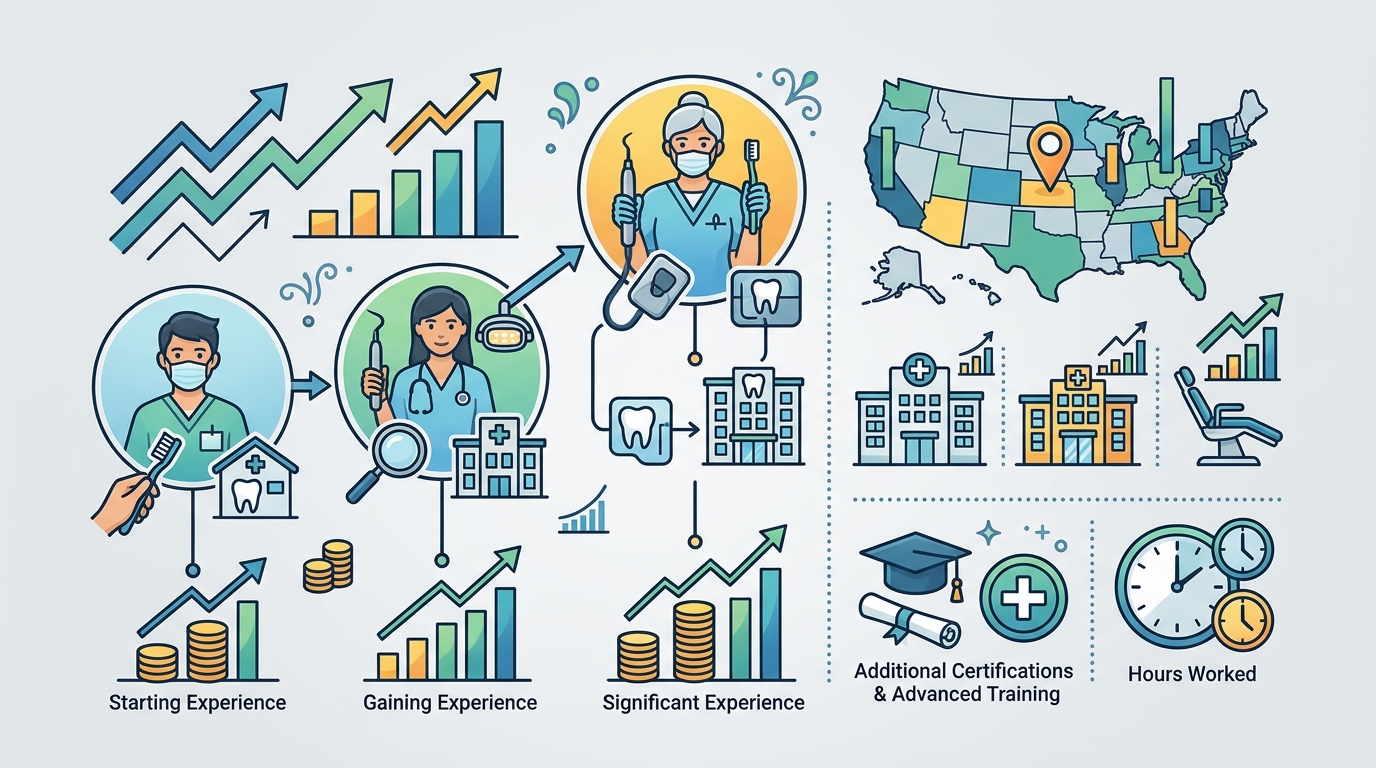
The median annual wage for dental hygienists was $98,100, or $47.16 per hour (U.S. Bureau of Labor Statistics, 2025). Earlier federal wage estimates show a wide spread around that middle point: from $65,110 at the 10th percentile to $118,400 at the 90th (U.S. Bureau of Labor Statistics, Occupational Employment and Wage Statistics, 2023).
Two things shape what you actually bank: the state you are licensed in, and your hours. Nearly all dental hygienists work in dentists' offices, and many work part time (U.S. Bureau of Labor Statistics, 2025), so published annual figures describe full-time, year-round work rather than every hygienist's paycheck.
What This Job Pays
The median annual wage for dental hygienists was $98,100, which works out to $47.16 per hour (U.S. Bureau of Labor Statistics, 2025). A median means half of dental hygienists earned more than that and half earned less — it is not an average, and it is not a starting figure.
For the spread, the most detailed published breakdown comes from the Occupational Employment and Wage Statistics program. Its percentile estimates were: 10th percentile $65,110, 25th percentile $78,010, median $87,530, 75th percentile $100,630, and 90th percentile $118,400 (U.S. Bureau of Labor Statistics, OEWS, 2023). Note that this 2023 median of $87,530 sits below the $98,100 median published for 2025 — they come from different releases and different reference periods, so compare like with like rather than treating the gap as a pay rise you can count on.
Other summaries citing the OEWS May 2025 release publish an updated national mean annual wage along with 25th and 75th percentile estimates (MedicalAid.org, citing BLS OEWS May 2025), and a separate summary converts the May 2025 10th and 90th percentile wages to hourly figures on a 40-hour week (Dreambound, citing BLS, May 2025). Check the current OEWS occupational profile for dental hygienists directly for the latest numbers before you negotiate.
A few things to understand about what these figures include:
- They are wages — gross pay before taxes and deductions. They do not describe the value of benefits such as health insurance, retirement contributions, continuing education allowances, or paid time off, which vary by employer and can be thin in small private practices.
- They are stated as full-time, year-round annual equivalents. Because many dental hygienists work part time (U.S. Bureau of Labor Statistics, 2025), a hygienist working three clinical days a week will not reach the published annual median even if the hourly rate matches.
- Hygienists are commonly paid an hourly rate or a daily rate. Some practices add production- or incentive-based pay on top. If an offer mentions bonuses tied to production, ask what the base hourly rate alone comes to, then compare that to the median hourly figure of $47.16 (U.S. Bureau of Labor Statistics, 2025).
Demand is one reason the figures hold up: employment of dental hygienists is projected to grow 8 percent from 2025 to 2035, much faster than average, with about 15,000 openings projected each year on average over the decade (U.S. Bureau of Labor Statistics, 2025).
Salary by Experience and Location
The federal data does not publish wages by years of experience. The percentile ladder below is the closest usable proxy: new graduates generally cluster near the lower percentiles, and hygienists with years in the same practice, specialist duties, or expanded-function permits sit higher up.
| Stage or place | Annual figure | Source and year |
|---|---|---|
| Entry level (10th percentile) | $65,110 | BLS OEWS, 2023 |
| Early career (25th percentile) | $78,010 | BLS OEWS, 2023 |
| Mid-career (median) | $87,530 | BLS OEWS, 2023 |
| Mid-career (national median, later release) | $98,100 ($47.16/hour) | U.S. Bureau of Labor Statistics, 2025 |
| Experienced (75th percentile) | $100,630 | BLS OEWS, 2023 |
| Top earners (90th percentile) | $118,400 | BLS OEWS, 2023 |
| Offices of dentists (annual mean) | $90,160 | BLS OEWS industry profile, 2023 |
| Employment services, including temp and placement agencies (annual mean) | $95,650 | BLS OEWS industry profile, 2023 |
| Outpatient care centers (annual mean) | $90,310 | BLS OEWS industry profile, 2023 |
| Federal, state and local government, excluding schools and hospitals (annual mean) | $74,260 | BLS OEWS industry profile, 2023 |
On location, the ranking is clearer than any single number. Washington is reported as the highest-paying state for dental hygienists and Alabama the lowest (DentX, citing BLS OEWS data updated for 2025). A second summary puts Washington and California at the top of the state list (Becker's Dental Review, citing BLS OEWS 2025 data). A third reports that the District of Columbia had the highest published annual median in May 2025, with Alaska, Washington, California and Oregon completing the top five (MedicalAid.org, citing BLS OEWS state wage estimates).
For exact dollars by state, use the OEWS geographic profile for dental hygienists, which publishes annual mean wages state by state — including California (BLS OEWS, 2023), Washington (BLS OEWS, 2023), Texas (BLS OEWS, 2023), and New York and Florida (BLS OEWS, 2023). State-level annual mean and median wages for Washington, California and the District of Columbia are also compiled in a published state pay table (TradeColleges.org, citing BLS OEWS May 2025), as are employment and median pay figures for Texas, New York and Florida (TradeColleges.org, citing BLS OEWS May 2025).
Within a state, metro figures differ from the statewide mean, and your own state labor department or workforce agency often publishes regional wage estimates that are more current than a national table. Look up both before you decide a given offer is low.
What Affects Pay in This Field
- Experience and position on the wage ladder. The published percentile range runs from $65,110 at the 10th percentile to $100,630 at the 75th and $118,400 at the 90th (U.S. Bureau of Labor Statistics, OEWS, 2023). Most of that movement happens through changing employers and locations rather than through automatic annual steps.
- Employer type. Employment services, which includes temporary and placement agencies, had an annual mean wage of $95,650, while federal, state and local government employers outside schools and hospitals had an annual mean of $74,260 (U.S. Bureau of Labor Statistics, OEWS industry profile, 2023). Offices of dentists, where nearly all hygienists work, sat at $90,160 and outpatient care centers at $90,310 in the same data.
- Temp and per-diem work. The employment services annual mean of $95,650 was above the offices-of-dentists annual mean of $90,160 (U.S. Bureau of Labor Statistics, OEWS industry profile, 2023). The trade-off is usually benefits and schedule certainty, not the hourly rate.
- State. Washington is reported as the top-paying state and Alabama the bottom (DentX, citing BLS OEWS data updated for 2025), with the District of Columbia, Alaska, Washington, California and Oregon listed as the five highest published medians in May 2025 (MedicalAid.org, citing BLS OEWS state wage estimates). State licensing boards also set scope of practice, which affects which procedures you can bill for; check your state board for what your license covers.
- Hours worked. Many dental hygienists work part time (U.S. Bureau of Labor Statistics, 2025). Pay is usually hourly or daily, so every clinical day added or dropped from the week changes annual gross pay proportionally, even when the hourly rate matches the published median of $47.16 (U.S. Bureau of Labor Statistics, 2025).
- Base rate versus incentive pay. Where a practice offers production bonuses, compare the base hourly or daily rate against the median hourly figure of $47.16 (U.S. Bureau of Labor Statistics, 2025) first. Incentive pay rises and falls with patient volume and cancellations; base pay does not.
- Local demand. Employment is projected to grow 8 percent from 2025 to 2035, with about 15,000 openings a year on average (U.S. Bureau of Labor Statistics, 2025). In areas where practices struggle to fill chairs, hygienists have more room to negotiate; in saturated metros, less.
How This Job's Pay Compares
Against the roles people most often confuse it with, dental hygiene sits in the middle: above chairside support roles, below dentistry.
- Dental hygienists: median annual wage $98,100, or $47.16 per hour (U.S. Bureau of Labor Statistics, 2025). Entry normally requires an associate degree in dental hygiene and a state license.
- Dental assistants: median annual wage $48,070, or $23.11 per hour (U.S. Bureau of Labor Statistics, 2025), against the hygienist median of $98,100 in the same release. Training is shorter, and requirements differ by state.
- Dentists: a 2025 median pay figure is published in the Similar Occupations table on the BLS dental hygienists profile (U.S. Bureau of Labor Statistics, 2025), and it is higher than the hygienist median. The route is a doctoral or professional degree plus licensure, so the comparison is a career-change question, not a promotion question.
- Medical assistants: a 2025 median pay figure also appears in that same Similar Occupations table (U.S. Bureau of Labor Statistics, 2025). Check the current figure there rather than assuming parity with dental assistants.
The practical takeaway: the clearest single step up in pay from chairside assisting is hygiene licensure, and the clearest step up from hygiene is dental school. Within hygiene itself, the levers are state, employer type and hours rather than title.
Frequently asked questions
Is $98,100 what a typical dental hygienist actually takes home in a year?
Not necessarily. The $98,100 median is a gross annual wage for full-time, year-round work (U.S. Bureau of Labor Statistics, 2025), before taxes and deductions, and it excludes the value of benefits. Many dental hygienists work part time (U.S. Bureau of Labor Statistics, 2025), so a three- or four-day clinical week produces a smaller annual total even at the median hourly rate of $47.16 (U.S. Bureau of Labor Statistics, 2025).
Why do the 2023 and 2025 federal figures differ?
They come from different releases. The Occupational Employment and Wage Statistics percentile table lists a median of $87,530 (U.S. Bureau of Labor Statistics, OEWS, 2023), while the occupational profile lists a median of $98,100 (U.S. Bureau of Labor Statistics, 2025). Compare figures from the same release and year, and check the current OEWS profile for the latest.
Which states pay dental hygienists the most?
Washington is reported as the highest-paying state and Alabama the lowest (DentX, citing BLS OEWS data updated for 2025). Washington and California are named as the top two in another summary (Becker's Dental Review, citing BLS OEWS 2025 data), and the District of Columbia is reported as having the highest published annual median in May 2025, followed by Alaska, Washington, California and Oregon (MedicalAid.org, citing BLS OEWS state wage estimates). For exact dollars, use the OEWS geographic profile for dental hygienists or your state labor department.
How does hygienist pay compare with dental assistant pay?
At the median, dental hygienists earned $98,100 a year, or $47.16 an hour, while dental assistants earned $48,070 a year, or $23.11 an hour (U.S. Bureau of Labor Statistics, 2025). Both are wage figures and exclude the value of benefits.
Do dental hygienists get bonuses or commission on top of base pay?
Some practices add production- or incentive-based pay, but it is not universal and it is not reflected as a separate line in the federal wage tables. Treat the base hourly or daily rate as the dependable part and compare it to the median hourly figure of $47.16 (U.S. Bureau of Labor Statistics, 2025), since incentive pay moves with patient volume, cancellations and recall rates.
Is the field growing enough to support pay?
Employment of dental hygienists is projected to grow 8 percent from 2025 to 2035, much faster than average, with about 15,000 openings projected each year on average over the decade (U.S. Bureau of Labor Statistics, 2025). Local conditions vary, so check your state workforce agency's projections alongside the national figure.
Sources
- U.S. Bureau of Labor Statistics — Dental Hygienists : Occupational Outlook Handbook (2025)
- U.S. Bureau of Labor Statistics — Dental Assistants : Occupational Outlook Handbook (2025)

Written by
Wyatt covers work outside the office: construction, logistics, repair, and the people who keep things running. He's skeptical of career advice that assumes everyone sits at a desk.