What It's Really Like to Work as a Welder
A look at the shifts, the protective gear, the certifications and the physical toll behind a trade that joins metal in shops, shipyards and on job sites.
Quick answer
- Entry is usually vocational-technical, community college or private welding school training, or an employer apprenticeship (BLS).
- Median annual wage for the occupation is published by the U.S. Bureau of Labor Statistics (2025) — check the current figure.
- BLS projects employment growth for welders, cutters, solderers and brazers over 2025-35, openings mostly replacing leavers.
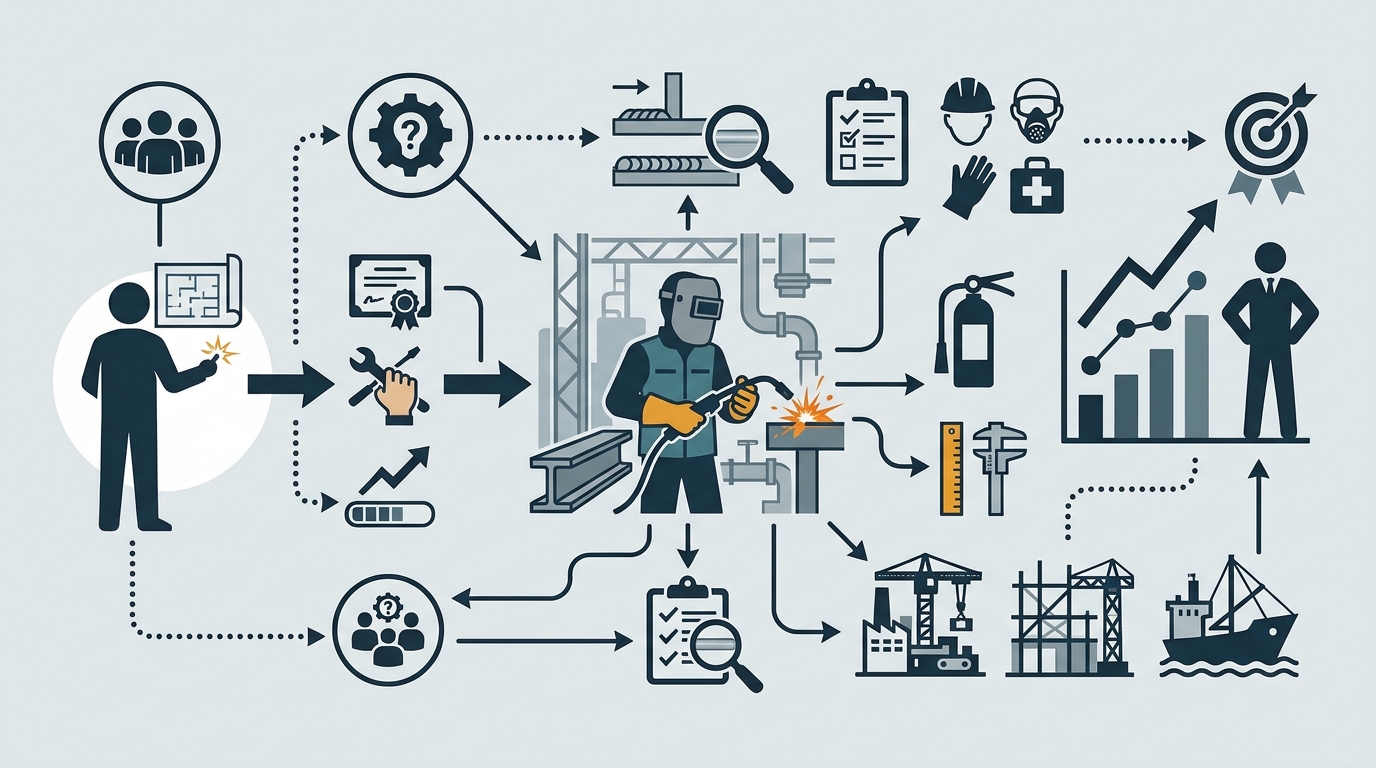
Welding is skilled manual work: you read a drawing, set up a joint, control heat and filler metal, and prove the result holds. Welders, cutters, solderers and brazers held about 437,700 jobs in 2025, with 63 percent in manufacturing, 8 percent with specialty trade contractors, 5 percent with merchant wholesalers of durable goods and 4 percent self-employed (U.S. Bureau of Labor Statistics, 2025).
Most people get in through technical training at a vocational-technical institute, community college or private welding school, or through an employer-based apprenticeship (U.S. Bureau of Labor Statistics). The work pays on an hourly or salaried basis depending on the employer, and the conditions — fumes, arc light, heat, height and shift schedules — are a real part of the job rather than a footnote.
What This Job Involves Day to Day
A common manufacturing pattern is a 6 a.m. start on the first of two or three daily shifts that run 8 to 12 hours, which is why evening and weekend work is normal in this occupation (U.S. Bureau of Labor Statistics).
You clock in, check the job packet and read the blueprint for the weldment you are assigned. Before an arc is struck you calculate and measure dimensions, inspect the material for rust, scale or the wrong alloy, and lay out the joint. By 6:30 you are tacking parts in a fixture, checking squareness with a straightedge or a template so the piece conforms to specification.
The rest of the morning is production. On gas metal arc work you load a wire spool, set wire feed speed and voltage on the MIG machine, change the contact tip when the arc starts wandering, and run beads with an auto-darkening welding helmet, heat-resistant gloves and hearing protection on — the standard PPE against fumes, very hot material and intense arc light. An angle grinder takes down tacks and preps stops and starts. Shielded metal arc work means a stinger, an electrode oven and more slag cleanup.
After lunch you might be on a TIG torch for thin stainless, where heat control is slower and more deliberate, or pulled onto a repair that puts you on a scaffold outdoors in whatever weather the day brings. Late in the shift you monitor and adjust heat on a thick section, let inspection check your work, then clean the gun liner, change gas bottles and log equipment maintenance before handing the cell to the next shift.
Common Tasks and Responsibilities
- Read and interpret blueprints, weld symbols and sketches to work out joint type, position and filler metal.
- Calculate and measure dimensions of parts to be welded, and lay out cuts before any heat is applied.
- Inspect structures and materials before welding to confirm alloy, thickness and fit-up are correct.
- Operate shielded metal arc and gas metal arc welding equipment, along with the hand and power tools common to the trade.
- Monitor the flow of metal and adjust heat, travel speed and machine settings so the weld meets specification.
- Examine finished workpieces with straightedges, templates and gauges to confirm conformance with the drawing.
- Cut, gouge and bevel metal with torch or plasma equipment during fabrication and repair work.
- Maintain machinery — tips, liners, nozzles, ground clamps, gas regulators — and report equipment faults.
- Wear and inspect PPE, including welding helmets, hearing protection and heat-resistant gloves, as protection against fumes, hot material and arc light.
Salary and Job Outlook by Experience Level
Welding pay is usually hourly, with overtime, shift differentials for evenings and nights, and sometimes per-diem or travel pay on contractor and shutdown work. Certified positions on pressure piping, structural steel or aerospace alloys tend to sit above general fabrication work. Figures below are national patterns; state, metro and industry pay differ, so look up your own area before you plan around a number.
| Career stage | Typical years of experience | Where to find the pay range |
|---|---|---|
| Entry-level | 0-2 years, often straight out of a welding program or early in an apprenticeship | The amount the lowest-paid 10 percent earned less than is published by the U.S. Bureau of Labor Statistics (2025) — use that as the floor for the occupation |
| Mid-career | 3-7 years, usually certified in one or more processes and positions | Compare against the published median annual wage for welders, cutters, solderers and brazers (U.S. Bureau of Labor Statistics, 2025) |
| Experienced / senior | 8+ years, often pipe, code or inspection-adjacent work, or self-employed | The amount the highest-paid 10 percent earned more than is published by the U.S. Bureau of Labor Statistics (2025) |
Source note: median, 10th percentile and 90th percentile annual wages for welders, cutters, solderers, and brazers come from the U.S. Bureau of Labor Statistics (2025) and are republished each year in the Occupational Outlook Handbook and the OEWS tables, including state and metropolitan-area figures. On outlook, the Bureau projects employment growth for the occupation over the 2025-35 period, with job openings each year over the decade arising mostly from the need to replace workers who leave the occupation (U.S. Bureau of Labor Statistics, 2025).
Skills and Traits That Fit This Work
The Bureau of Labor Statistics lists detail orientation, manual dexterity, physical stamina, physical strength and spatial-orientation skills as the important qualities for this occupation. In practice they look like this:
- Detail orientation — you catch that the drawing calls for a 3/8 inch fillet on both sides, not one, before the piece goes to inspection.
- Manual dexterity — you hold a steady 1/8 inch arc length around a pipe joint while your hand moves through an awkward angle.
- Physical stamina — you stay productive through the back half of a 12-hour shift, crouched over a fixture in a leather jacket in summer heat.
- Physical strength — you lift and clamp plate, drag welding leads and gas bottles, and hold a torch overhead without the bead wandering.
- Spatial-orientation skills — you look at a flat drawing and see how the bracket sits in three dimensions, so you tack it the right way round the first time.
- Tolerance for the environment — you can work outdoors in bad weather, inside a booth built to contain sparks and glare, or on a scaffold high off the ground without it rattling you.
- Self-discipline about safety — you put the helmet down, the gloves on and the extraction on every time, because fumes and arc light do their damage gradually.
How to Get Started
- Enrol in hands-on welding training or an apprenticeship. The usual routes are a certificate or diploma program at a vocational-technical institute, community college or private welding school, or an employer-based apprenticeship that pays you while you learn (U.S. Bureau of Labor Statistics). Program length varies by school and state — ask admissions for the total instructional hours and which processes, positions and thicknesses you will actually burn. As a benchmark, the AWS Certified Welder credential is associated with 80 related instructional hours (Indiana Department of Workforce Development).
- Complete the safety training the law requires. OSHA requires that welders complete training on electrical safety (U.S. Bureau of Labor Statistics). Many employers also expect site safety orientation and documented PPE training before you touch a machine, so keep the paperwork.
- Take a performance test for the AWS Certified Welder credential. The program is performance-based with no prerequisite courses or certifications; you test at an AWS-Accredited Testing Facility, which submits the Certified Welder Application to the American Welding Society. Budget for the exam fee of $500 and the $75 renewal fee; the credential runs for three years, with recertification by exam or approved endorsements every nine years (Indiana Department of Workforce Development). Keep it live by submitting certification maintenance documentation every six months confirming you are still performing the certified process (American Welding Society).
- Check licensing where you intend to work. Welders must be licensed in some states and localities, and the requirements vary, so confirm with the state or city authority rather than assuming your certificate is enough (U.S. Bureau of Labor Statistics).
- Apply where the jobs are. Manufacturing employs 63 percent of welders, cutters, solderers and brazers, specialty trade contractors 8 percent and merchant wholesalers of durable goods 5 percent (U.S. Bureau of Labor Statistics, 2025). Search and apply under the job titles employers actually post: MIG Welder, TIG Welder, Welder Fitter, Fabrication Welder and Maintenance Welder (O*NET OnLine, 2026). Expect a weld test as part of the interview.
Frequently asked questions
How does pay usually progress for a welder?
Progression comes from processes, positions and codes you can prove, plus overtime and shift differentials. A useful way to track it is to compare your hourly rate against the 10th percentile, median and 90th percentile annual wages the U.S. Bureau of Labor Statistics published for welders, cutters, solderers and brazers in 2025, and against your own state and metro figures rather than the national one.
What are the physical and schedule demands really like?
Many manufacturing firms run two or three 8- to 12-hour shifts a day, so evenings and weekends come with the territory (U.S. Bureau of Labor Statistics). You may work outdoors in all weather, inside a booth built to contain sparks and glare, or on a scaffold or platform high off the ground. Physical stamina and strength are listed as core requirements for good reason.
What are the main hazards, and how are they managed?
The Bureau of Labor Statistics names exposure to fumes, very hot materials and intense arc light as the central risks. They are controlled with PPE — welding helmets, hearing protection and heat-resistant gloves — plus ventilation, screens and procedure. OSHA also requires training on electrical safety. None of this removes the risk entirely, which is why discipline about gear matters every single shift.
Do I need a college degree to start?
No. The standard entry routes are technical training at a vocational-technical institute, community college or private welding school, or an employer-based apprenticeship (U.S. Bureau of Labor Statistics). Check the typical entry-level education the Bureau lists for the occupation, then compare specific programs on instructional hours, processes taught and whether they host accredited testing on site.
Is certification worth the cost?
The AWS Certified Welder credential costs $500 to test, $75 to renew, lasts three years and needs recertification every nine years (Indiana Department of Workforce Development). It is performance-based with no prerequisites, so you can test once you can run the weld. The tradeoff is upkeep: continuity requires maintenance documentation every six months (American Welding Society).
Will there be jobs in ten years?
The Bureau of Labor Statistics projects employment growth for welders, cutters, solderers and brazers over the 2025-35 period, and expects job openings each year across the decade to come mostly from replacing workers who leave the occupation. Demand is uneven by sector and region, though, since manufacturing employs most welders and construction contractors follow local project cycles.
Sources
- U.S. Bureau of Labor Statistics — Welders, Cutters, Solderers, and Brazers : Occupational Outlook Handbook (2025)
- O*NET OnLine (U.S. Department of Labor) — 51-4121.00 - Welders, Cutters, Solderers, and Brazers (2026)

Written by
Desmond writes about the mechanics of job searching: resumes, interviews, the long silence after applying. He's fascinated by how much of getting hired depends on luck dressed up as skill.