How to Become a Solar Panel Installer: Step-by-Step Guide
What the job asks of you physically, which credentials matter in practice, and how long it usually takes before you are working on an install crew.
Quick answer
- Minimum credential: a high school diploma or equivalent, plus a driver's license at many employers since installers travel to jobsites (U.S. Bureau of Labor Statistics, 2025).
- Realistic time from starting training to a first crew job: roughly 1 to 12 months, matching the moderate-term on-the-job training period (U.S. Bureau of Labor Statistics, 2025).
- Median pay was $53,140 a year, or $25.55 an hour, in May 2025 nationally; state and local rates differ (U.S. Bureau of Labor Statistics, 2025).
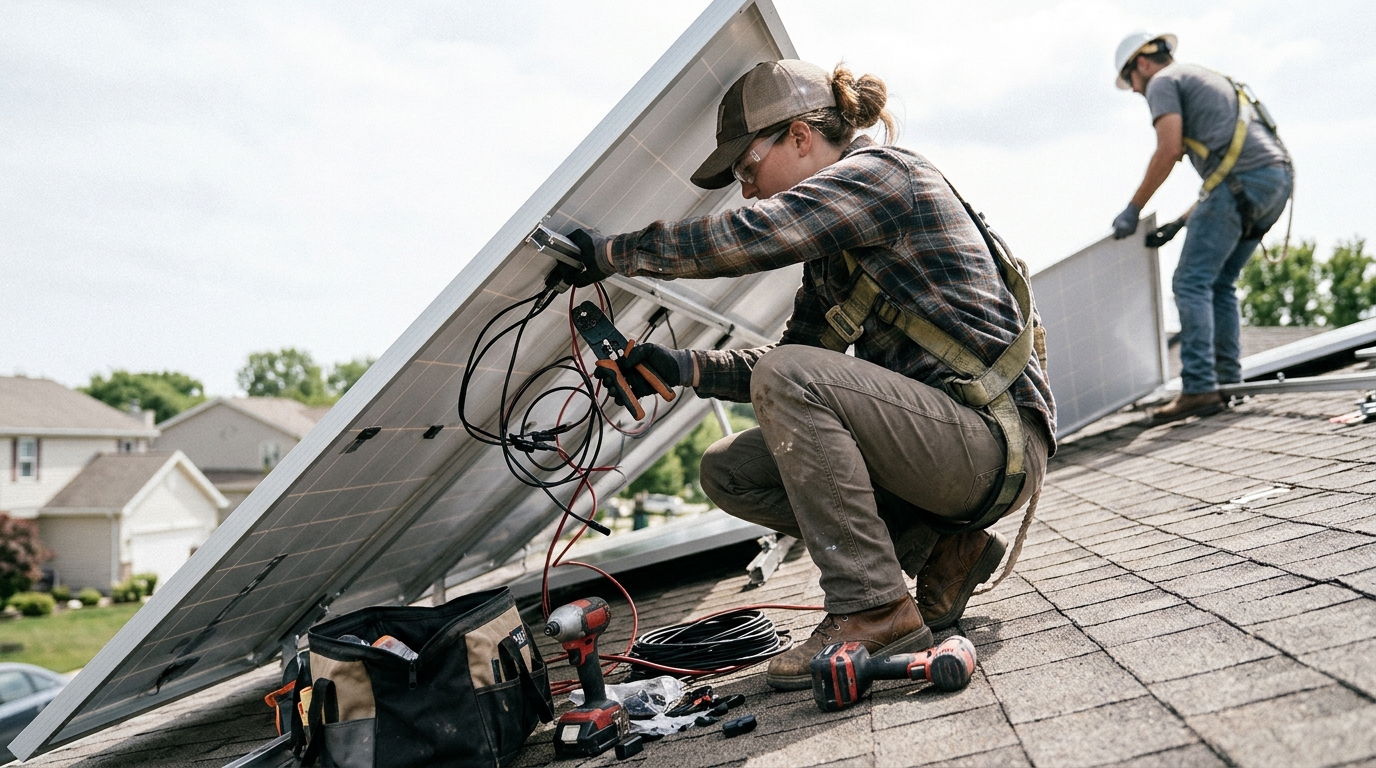
Solar photovoltaic installers mount, wire and commission solar panel systems on roofs, carports and ground mounts. Entry-level education is typically a high school diploma or equivalent, with no prior related work experience required, and most new installers learn through moderate-term on-the-job training that usually lasts between one month and one year (U.S. Bureau of Labor Statistics, 2025).
That makes it one of the faster construction trades to enter, but it is outdoor work at height, in heat and cold, carrying heavy modules. Certification from bodies such as NABCEP is not required for employment, though it demonstrates competency and some states require it for projects to qualify for solar-related subsidies (U.S. Bureau of Labor Statistics, 2025).
Step-by-Step Path to Entry
- Finish a high school diploma or GED. This is the typical entry-level education for solar photovoltaic installers, and no prior work experience in a related occupation is typically required (U.S. Bureau of Labor Statistics, 2025). ONET places the occupation in Job Zone 1-2, "Very Little to Some Preparation Needed" (ONET OnLine).
- Get a valid driver's license and complete OSHA 10 training. Installers must travel to jobsites, so employers may require a driver's license (U.S. Bureau of Labor Statistics, 2025). OSHA 10 is also a documented requirement for the NABCEP PV Installation Professional exam later on (Midwest Renewable Energy Association), so taking it early serves two purposes.
- Take a short PV course at a community college or technical school. Courses range from basic safety and PV knowledge through to system design, and usually last a few days to several months (U.S. Bureau of Labor Statistics, 2025). The Interstate Renewable Energy Council maintains a Solar Training Directory listing NABCEP-registered, IREC-accredited, online and GI Bill-eligible providers across the US, which is the place to compare options in your state.
- Sit the NABCEP PV Associate (PVA) exam if you want proof of knowledge before you have site hours. NABCEP's published fee schedule lists the PV Associate credential at a $25.00 application fee and a $125.00 exam fee, with candidates using an Associate Registered Training Provider's education pathway charged $125–$180 for the exam instead (NABCEP). Other national credentials listed for the occupation include the Photovoltaic System Installation Certification from Underwriters Laboratories and Photovoltaic Installer/Designer from ETA International (O*NET OnLine).
- Apply for an entry role as a solar installer helper, PV installation apprentice or construction craft laborer on a solar crew. The Department of Labor does not recognize "solar installer" as a standalone apprenticeable occupation, so industry groups have built national apprenticeship guidelines around the DOL-recognized Construction Craft Laborer occupation instead (GreenLancer). Registered Apprenticeships specific to solar are therefore limited (American Solar Energy Society).
- Complete moderate-term on-the-job training with your employer. This typically lasts between one month and one year and covers safety, racking, module handling, wiring and commissioning (U.S. Bureau of Labor Statistics, 2025).
- Check your state's licensing rule, then build toward the NABCEP PV Installation Professional (PVIP). Some states require a license for PV installers (U.S. Bureau of Labor Statistics, 2025) — check with your state's contractor licensing board, because the rule differs by state. For the PVIP exam you must document a decision-making role in a set number of qualifying PV installations, complete at least 58 hours of advanced PV training and complete OSHA 10 or a provincial equivalent (Midwest Renewable Energy Association). NABCEP lists the PVIP at a $125.00 application fee plus a $375.00 exam fee (NABCEP).
Education and Certification Options
Several routes lead to the same crew. The table compares what each typically takes and how employers treat it. Costs for college courses and apprenticeships vary by state, institution and residency status, so confirm current figures with the provider.
| Route | Typical duration | Approximate cost | Required or preferred |
|---|---|---|---|
| High school diploma or GED | Varies by starting point | Public school tuition-free; GED test fees vary by state | Required — the typical entry-level education for the occupation (U.S. Bureau of Labor Statistics, 2025) |
| Community college or technical school PV course | A few days to several months (U.S. Bureau of Labor Statistics, 2025) | Varies by school and state residency; check the provider directly | Preferred, not required — some PV installers take these courses (U.S. Bureau of Labor Statistics, 2025) |
| Employer on-the-job training | 1 month to 1 year (U.S. Bureau of Labor Statistics, 2025) | Paid by the employer | Required in practice; this is how most installers reach competency |
| Apprenticeship via an electrician or roofing program with PV modules | Varies by trade and sponsor | Typically paid employment with some tuition costs | Preferred route into higher-skill work; electrician and roofing apprentices and journey workers may complete photovoltaic-specific training modules (U.S. Bureau of Labor Statistics, 2025) |
| Construction Craft Laborer apprenticeship guidelines | Set by the sponsor | Typically paid employment | An available structure because DOL does not recognize solar installer as apprenticeable (GreenLancer; American Solar Energy Society) |
| NABCEP PV Associate (PVA) | Exam preparation alongside a short course | $25.00 application fee plus $125.00 exam fee, or $125–$180 exam fee via an Associate Registered Training Provider (NABCEP) | Preferred — certification is not required for employment but demonstrates competency (U.S. Bureau of Labor Statistics, 2025) |
| NABCEP PV Installation Professional (PVIP) | After documented installations plus 58+ hours of advanced PV training (Midwest Renewable Energy Association) | $125.00 application fee plus $375.00 exam fee (NABCEP) | Preferred; some states require certification for projects to qualify for solar-related subsidies (U.S. Bureau of Labor Statistics, 2025) |
| State PV installer license | Set by the state board | Set by the state board | Required in some states only (U.S. Bureau of Labor Statistics, 2025) |
Other national certifications listed for the occupation include the Photovoltaic System Installation Certification from Underwriters Laboratories, the PV Installer Specialist from NABCEP, and Photovoltaic Installer/Designer from ETA International (O*NET OnLine).
Are You Ready? Readiness Checklist
Work through these before you commit money or time. Each one is something you can confirm yourself this week.
- You hold a high school diploma or GED, or have a dated plan to finish one — this is the typical entry-level education for the occupation (U.S. Bureau of Labor Statistics, 2025).
- You hold a valid driver's license, since installers travel to jobsites and employers may require one (U.S. Bureau of Labor Statistics, 2025).
- You can work at height on a pitched roof, on ladders and on scaffolding, and you have no medical restriction on doing so.
- You can repeatedly lift and carry solar modules and racking with a partner, in summer heat and winter cold, for a full shift.
- You have checked your state's contractor licensing board to see whether a PV installer license applies where you plan to work, because some states require one (U.S. Bureau of Labor Statistics, 2025).
- You have booked or priced an OSHA 10 course, which is a documented requirement for the NABCEP PVIP exam (Midwest Renewable Energy Association).
- You have searched the Interstate Renewable Energy Council Solar Training Directory for NABCEP-registered, IREC-accredited, online or GI Bill-eligible providers near you.
- You can pass the pre-employment screening a construction employer uses — typically a background check and drug screen; ask the employer what theirs involves, as requirements differ by company and state.
One tradeoff to weigh honestly: the trade is seasonal and weather-dependent in much of the country, the work is physically repetitive, and falls from height are the central safety risk of the job.
Typical Timeline From Start to First Job
Elapsed times below assume you start with a diploma or GED in hand. The on-the-job training span is the one firm anchor: it typically runs one month to one year (U.S. Bureau of Labor Statistics, 2025).
- Month 0: Confirm your diploma or GED, obtain or renew a driver's license, and check whether your state requires a PV installer license (U.S. Bureau of Labor Statistics, 2025).
- Month 0–1: Complete OSHA 10 training (Midwest Renewable Energy Association) and shortlist training providers using the IREC Solar Training Directory.
- Month 1–4: Finish a community college or technical school PV course — these usually last a few days to several months (U.S. Bureau of Labor Statistics, 2025) — and, if you want a credential early, sit the NABCEP PV Associate exam at a $25.00 application fee plus a $125.00 exam fee (NABCEP).
- Month 2–6: Apply to residential and commercial solar contractors for solar installer helper or PV apprentice roles, or to an electrician or roofing apprenticeship that includes photovoltaic-specific training modules (U.S. Bureau of Labor Statistics, 2025). About 4,200 openings a year are projected on average over the decade (U.S. Bureau of Labor Statistics, 2025).
- Month 3–15: Complete moderate-term on-the-job training with your employer, lasting one month to one year (U.S. Bureau of Labor Statistics, 2025).
- Month 6–18: Hold the title of solar photovoltaic installer on a working crew, with the option later to pursue the NABCEP PV Installation Professional once you can document a decision-making role in qualifying installations and 58 hours of advanced PV training (Midwest Renewable Energy Association).
Frequently asked questions
Can I become a solar panel installer without a four-year degree?
Yes. The typical entry-level education is a high school diploma or equivalent, and no prior work experience in a related occupation is typically required (U.S. Bureau of Labor Statistics, 2025). The usual route is a short PV course at a community college or technical school, lasting a few days to several months, followed by moderate-term on-the-job training of one month to one year with an employer (U.S. Bureau of Labor Statistics, 2025).
Do I need a license or certification to install solar panels?
It depends where you work. Some states require a license for PV installers, so check your state contractor licensing board (U.S. Bureau of Labor Statistics, 2025). Certification is a separate matter: it is not required for employment but demonstrates competency, and some states require it for projects to qualify for solar-related subsidies (U.S. Bureau of Labor Statistics, 2025). NABCEP, Underwriters Laboratories and ETA International all offer recognized credentials (O*NET OnLine).
Is there a registered apprenticeship for solar installers?
Not a solar-specific one nationally. The Department of Labor does not recognize any solar-specific occupation as apprenticeable, so registered apprenticeships in the field are limited (American Solar Energy Society). Industry groups built national apprenticeship guidelines around the DOL-recognized Construction Craft Laborer occupation instead (GreenLancer). Electrician and roofing apprentices also complete photovoltaic-specific training modules, which is a common route in (U.S. Bureau of Labor Statistics, 2025).
What does the job pay, and where should I check current rates?
The national median annual wage was $53,140, or $25.55 an hour, in May 2025 (U.S. Bureau of Labor Statistics, 2025). That is a national midpoint — state and metropolitan rates differ substantially, and pay is usually hourly with overtime on long install days. Check the Bureau of Labor Statistics Occupational Employment and Wage Statistics tables for your state, and compare against live local job postings.
How secure is the work, and where does it lead?
Employment of solar photovoltaic installers is projected to grow 37 percent from 2025 to 2035, much faster than average, with about 4,200 openings projected each year on average over the decade (U.S. Bureau of Labor Statistics, 2025). The occupation held roughly 31,100 jobs in 2025, so it remains small. With experience, installers may advance to project supervisor or project manager, move into sales, or start their own PV installation business (U.S. Bureau of Labor Statistics, 2025).
What is physically hardest about the work?
The job is outdoors and at height. You carry modules and racking up ladders onto pitched roofs, kneel and bend for long stretches, and work through heat, cold and wind. Falls are the main safety hazard, which is why OSHA 10 training appears both in employer requirements and as a documented prerequisite for the NABCEP PV Installation Professional exam (Midwest Renewable Energy Association). Work can also be seasonal and weather-dependent.
Sources
- U.S. Bureau of Labor Statistics — Solar Photovoltaic Installers : Occupational Outlook Handbook (2025)
- O*NET OnLine — 47-2231.00 - Solar Photovoltaic Installers

Written by
Wyatt covers work outside the office: construction, logistics, repair, and the people who keep things running. He's skeptical of career advice that assumes everyone sits at a desk.