HVAC Technician vs. Electrician Salary: Which Pays More?
Electricians edge ahead at the national median, but industry, license level and self-employment shift both numbers more than the job title does.
Quick answer
- Electricians had a median annual wage of $63,190 in May 2025; HVAC technicians had $61,010 (U.S. Bureau of Labor Statistics, 2025). Electricians pay more on average.
- Industry separates earnings more than job title: electricians in government had a median of $79,820 and HVAC techs in wholesale trade $71,190 in May 2025 (U.S. Bureau of Labor Statistics, 2025).
- The top earners pull apart furthest: the highest-paid tenth of electricians cleared $108,510 (U.S. Bureau of Labor Statistics, 2025) against $95,210 for HVAC techs (BLS figures reported by Subcontractor Hub, undated).
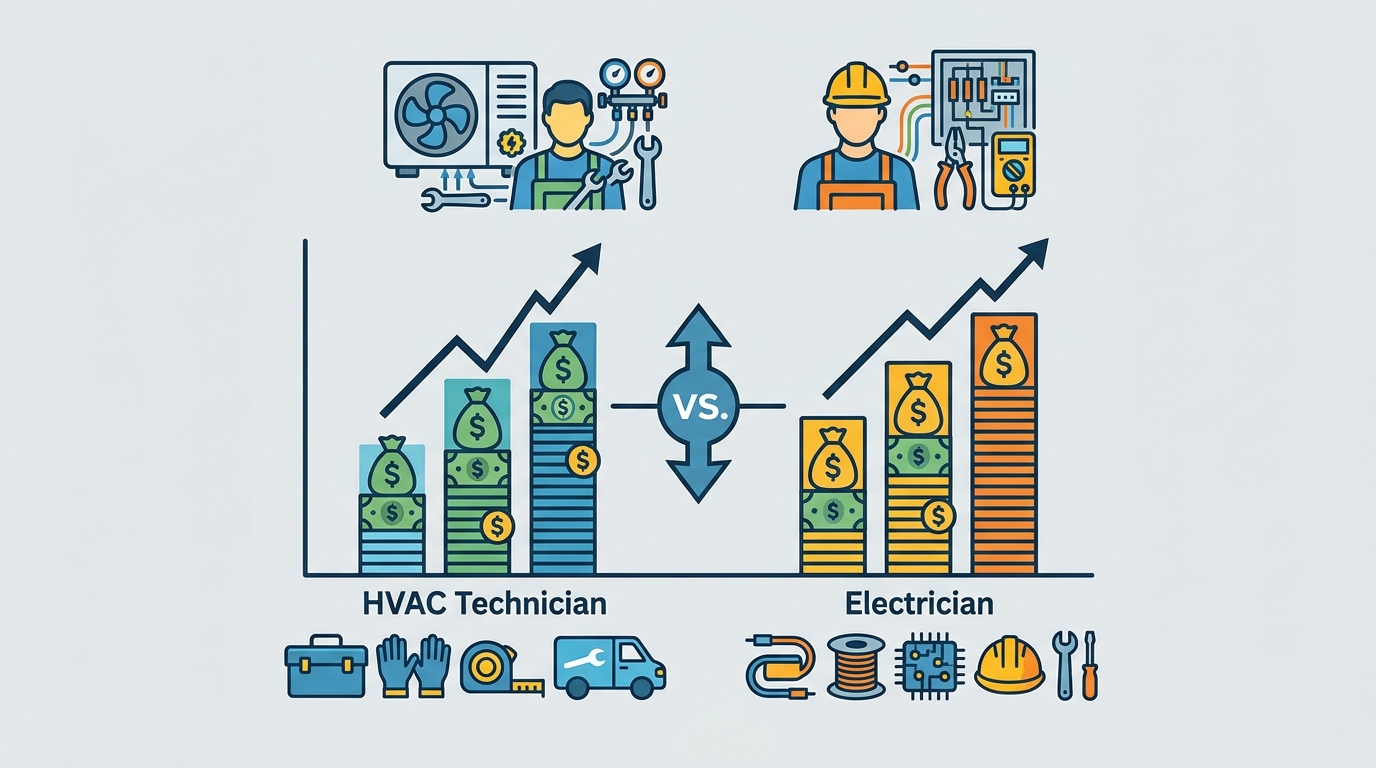
Electricians earn more at the national midpoint: a median annual wage of $63,190 in May 2025, against $61,010 for heating, air conditioning, and refrigeration mechanics and installers (U.S. Bureau of Labor Statistics, 2025). The two medians sit close together, and the spread inside each trade is much wider than the space between them.
Which industry you work in, how far you take the license ladder, and whether you work for yourself move your pay more than the choice of trade does.
Pay Side by Side
All figures below are national annual wages, with the hourly equivalent shown where the source publishes one. "Entry-level" uses the lowest-paid 10 percent and "experienced" uses the highest-paid 10 percent, which is how the Bureau of Labor Statistics publishes the ends of the range. Those are percentile cut-offs, not a starting offer or a ceiling at any one employer.
| Measure | HVAC technician | Electrician |
|---|---|---|
| Entry-level (lowest 10 percent, annual) | Under $40,050 (BLS figures reported by Subcontractor Hub, undated) | Under $42,640, May 2025 (U.S. Bureau of Labor Statistics, 2025) |
| Median annual wage | $61,010, May 2025 (U.S. Bureau of Labor Statistics, 2025) | $63,190, May 2025 (U.S. Bureau of Labor Statistics, 2025) |
| Median hourly wage | $29.33, May 2025 (U.S. Bureau of Labor Statistics, 2025) | $30.38, May 2025 (U.S. Bureau of Labor Statistics, 2025) |
| Experienced (highest 10 percent, annual) | Over $95,210 (BLS figures reported by Subcontractor Hub, undated) | Over $108,510, May 2025 (U.S. Bureau of Labor Statistics, 2025) |
| Best-paying top industries, median annual | $71,190 in wholesale trade; $60,030 with plumbing, heating and air-conditioning contractors, May 2025 (U.S. Bureau of Labor Statistics, 2025) | $79,820 in government excluding education and hospitals; $74,550 in manufacturing, May 2025 (U.S. Bureau of Labor Statistics, 2025) |
Two cautions. These are occupation-wide wage figures for the United States; the BLS Occupational Employment and Wage Statistics tables also publish a median for each state and most metro areas, so look up the one for where you plan to work rather than planning around the national number. And both trades routinely add earnings on top of base wage — overtime and on-call callouts in HVAC, overtime and shift work on construction and utility jobs for electricians, and commission where technicians sell replacement equipment. Ask any employer whether a quoted number is base hourly, base plus expected overtime, or total compensation.
One occupation is often mistaken for electricians and sits higher: electrical and electronics installers and repairers had a median annual wage of $74,490 in May 2025, with the top tenth above $114,240 (U.S. Bureau of Labor Statistics, 2025). Different training, different job — don't use it as an electrician benchmark.
Why the Pay Differs
The national medians are close, so the useful question is what moves individuals away from the midpoint. Four things do most of the work.
1. The license ladder is longer and more formal for electricians. The typical electrician route is a multi-year paid apprenticeship, a journeyman exam, then a master license, with pay rising at each step (MetaIntro, undated), starting from a high school diploma or equivalent plus apprenticeship (U.S. Bureau of Labor Statistics, 2025). HVAC runs through a postsecondary nondegree award or apprenticeship, then the EPA Section 608 exam — Core plus Type I, II, III or Universal — with state or local licensing and NATE or manufacturer certification optional depending on where you work (Wagelark, undated; U.S. Bureau of Labor Statistics, 2025). More mandatory gates show up at the top of the range: $108,510 for the top tenth of electricians (U.S. Bureau of Labor Statistics, 2025) against $95,210 for HVAC (Subcontractor Hub, undated).
2. Electricians can reach a higher-paying industry mix. Utility work is the clearest case: electricians in electric power generation, transmission and distribution had an annual mean wage of $91,750 in May 2023 (U.S. Bureau of Labor Statistics, 2023). Government work paid a median of $79,820 and manufacturing $74,550 in May 2025 (U.S. Bureau of Labor Statistics, 2025). HVAC's largest employer group, plumbing, heating and air-conditioning contractors, paid a median of $60,030 in May 2025, just under the occupation median of $61,010, while HVAC techs in wholesale trade reached $71,190 (U.S. Bureau of Labor Statistics, 2025).
3. Self-employment is a similar share in both, and it changes what the medians mean. About 7 percent of electricians are self-employed (Boostpoint, undated) and about 6.3 percent of HVAC technicians (ScholarshipsClosingSoon.com, undated). Running your own shop replaces an hourly wage with business income, so the medians of $63,190 and $61,010 (U.S. Bureau of Labor Statistics, 2025) describe employees far better than owners, who carry their own tools, van and seasonal swings.
4. Market size and growth differ. Electricians held about 821,000 jobs in 2025 and HVAC technicians about 440,900 (U.S. Bureau of Labor Statistics, 2025). HVAC employment is projected to grow 11 percent from 2025 to 2035 and electrician employment 9 percent, both much faster than average (U.S. Bureau of Labor Statistics, 2025). Faster growth in the smaller occupation gives HVAC room to catch up, though a projection is not a promise about any one person's wage.
Earnings Over a Career
At the start the two trades sit close, with electricians a little ahead: the lowest-paid tenth of HVAC technicians earn under $40,050 (BLS figures reported by Subcontractor Hub, undated) and the lowest-paid tenth of electricians under $42,640 (U.S. Bureau of Labor Statistics, 2025). Both routes are earn-while-you-learn — electrician apprenticeships are paid, and HVAC on-the-job training is described as a long-term apprenticeship usually lasting several years (U.S. Bureau of Labor Statistics, 2025).
The first hard milestone in HVAC is the EPA Section 608 certification, Core plus the type you need or Universal, which you must hold to handle refrigerants; NATE or manufacturer certification comes later and is optional (Wagelark, undated). Credentials do not set a wage on their own, but they open the industries that pay more. The median for HVAC techs working for plumbing, heating and air-conditioning contractors was $60,030 in May 2025, while the median in wholesale trade was $71,190 (U.S. Bureau of Labor Statistics, 2025). Reaching the top tenth of the occupation means clearing $95,210 (Subcontractor Hub, undated), against an occupation median of $61,010 (U.S. Bureau of Labor Statistics, 2025).
For electricians the milestones are the journeyman exam and then the master license, with pay rising at each step (MetaIntro, undated). The industry effect is larger. Against an occupation median of $63,190, government electricians had a median of $79,820 and manufacturing $74,550 in May 2025 (U.S. Bureau of Labor Statistics, 2025). Utility work sits higher again, at an annual mean of $91,750 in electric power generation, transmission and distribution in May 2023 (U.S. Bureau of Labor Statistics, 2023) — a mean is pulled up by top earners, so treat it as a different kind of figure from a median. At the top tenth, electricians clear $108,510 (U.S. Bureau of Labor Statistics, 2025).
So the two trades separate more with seniority than they do at the median. The practical reading: the trade you pick moves your pay a little, and the industry, license level and willingness to take overtime or go out on your own move it a lot. Before you commit, check the current median for your own state in the BLS Occupational Employment and Wage Statistics tables, and ask any employer to separate base wage from overtime, on-call and commission when they make an offer.
Frequently asked questions
Which trade pays more on average?
Electricians, narrowly. The median annual wage was $63,190 for electricians and $61,010 for HVAC technicians in May 2025, with published hourly medians of $30.38 and $29.33 (U.S. Bureau of Labor Statistics, 2025).
Can an HVAC technician out-earn an electrician?
Often. The highest-paid tenth of HVAC technicians cleared $95,210 (BLS figures reported by Subcontractor Hub, undated), well above the electrician median of $63,190 in May 2025 (U.S. Bureau of Labor Statistics, 2025). Industry matters too: HVAC techs in wholesale trade had a median of $71,190 in May 2025, above that electrician median.
Do these figures include overtime, bonuses or commission?
Treat the medians of $61,010 for HVAC and $63,190 for electricians (U.S. Bureau of Labor Statistics, 2025) as wage figures for the occupation rather than a full picture of take-home pay. Both trades commonly add overtime and on-call callouts, and HVAC work can include commission on equipment sales, so ask an employer to state base hourly separately from expected total compensation.
Which path takes longer before the pay improves?
Electricians typically work through a multi-year paid apprenticeship, a journeyman exam and then a master license, with pay rising at each step (MetaIntro, undated), while HVAC runs through a postsecondary program or apprenticeship and the EPA Section 608 exam (Wagelark, undated). Both begin near the bottom deciles — under $42,640 for electricians and under $40,050 for HVAC — and the reward for finishing the ladder shows at the top, $108,510 against $95,210 (U.S. Bureau of Labor Statistics, 2025; Subcontractor Hub, undated).
Sources
- U.S. Bureau of Labor Statistics — Heating, Air Conditioning, and Refrigeration Mechanics and Installers : Occupational Outlook Handbook (2025)
- U.S. Bureau of Labor Statistics — Electricians : Occupational Outlook Handbook (2025)

Written by
Wyatt covers work outside the office: construction, logistics, repair, and the people who keep things running. He's skeptical of career advice that assumes everyone sits at a desk.