
How to Negotiate a Higher Salary as a Software Developer
Preparation beats improvisation: gather the pay data, build your number, rehearse the opening line, and plan what you say when your manager pushes back.
Quick answer
- A routine annual raise is usually around 3 to 5 percent (Glassdoor, undated); actual U.S. increases averaged 3.7 percent in 2025 and 3.9 percent in 2024 (WorldatWork, 2025).
- When you ask rather than wait, common guidance is to request 10 to 20 percent depending on your circumstances and time since your last raise (Intuit, undated; Business News Daily, undated); promotion raises have averaged about 8.7 percent (Glassdoor, undated).
- Anchor your number to the software developer median annual wage of $135,980 in 2025 (U.S. Bureau of Labor Statistics, 2025), then adjust with local and employer-level data before you name a figure.
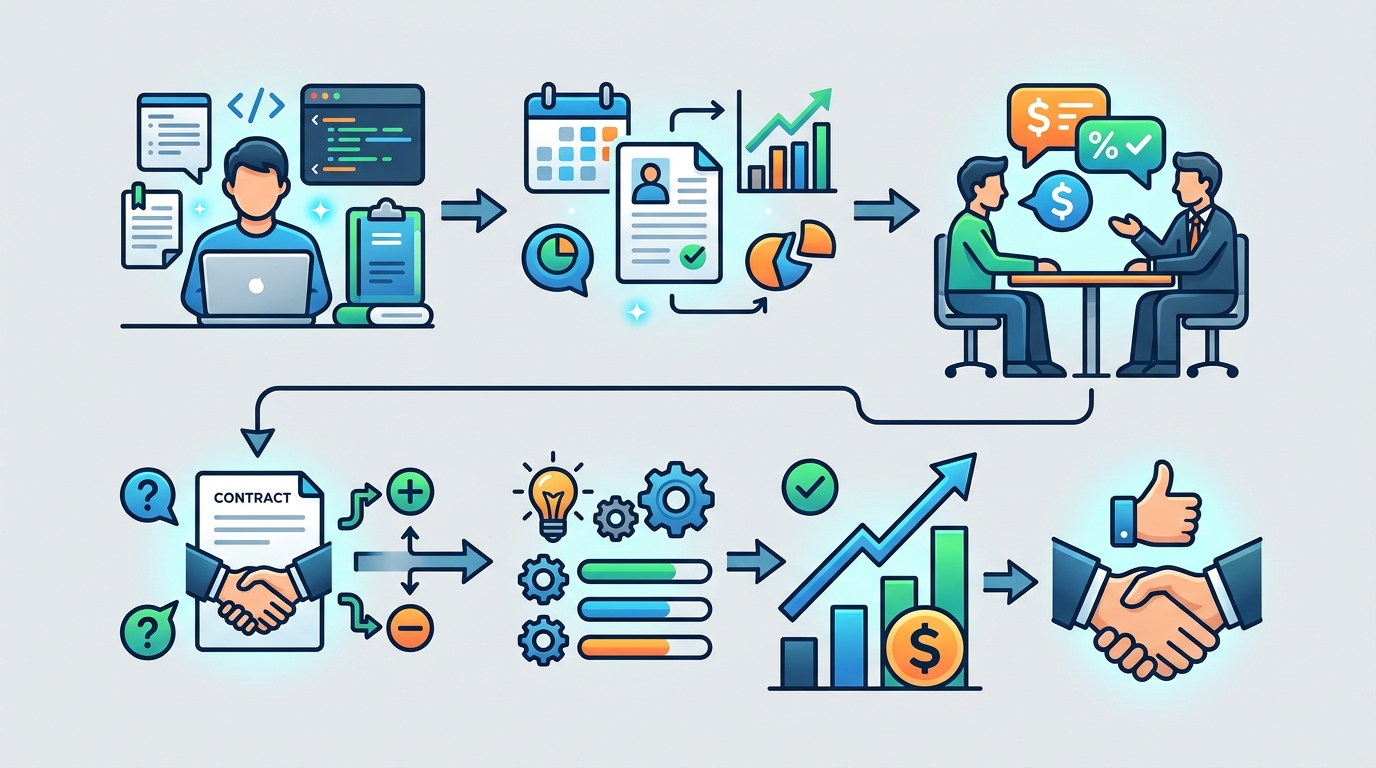
Negotiating a higher salary as a software developer comes down to three things you prepare in advance: a defensible market number, a short list of your own work expressed in numbers, and a sentence you can say out loud without flinching. The national benchmark to start from is the median annual wage for software developers, $135,980 in 2025, in an occupation holding about 1.7 million jobs with projected growth of 10 percent through 2035 (U.S. Bureau of Labor Statistics, 2025).
Know the gap between a routine annual bump and a negotiated increase. Standard annual raises typically land around 3 to 5 percent (Glassdoor, undated), while negotiation guides commonly suggest asking for 10 to 20 percent when circumstances justify it (Intuit, undated). None of this guarantees a yes.
Before You Ask: Research and Preparation
Each step should end with something you can print, hold, or read off a screen.
- Print the national benchmark. Save the software developer page from the U.S. Bureau of Labor Statistics showing the median annual wage of $135,980 for 2025 and 10 percent projected growth for 2025-2035 (U.S. Bureau of Labor Statistics, 2025). Artifact: one printed page with the median circled. It is an occupational median annual wage, not a starting figure and not total compensation.
- Add data for your own state and metro. Look up your state and metropolitan area in the BLS Occupational Employment and Wage Statistics tables, then check Payscale and Glassdoor for your title, experience and stack. Artifact: a three-row table listing each source, its year, and whether the figure is a median, a mean, or a range.
- Separate base pay from total compensation. Write out your base salary, your bonus target and what you actually received, the value and vesting schedule of any equity, on-call differentials, and overtime if your role is non-exempt. Artifact: a one-page worksheet with a base number and a total number, labelled. Employers often answer the question you did not ask.
- Build an achievements list with metrics. Six bullets, each with a number in it: p95 latency before and after, incidents reduced, deploy frequency, build minutes saved, tickets eliminated, revenue or cost tied to something you shipped. Artifact: a printed list you can read from.
- Set three numbers. An ask, a target and a floor. Calibrate against budgets: U.S. employers predicted mean salary increase budgets of 3.6 percent for 2026, after actual mean increases of 3.7 percent in 2025 and 3.9 percent in 2024 (WorldatWork, 2025), and Payscale found actual increases averaging 3.6 percent in 2024 against 4 percent in 2023 (Payscale Salary Budget Survey, reported by WorldatWork, 2024). Anything above that band is an exception you must argue for, which is why advice to ask in the 10 to 20 percent range is tied to circumstances and time since your last increase (Business News Daily, undated). Artifact: three figures on one card.
- Date the budget cycle and list credentials. Ask HR when compensation decisions are made and locked, and put a calendar entry six to eight weeks earlier. Note what certifications you hold or have started; ONET lists ones relevant to software developers, including the Certified Software Development Professional from the IEEE Computer Society and certifications from the International Software Certification Board, Pearson and Cisco (ONET OnLine, U.S. Department of Labor, undated).
What to Say
Substitute your own figures. The examples below use the BLS occupational median as the anchor because it is public and checkable by both sides of the table.
Naming the number
The ask, said out loud
Over the past year I cut p95 checkout latency by a third and took our on-call pages from twelve a month to three. Based on the Bureau of Labor Statistics median annual wage of $135,980 for software developers in 2025, and on Payscale and Glassdoor figures for this title in this metro, I am asking for a 12 percent increase to my base salary. To be clear, I mean base, separate from bonus and equity.
Handling pushback on budget
When you hear "the budget is only 3 percent"
I understand the merit pool is around 3 percent, which matches what WorldatWork reported for 2025 and 2026, and I am not asking you to break it. I am asking whether this is a market adjustment rather than a merit increase, because those usually come from a different pot. If that pot is closed, what would it take to get an out-of-cycle review in 90 days, and can we write the criteria down now?
When the answer is no
Keeping the door open
That is a clear answer and I appreciate it. Can we agree on two or three specific outcomes that would justify a 10 percent increase, put them in writing, and review them on a set date? I would also like to know whether a title change is possible, since promotion increases tend to run higher than annual ones.
Stay quiet after you name the figure. Do not fill the silence by lowering it yourself.
Negotiation Checklist
Answer each one yes or no. Anything still at no is work you have not done.
- I have saved the BLS median annual wage for software developers and the year it refers to.
- I have written down at least two other pay figures for my title and metro, each labelled with source, year, and whether it is a median, mean or range.
- I have written three to six accomplishments from the past 12 months, each with a number attached.
- I have a single sheet showing my base salary separately from bonus, equity, on-call pay and overtime.
- I have written an ask figure, a target figure and a floor figure on one card.
- I have confirmed the month in which my employer sets compensation budgets.
- I have requested a dedicated meeting about pay, not raised it at the end of a one-to-one about something else.
- I have said my ask sentence out loud, including the dollar figure or percentage, at least three times.
- I have written one reply to "there is no budget" and one to "let's revisit next year."
- I have decided in advance whether I will accept a title change, a bonus or extra equity instead of base pay.
- I have noted who makes the final decision and whether my manager needs approval above them.
- I have committed to following up in writing within 24 hours, summarising what was said and what happens next.
Frequently asked questions
How much of a raise is realistic to ask for?
Two ranges matter. Routine annual increases typically land around 3 to 5 percent (Glassdoor, undated), and Forbes reports the same 3 to 5 percent band, with higher requests justified by exceptional circumstances or outstanding performance (Forbes, 2024). When you actively negotiate, common guidance is to ask for 10 to 20 percent depending on your situation and how long it has been since your last increase (Intuit, undated; Business News Daily, undated). A larger ask is not automatically unreasonable, but it needs market data and your own results behind it, and no figure is guaranteed to be accepted.
When is the best time to ask?
Six to eight weeks before your employer locks its compensation budget, which differs by company, so ask HR when the cycle runs. Budgets have tightened: actual U.S. mean increases were 4.4 percent in 2023, 3.9 percent in 2024 and 3.7 percent in 2025, with 3.6 percent predicted for 2026 (WorldatWork, 2025), and among the 60 percent of workers who got a raise in 2024 the average was 3.6 percent, down from 4.6 percent in 2023 and 6.2 percent in 2022 (BambooHR, reported by SHRM, 2024). Asking after budgets are set usually means waiting for the next cycle or an out-of-cycle adjustment.
Is base salary the only thing I should negotiate?
No. Developer pay often includes an annual bonus, equity with a vesting schedule, and on-call pay, and some roles are non-exempt and earn overtime. Base salary is what future raises and often your bonus percentage are calculated from, so an increase there compounds while a one-off bonus does not. Ask which pool a proposed increase comes from: merit and market-adjustment budgets are usually separate, and Mercer figures reported by Glassdoor for 2026 show employers budgeting about 3.2 percent for merit against about 3.5 percent for total pay increases (Mercer, reported by Glassdoor, undated).
Will a competing offer get me a bigger increase?
Sometimes, and sometimes it ends the relationship. An outside offer gives your manager a concrete number to take upstairs, but use it only if you are genuinely willing to leave, because some employers will tell you to take it. A market-adjustment case built on published figures, such as the 2025 BLS median annual wage of $135,980 for software developers (U.S. Bureau of Labor Statistics, 2025) plus local data, makes a similar argument without the ultimatum. No approach works every time.
Sources
- U.S. Bureau of Labor Statistics — Software Developers, Quality Assurance Analysts, and Testers : Occupational Outlook Handbook (2025)
- O*NET OnLine (U.S. Department of Labor) — National Certifications: 15-1252.00 - Software Developers

Written by
Desmond writes about the mechanics of job searching: resumes, interviews, the long silence after applying. He's fascinated by how much of getting hired depends on luck dressed up as skill.