
HVAC Technician Pay: Average Salary, Range, and What Affects It
What the federal wage data actually shows for HVAC work, which parts of your paycheck come from overtime and on-call, and where to look up local numbers.
Quick answer
- The national median wage for HVAC technicians is $61,010 a year (U.S. Bureau of Labor Statistics (BLS), 2025); BLS also publishes the hourly equivalent of that median in its Quick Facts table.
- Pay rises substantially from helper to experienced service tech — rather than guess, compare the 10th-percentile and 90th-percentile wages BLS publishes for this occupation in your own state and metro area.
- EPA Section 608 refrigerant certification is required of nearly all HVAC technicians (U.S. Bureau of Labor Statistics (BLS), 2025), so it is a condition of being paid at all, not a raise.
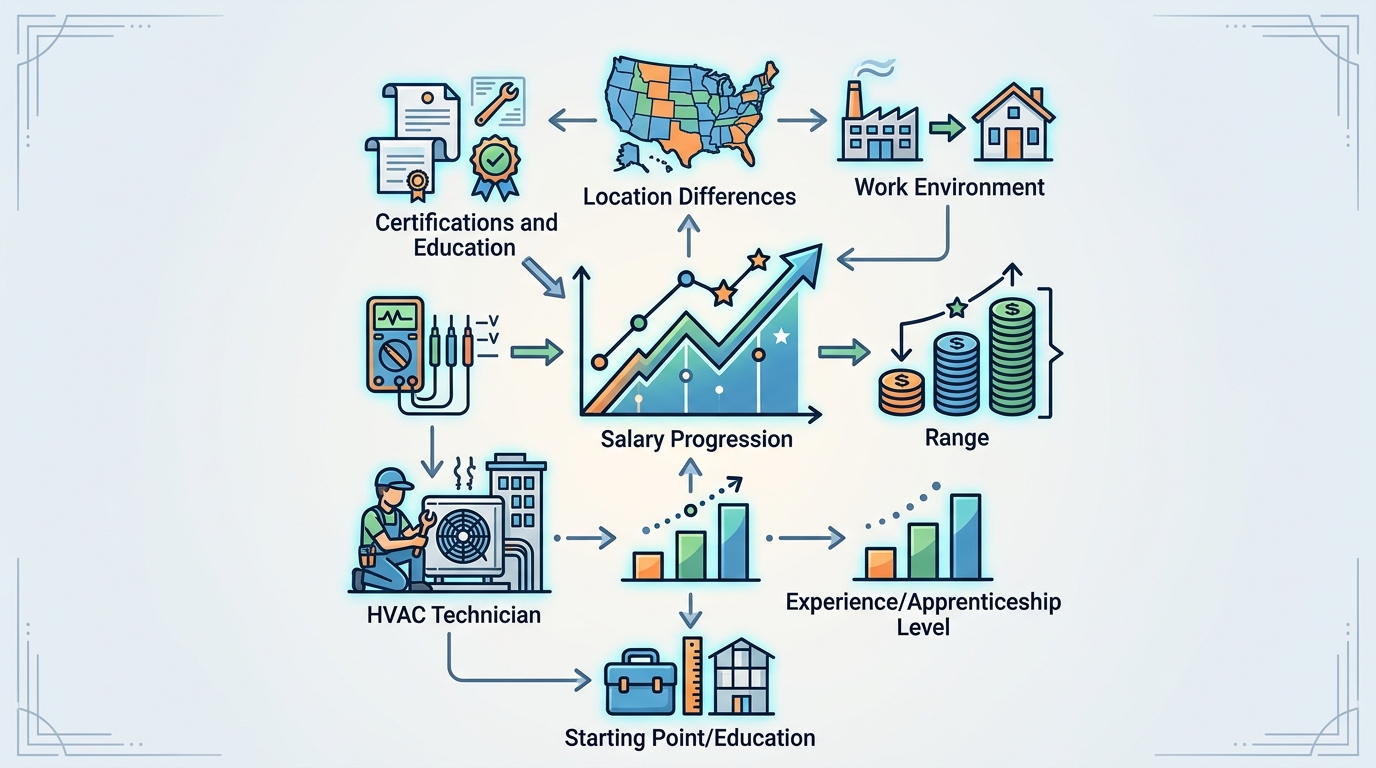
The median annual wage for heating, air conditioning, and refrigeration mechanics and installers was $61,010 (U.S. Bureau of Labor Statistics (BLS), 2025). That is the midpoint for the whole occupation nationally — half of technicians earned more, half earned less — and it covers everyone from first-year helpers to senior commercial service techs.
What you earn depends on a short list of specific things: your state and metro area, residential versus commercial or industrial refrigeration work, whether you hold EPA Section 608 and any manufacturer certifications, how much overtime and on-call you take, and whether your employer pays commission on equipment and service agreements.
What This Job Pays
The headline number is the median annual wage of $61,010 for heating, air conditioning, and refrigeration mechanics and installers (U.S. Bureau of Labor Statistics (BLS), 2025). Median means the middle of the distribution, not an average — half the occupation earned more than $61,010 and half earned less. An average would be pulled upward by the highest-paid commercial and industrial technicians.
BLS publishes the hourly equivalent of that same median in its Quick Facts table for the occupation (U.S. Bureau of Labor Statistics (BLS), 2025), which helps when you are comparing a shop's hourly offer against the national midpoint. ONET OnLine lists the same median wage figures from the same federal wage survey (ONET OnLine (U.S. Department of Labor), 2025) — so those two sources agreeing is one survey quoted twice, not independent confirmation.
For the spread rather than the midpoint, go to the federal wage data directly. BLS publishes 10th, 25th, 50th, 75th and 90th percentile wages for this occupation nationally and by state and metro area in its Occupational Employment and Wage Statistics (OEWS) tables. The 10th percentile approximates newly trained helpers in low-wage markets; the 90th approximates experienced commercial, refrigeration and controls technicians in high-wage ones.
One caution about what these figures cover. Federal wage estimates describe wages paid for work, not total HVAC take-home pay. A large share of annual earnings for many technicians comes from items negotiated shop by shop:
- Overtime, concentrated in summer cooling and winter heating season
- On-call and callback pay, often a weekly stipend on rotation plus a premium call rate
- Commission or spiffs on replacement equipment, air quality add-ons and maintenance agreements
- Truck, tool, phone and uniform allowances, which are not wages but change what you spend
When comparing offers, ask each employer to separate base hourly rate, expected overtime hours, on-call pay and commission structure.
Salary by Experience and Location
One national figure is published and settled: the $61,010 median (U.S. Bureau of Labor Statistics (BLS), 2025). Experience-level and state-level numbers are updated every year and differ between surveys, so the useful version of this table is a map of exactly where to pull each figure.
| What you want to know | Published figure to use | Where to look it up |
|---|---|---|
| Occupation midpoint, all experience levels | Median annual wage $61,010 (U.S. Bureau of Labor Statistics (BLS), 2025) | BLS Occupational Outlook Handbook page for heating, air conditioning, and refrigeration mechanics and installers |
| Hourly equivalent of that median | Listed in the BLS Quick Facts table (U.S. Bureau of Labor Statistics (BLS), 2025) | Same BLS page, Quick Facts box |
| Entry-level apprentice or helper pay | 10th and 25th percentile annual and hourly wages | BLS OEWS tables, national and by state |
| Mid-career service technician pay | 50th percentile for your state and metro | BLS OEWS state and metropolitan area tables |
| Experienced commercial, refrigeration or controls tech | 75th and 90th percentile wages | BLS OEWS state and metropolitan area tables |
| California | State median and percentile wages for this occupation | BLS OEWS California tables; California Employment Development Department wage data |
| Texas | State median and percentile wages for this occupation | BLS OEWS Texas tables; Texas Workforce Commission labor market information |
| Florida | State median and percentile wages for this occupation | BLS OEWS Florida tables; Florida's state labor market information site |
| Your own metro area | Metro-level median and percentile wages | BLS OEWS metropolitan area tables |
| Self-reported pay by years of experience | Reported ranges by experience band | Payscale and Glassdoor pages for "HVAC Technician" — self-reported and usually lagging |
Two things to keep in mind. Within a single state, the spread between a rural county and the main metro is often wider than the gap between two states, so use the metro figure where one exists. And state labor department figures usually come from the same federal survey as BLS OEWS, so treat them as one source checked twice.
Outside the United States none of this applies — BLS covers US wages only. In Canada, the UK or elsewhere, use that country's national statistics agency or labour market information service.
What Affects Pay in This Field
These are the levers that move an HVAC paycheck. Where a national figure is published it is given; where the effect is real but not published, price it locally using OEWS percentiles and shop-by-shop offers.
- EPA Section 608 certification. Nearly all HVAC technicians must be certified in proper refrigerant handling under Section 608, which requires passing an exam typically completed as part of a postsecondary HVACR program (U.S. Bureau of Labor Statistics (BLS), 2025). Treat it as the price of entry, not a raise.
- State or local licensing. Some states and localities require HVAC technicians to be licensed (U.S. Bureau of Labor Statistics (BLS), 2025), and BLS directs readers to CareerOneStop's license-finder tool to check their own. Where licensing applies, holding the license yourself usually separates a service tech's rate from a lead or contractor's rate.
- Manufacturer and industry certifications. Many are optional, though some employers prefer or require specific types (U.S. Bureau of Labor Statistics (BLS), 2025); CareerOneStop's certification finder lists what exists. Ask local employers which ones they actually pay more for before enrolling.
- Residential versus commercial, industrial refrigeration and controls. The occupation's 90th-percentile OEWS wage is driven largely by commercial, industrial and refrigeration technicians. Compare the 50th and 90th percentile for your metro to see the headroom that move offers.
- Overtime and on-call. Seasonal peaks generate overtime, and on-call rotations usually carry a weekly stipend plus a premium call rate. Paid on top of base, these can leave two technicians on identical hourly rates far apart by December. Ask for last year's average overtime hours per technician.
- Commission and sales spiffs. Residential replacement shops often pay a percentage of equipment sales or a flat spiff per maintenance agreement. That is total compensation, not base pay — ask what the median technician earned from it, not the top one.
- Union membership. Where HVAC work is organized, wages follow a negotiated scale with scheduled step increases. Ask the local for its current wage sheet; that is a checkable number for that jurisdiction.
- Training time. Technicians typically need a postsecondary nondegree award and a lengthy period of on-the-job training to reach competency (U.S. Bureau of Labor Statistics (BLS), 2025), so expect early-career earnings nearer the lower OEWS percentiles.
How This Job's Pay Compares
The HVAC median to anchor on is $61,010 a year (U.S. Bureau of Labor Statistics (BLS), 2025). BLS publishes a similar-occupations comparison table on the same page listing median pay for the trades people most often weigh against HVAC work. Pull those current figures yourself, since they update with each release.
- Electricians. BLS lists a median pay figure for electricians in its similar-occupations comparison table (U.S. Bureau of Labor Statistics (BLS), 2025). Electrical work is more heavily licensed and apprenticeship-structured in most states, and less seasonal than cooling and heating service.
- Plumbers, pipefitters, and steamfitters. BLS lists a median pay figure for this group in the same table (U.S. Bureau of Labor Statistics (BLS), 2025). Like HVAC, it carries emergency callout work, so overtime and on-call pay matter to annual earnings in both.
- Sheet metal workers. BLS lists a median pay figure for sheet metal workers in the same table (U.S. Bureau of Labor Statistics (BLS), 2025). Their work overlaps HVAC through ductwork fabrication and installation, and technicians often cross between the two.
- Boilermakers. BLS also lists a median pay figure for boilermakers (U.S. Bureau of Labor Statistics (BLS), 2025). This is heavier industrial work, often travel-based, with earnings tied to project availability.
Compare like with like: medians against medians, same survey year, and where possible the same state. A national median for one trade against a metro median for another will mislead you. The trade with the higher published median is also not automatically better paying for you, because overtime, on-call and commission differ by employer within all of these occupations.
Frequently asked questions
What is the average HVAC technician salary?
The most reliable published figure is a median rather than an average: $61,010 a year for heating, air conditioning, and refrigeration mechanics and installers (U.S. Bureau of Labor Statistics (BLS), 2025). Half the occupation earned more and half less. BLS also publishes the hourly equivalent of that median in its Quick Facts table (U.S. Bureau of Labor Statistics (BLS), 2025), and O*NET OnLine lists the same figures from the same federal survey (O*NET OnLine (U.S. Department of Labor), 2025).
How much do HVAC technicians make starting out?
Entry-level pay is not published as its own national number. Use the 10th and 25th percentile wages for this occupation in the BLS Occupational Employment and Wage Statistics tables for your state and metro area, and compare them with the $61,010 occupation median (U.S. Bureau of Labor Statistics (BLS), 2025). Early pay is lower because technicians typically need a postsecondary nondegree award and then a lengthy period of on-the-job training to reach competency (U.S. Bureau of Labor Statistics (BLS), 2025).
Does certification increase HVAC pay?
Section 608 refrigerant certification is required of nearly all HVAC technicians (U.S. Bureau of Labor Statistics (BLS), 2025), so it is a requirement to do the work rather than a premium on top of it. Manufacturer and industry certifications are mostly optional, though some employers prefer or require specific ones (U.S. Bureau of Labor Statistics (BLS), 2025), and CareerOneStop's certification finder lists what is available. Whether one raises your rate is set by local employers, so ask two or three in your area first.
Why does HVAC pay differ so much between states?
Four specific factors: whether the state or locality requires licensing, which differs by state and sometimes by city (U.S. Bureau of Labor Statistics (BLS), 2025); the mix of residential versus commercial and industrial refrigeration work locally; whether the work is unionized and covered by a negotiated wage scale; and local demand, driven by climate and construction activity. Pull the figures for California, Texas, Florida or wherever you live from the BLS OEWS tables or your state labor department rather than applying the national median.
Do HVAC technicians earn more than electricians or plumbers?
BLS publishes median pay figures for electricians, for plumbers, pipefitters and steamfitters, for sheet metal workers, and for boilermakers in its similar-occupations comparison table alongside the $61,010 HVAC median (U.S. Bureau of Labor Statistics (BLS), 2025). Check the current figures there and compare the same year and, where possible, the same state. Published medians describe base wages for an occupation, not overtime, on-call or commission at a specific employer.
How much of HVAC pay is overtime and commission?
That varies by employer and by the kind of work. Residential replacement shops often pay commission on equipment and maintenance agreements; service departments pay overtime concentrated in summer and winter peaks, plus on-call stipends and callback premiums; new-construction installation tends to be steadier hours with less of both. Ask any prospective employer to state the base hourly rate, average overtime hours per technician last year, the on-call rotation and its pay, and the commission structure as separate numbers.
Sources
- U.S. Bureau of Labor Statistics (BLS) — Occupational Outlook Handbook: Heating, Air Conditioning, and Refrigeration Mechanics and Installers (2025)
- O*NET OnLine (U.S. Department of Labor) — Summary Report for: 49-9021.00 - Heating, Air Conditioning, and Refrigeration Mechanics and Installers (2025)

Written by
Noor writes personal essays and interviews about career changes, burnout, and starting over. She's interested in the stories people tell themselves about what a job is supposed to mean.