Pharmacy Technician vs. Pharmacist: Pay, Duties, and Day-to-Day Differences
Two jobs behind the same counter, separated by years of schooling, who signs off on a prescription, and how each paycheck is calculated.
Quick answer
- The biggest practical difference is authority: only the pharmacist makes the final clinical check on a prescription and supervises technicians and interns (U.S. Bureau of Labor Statistics, 2025).
- Pharmacist is by far the longer path — a Pharm.D. usually takes 4 years, with some 3-year options and some 6-year programs entered straight from high school, followed by two licensure exams and state-specified intern hours (U.S. Bureau of Labor Statistics, 2025), while technicians typically start with a high school diploma or equivalent (U.S. Bureau of Labor Statistics, undated).
- Technicians are usually paid hourly and pharmacists usually salaried; check current medians in the BLS Occupational Outlook Handbook and state-level numbers in the BLS Occupational Employment and Wage Statistics tables, and expect both roles to keep you standing most of the shift, with nights and weekends common (U.S. Bureau of Labor Statistics, 2024; U.S. Bureau of Labor Statistics, 2025).
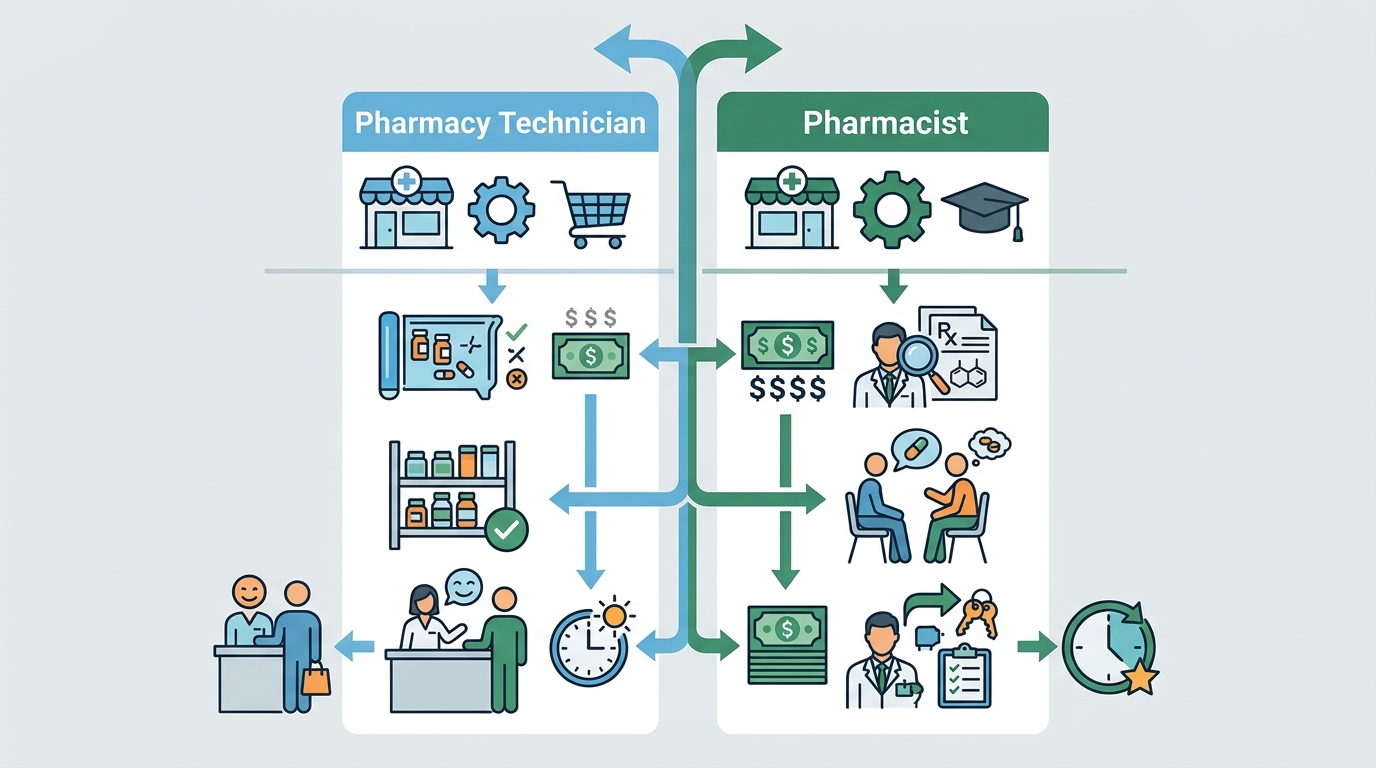
Pharmacy technicians and pharmacists work side by side, but the two roles differ in schooling, legal responsibility and pay structure. Technicians typically need a high school diploma or equivalent (U.S. Bureau of Labor Statistics, undated) and, in many states, certification; pharmacists need a Doctor of Pharmacy degree, which usually takes four years after prerequisite coursework (U.S. Bureau of Labor Statistics, 2025), plus state licensure.
Both spend most of the day on their feet, and both may work nights and weekends. The question for you is whether you want to be in a pharmacy within a year or so, or whether you are willing to spend several years in school for the clinical decision-making and supervisory authority that only a licensed pharmacist holds.
Head-to-Head Comparison
| Dimension | Pharmacy technician | Pharmacist |
|---|---|---|
| Typical entry requirement | High school diploma or equivalent (U.S. Bureau of Labor Statistics, undated) — about 4 years of secondary school. Most states regulate technicians in some way, and some states and employers require certification (U.S. Bureau of Labor Statistics, 2024). | Doctor of Pharmacy (Pharm.D.) from an accredited pharmacy program, usually 4 years, with some 3-year options and some 6-year programs that admit high school graduates (U.S. Bureau of Labor Statistics, 2025). All states require a license (U.S. Bureau of Labor Statistics, 2025). |
| Median pay | Usually paid an hourly rate, often with shift differentials for nights and weekends. The BLS Occupational Outlook Handbook publishes a median annual wage for pharmacy technicians; the figure carried in an older edition is tied to the 2020–30 projections cycle (U.S. Bureau of Labor Statistics, undated), so read the current edition rather than a cached one. | Usually a salaried position, with per-diem and floater roles paid hourly. The BLS Occupational Outlook Handbook publishes a 2025 median pay figure for pharmacists (U.S. Bureau of Labor Statistics, 2025). |
| Physical and schedule demands | Most of the workday is spent on your feet; most technicians work full time and may work nights or weekends (U.S. Bureau of Labor Statistics, 2024). | Much of the workday is spent standing; most pharmacists work full time, and in hospitals and other 24-hour facilities they may work nights, weekends and holidays (U.S. Bureau of Labor Statistics, 2025). |
| Five-year outlook | BLS publishes employment projections for pharmacy technicians; the projections in the older edition cover the 2020–30 cycle (U.S. Bureau of Labor Statistics, undated). Technicians held about 490,400 jobs in 2024 (U.S. Bureau of Labor Statistics, 2024), so the base of jobs is large. | BLS projects employment over 2025–35 (U.S. Bureau of Labor Statistics, 2025) and expects about 12,500 openings a year on average over that decade, mostly from workers transferring to other occupations or leaving the labor force (U.S. Bureau of Labor Statistics, 2025). |
Two points on reading those pay rows. First, BLS medians are national. Pay in a rural independent pharmacy, a hospital system in a high-cost metro and a mail-order fulfillment center are not the same number, and the BLS Occupational Employment and Wage Statistics (OEWS) tables break figures out by state and metro area — that is where to check what your area actually pays. Second, pay structure differs by role: technicians are generally on an hourly clock where overtime and night differentials matter, while pharmacists are generally salaried, which means a long Saturday shift does not usually show up as extra hours on the check.
On outlook, BLS publishes ten-year projections, not five-year ones. For pharmacists, the window currently in use is 2025–35 (U.S. Bureau of Labor Statistics, 2025); for technicians, the figures carried in the older Handbook edition use the 2020–30 cycle (U.S. Bureau of Labor Statistics, undated). Treat the first half of each window as your five-year view, and note the pharmacist pattern: most annual openings come from replacement needs rather than new positions (U.S. Bureau of Labor Statistics, 2025).
The tradeoff is blunt. The technician route gets you working sooner and with far less schooling, but your scope of practice is bounded by what a pharmacist signs off on, and advancement past a senior or lead technician role usually means going back to school. The pharmacist route carries several years of tuition and deferred earnings before you can sit for licensure, plus continuing education for as long as you hold the license (U.S. Bureau of Labor Statistics, 2025).
Day-to-Day Differences
Picture the same Tuesday in a busy retail pharmacy, one shift, two people.
The technician. You open the gate, start the register and take the first phone refill. Most of the morning runs through intake: typing new prescriptions into the system, pulling stock, counting and labeling, and bagging for will-call. When a claim rejects, you are the one on hold with the insurer finding out whether it is a refill-too-soon, a prior authorization or a bad member number. You check in the wholesaler delivery, put stock away, pull expired product, and run the will-call bins. Your prepared prescriptions all go into the basket for the pharmacist's final check before they leave the counter. You never make that final clinical call yourself, and you never supervise the pharmacist or an intern.
The pharmacist. You are the person that basket goes to. Your Tuesday is final verification: confirming each prescription matches the order, checking the patient's allergies and drug interactions before product goes out the door (U.S. Bureau of Labor Statistics, 2025). Between checks you counsel a patient starting a new blood thinner, call a prescriber about a dose that looks wrong, administer a round of scheduled vaccinations, work a knot of billing problems the technicians escalated, and keep patient and pharmacy records current (U.S. Bureau of Labor Statistics, 2025). You also direct the shift — assigning technicians and pharmacist interns to intake, production and register, which no technician can do.
In a hospital, the shape changes but the split holds. Technicians stock automated dispensing cabinets, deliver medications to units and prepare compounded doses; the pharmacist reviews orders against a patient's chart, rounds with clinical teams in some facilities, and signs off on what is dispensed. Hospitals and other 24-hour facilities also mean nights, weekends and holidays for pharmacists (U.S. Bureau of Labor Statistics, 2025), and technicians there may work nights or weekends too (U.S. Bureau of Labor Statistics, 2024).
The common thread is that neither shift lets you sit much. Technicians are on their feet most of the day (U.S. Bureau of Labor Statistics, 2024); pharmacists spend much of the day standing (U.S. Bureau of Labor Statistics, 2025). If standing for eight to twelve hours is a problem for you, that applies to both roles, not just one.
Who Thrives in Each Path
Pharmacy technician suits you if:
- You have retail, food service or call-center experience and are quick with a queue — intake, register and insurance rejections run on speed and accuracy under a line of waiting customers.
- You want to be earning inside a year rather than four: the typical entry requirement is a high school diploma or equivalent (U.S. Bureau of Labor Statistics, undated), with state rules and sometimes certification on top (U.S. Bureau of Labor Statistics, 2024).
- You are detail-literal and like a checkable standard — counting, labeling and data entry are judged on whether they match the order exactly, not on interpretation.
- You are comfortable with your work being reviewed every time, because a pharmacist checks each prescription you prepare before it leaves the counter.
Pharmacist suits you if:
- You did well in chemistry, biology and math and can sustain that for a Pharm.D. program of about 4 years, or a 3-year or 6-year variant (U.S. Bureau of Labor Statistics, 2025).
- You want to be the one making and owning the clinical call on interactions and allergies, and to counsel patients directly (U.S. Bureau of Labor Statistics, 2025).
- You have supervised people before and want that back — pharmacists direct technicians and pharmacist interns on shift (U.S. Bureau of Labor Statistics, 2025).
- You can absorb a long licensure runway without losing momentum: two exams, a state-specified number of intern hours, and continuing education for the life of the license (U.S. Bureau of Labor Statistics, 2025).
Frequently asked questions
I'm a pharmacy technician. How do I move up to pharmacist mid-career?
There is no shortcut around the degree. You complete the prerequisite coursework a school requires, earn a Doctor of Pharmacy from an ACPE-accredited college or school of pharmacy, then pass the NAPLEX plus your state's other licensure requirements (American Association of Colleges of Pharmacy, undated). Ask your state board whether any technician hours count toward required intern hours (U.S. Bureau of Labor Statistics, 2025).
Do I need to be certified to work as a pharmacy technician?
It depends on your state and employer. Most states regulate technicians in some way, and some states and employers require certification (U.S. Bureau of Labor Statistics, 2024). The PTCB route requires completing a PTCB-Recognized Education/Training Program or equivalent work experience, then passing the Pharmacy Technician Certification Exam to earn the CPhT credential (Pharmacy Technician Certification Board, undated).
Which role pays more, and where do I check current figures?
Pharmacists, given the Pharm.D. requirement and licensure, sit higher on the scale. For exact numbers, read the current BLS Occupational Outlook Handbook entries — it publishes 2025 median pay for pharmacists (U.S. Bureau of Labor Statistics, 2025) — and the BLS Occupational Employment and Wage Statistics tables for your state and metro, since national medians hide large local differences.
Is the pharmacist job market still worth the four years of school?
Look at the projection period rather than general talk of demand. BLS projects pharmacist employment over 2025–35 and expects about 12,500 openings a year on average across that decade, mostly from workers transferring occupations or leaving the labor force (U.S. Bureau of Labor Statistics, 2025). Weigh that against tuition, deferred earnings and ongoing continuing education requirements.
What is the schedule really like in each role?
Most pharmacy technicians work full time and may work nights or weekends (U.S. Bureau of Labor Statistics, 2024). Most pharmacists also work full time, and in hospitals and other 24-hour facilities they may work nights, weekends and holidays (U.S. Bureau of Labor Statistics, 2025). Retail hours track store hours; hospital roles rotate shifts. Both involve standing most of the day.
Sources
- U.S. Bureau of Labor Statistics — Pharmacists : Occupational Outlook Handbook (2025)
- U.S. Bureau of Labor Statistics — Pharmacy Technicians : Occupational Outlook Handbook (2024)

Written by
Marisol steers Jobladderhq's coverage of hiring trends and the strange rituals of modern recruiting. She's drawn to the gap between what job ads promise and what the work actually feels like. Her editing hand favors clarity over jargon, always.