What Does a Veterinarian Do? Duties, Skills, and Salary Explained
From morning surgery and x-rays to end-of-life conversations, here is how veterinary practice actually works and what it takes to qualify.
Quick answer
- Entry requires a DVM or VMD from an accredited veterinary college (BLS, 2025).
- BLS publishes the median annual wage for veterinarians in its May 2025 wage data.
- BLS projects much faster than average growth over the 2025–35 projection period.
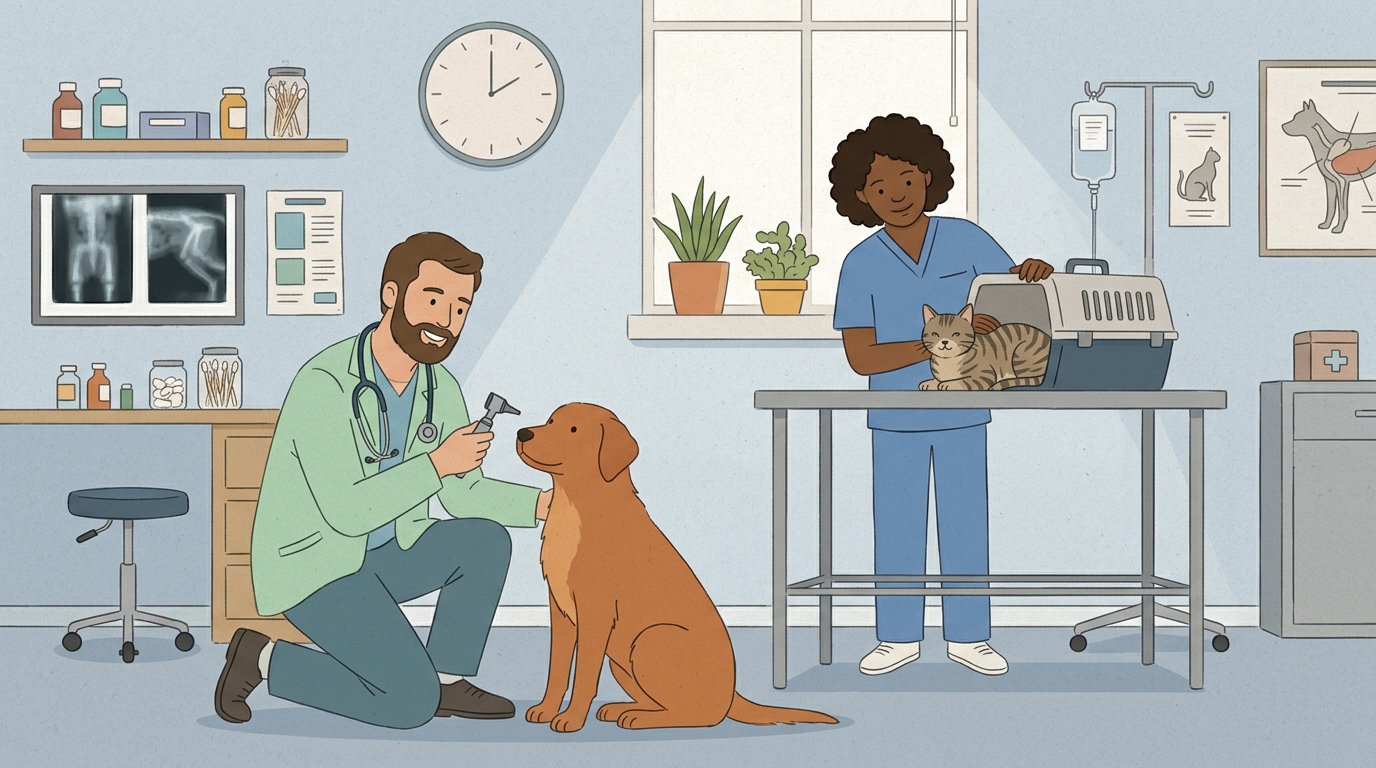
A veterinarian diagnoses and treats animals: examining patients, performing surgery, running and reading tests, vaccinating against disease, prescribing medication, and euthanizing animals when treatment is no longer humane (U.S. Bureau of Labor Statistics, 2025). The job also means explaining all of that to the people who own the animal and who pay for the care.
Entry is tightly controlled. You need a Doctor of Veterinary Medicine (DVM or VMD) from an accredited college of veterinary medicine and a license in the state where you practice (U.S. Bureau of Labor Statistics, 2025), and licensing rules differ from state to state.
What This Job Involves Day to Day
In a small-animal clinic, the day usually starts before the doors open. At 7:30 a.m. you review overnight notes on hospitalized patients in the practice management system — commonly something like IDEXX VPM, Vetport, or DVMax Practice, all of which ONET lists as software veterinarians use (ONET OnLine, U.S. Department of Labor, 2026). You check fluid rates, decide who eats and who stays fasted for surgery, and confirm the day's anesthetic cases.
From 8 a.m. to about noon, appointments run in short blocks: a vaccination and wellness exam, a limping dog that needs the x-ray machine and a sedation plan, a cat whose bloodwork has come back off. Between rooms you dictate records, call in prescriptions, and triage anything the front desk flags as urgent.
Early afternoon is often surgery and dentistry — spays, mass removals, extractions — with a technician monitoring anesthesia while you operate. Then back to appointments until early evening. One of them may be a euthanasia, which means a conversation with a family before anything else happens (U.S. Bureau of Labor Statistics, 2025).
The day rarely stops at closing. Records, lab callbacks, and referral letters get finished after the last client leaves. Most veterinarians work full time and often more than 40 hours per week, and some work nights or weekends and respond to emergencies outside scheduled hours (U.S. Bureau of Labor Statistics, 2025). Farm, equine, and mixed-practice days look different again, built around driving between properties rather than a single building.
Common Tasks and Responsibilities
- Examine animals to diagnose illness and injury, working from history, physical findings, and test results (U.S. Bureau of Labor Statistics, 2025).
- Treat sick or injured animals by prescribing medication, setting bones, dressing wounds, or performing surgery (O*NET OnLine, U.S. Department of Labor, 2026).
- Perform routine and emergency surgical procedures, including anesthesia planning and post-operative pain management.
- Operate and interpret output from medical equipment such as x-ray machines and in-house laboratory analyzers (U.S. Bureau of Labor Statistics, 2025).
- Test for and vaccinate against infectious disease, and advise on parasite control and herd or household health.
- Counsel owners on feeding, behavior, breeding, and what a treatment plan will involve before they agree to it.
- Euthanize animals when illness or injury makes further treatment inhumane, and talk the owner through the decision (U.S. Bureau of Labor Statistics, 2025).
- Record findings, drug doses, and surgical reports in practice management software so other clinicians can pick the case up.
- Direct veterinary technicians and assistants during procedures, monitoring, and discharge instructions.
Salary and Job Outlook by Experience Level
Veterinarian pay is normally a salary, sometimes with production-based pay (a percentage of the revenue you generate) or a bonus, and practice owners also take a share of profit. Associates in relief or emergency work may be paid per shift. Because the structure differs by employer and practice type, look up the current published figures rather than relying on a single number.
| Career stage | Typical years of experience | Published pay figure to check |
|---|---|---|
| Entry-level associate | 0–3 years, first roles after licensure | Mean starting compensation for 2024 graduates of U.S. and Caribbean veterinary colleges entering full-time employment (American Veterinary Medical Association, 2024); the lowest 10 percent threshold in BLS wage data (U.S. Bureau of Labor Statistics, May 2025) |
| Mid-career | Roughly 4–10 years in practice | Median annual wage for veterinarians (U.S. Bureau of Labor Statistics, May 2025); mean income for the overall population of veterinarians in the AVMA Census of Veterinarians (American Veterinary Medical Association, 2024); median wages are also listed by O*NET OnLine (U.S. Department of Labor, 2025) |
| Experienced or senior | 10+ years, specialists, owners, corporate medical directors | The highest 10 percent threshold in BLS wage data (U.S. Bureau of Labor Statistics, May 2025) |
Sources: U.S. Bureau of Labor Statistics Occupational Employment and Wage Statistics, May 2025; AVMA Census of Veterinarians and new graduate compensation report, 2024; O*NET OnLine, U.S. Department of Labor, 2025. BLS wage figures are national; state and metropolitan figures are published separately and differ, so check your own state's table.
Outlook: BLS projects employment of veterinarians to grow much faster than the average for all occupations over the 2025–35 projection period, and publishes a projected average number of annual openings over that decade (U.S. Bureau of Labor Statistics, 2025).
Skills and Traits That Fit This Work
- Clinical reasoning under uncertainty — your patient cannot describe symptoms, so you build a differential list from a limp, a temperature, and a blood panel, then decide which test is worth the owner's money.
- Manual dexterity — closing a spay incision or extracting a fractured tooth depends on steady, precise hand work in a small field.
- Composure with distressed people — you explain a cancer diagnosis or a euthanasia decision to someone who is crying, then walk into the next exam room on time.
- Comfort handling frightened animals — you read body language and use safe restraint, knowing that bites, kicks, and scratches are part of the risk, along with infection from diseased animals (U.S. Bureau of Labor Statistics, 2025).
- Financial frankness — you present treatment options with costs attached, including the option the owner can actually afford, without pretending the cheaper plan carries no risk.
- Record discipline — you keep legible, same-day notes in software such as IDEXX VPM or Vetport (O*NET OnLine, U.S. Department of Labor, 2026) because the next clinician to see the case may be a stranger.
- Stamina for long and interrupted days — you stay sharp during an afternoon surgery block after a full morning of appointments.
How to Get Started
- Finish the prerequisite undergraduate coursework. Veterinary colleges expect specific science credits — typically biology, general and organic chemistry, physics, and biochemistry — so check the requirements of each school you plan to apply to while you are still choosing undergraduate classes. Veterinary clinic, shelter, farm, or research hours usually form part of the application too.
- Earn a Doctor of Veterinary Medicine (DVM or VMD) at an accredited college of veterinary medicine. This is the required entry credential (U.S. Bureau of Labor Statistics, 2025), and ONET respondents overwhelmingly reported that a doctoral degree is needed for a new hire (ONET OnLine, U.S. Department of Labor, 2026). The program combines classroom, laboratory, and clinical components (U.S. Bureau of Labor Statistics, 2025); each college publishes its own program length and clinical year structure.
- Sit the North American Veterinary Licensing Examination (NAVLE). Eligibility requires graduation from, or enrollment in, a veterinary school accredited by the AVMA Council on Education, or certification through ECFVG or PAVE for international graduates, and the exam is administered only to bona fide candidates for licensure (International Council for Veterinary Assessment, 2024).
- Obtain a state license. All states require completion of an accredited program and a qualifying exam, and most also require a state exam covering that state's laws and regulations (U.S. Bureau of Labor Statistics, 2025). Requirements differ by state, so apply through the veterinary licensing board where you intend to practice.
- Apply for first roles, or add training. Common entry points are associate positions in small-animal, mixed, equine, or food-animal practice, advertised through veterinary college career services, AVMA and state VMA job boards, and corporate group career pages. Graduates aiming at specialty medicine apply instead to a rotating internship and then a residency.
Frequently asked questions
How does pay usually progress for a veterinarian?
Most start as salaried associates and move up as caseload speed, surgical range, and client base grow. Later increases often come from production-based pay, specialty board certification, a medical director role, or practice ownership. Compare the 2024 AVMA new-graduate mean starting compensation with the BLS median and upper-decile wage data for May 2025 to see the shape of that climb.
What are the schedule and physical demands really like?
Most veterinarians work full time and often more than 40 hours a week, with some nights, weekends, and emergency calls outside scheduled hours (U.S. Bureau of Labor Statistics, 2025). Expect long periods standing, lifting and restraining animals, and bending over a surgical table. Bites, kicks, scratches, and infection from diseased animals are recognized occupational risks (U.S. Bureau of Labor Statistics, 2025).
Can I practice in another state once I am licensed?
No. Licensure is state by state, and while every state requires an accredited degree plus a qualifying exam, most add a state exam on local laws and regulations (U.S. Bureau of Labor Statistics, 2025). Moving usually means applying to the new state's licensing board and meeting its conditions. Contact that board directly before you accept a job across a state line.
Is demand for veterinarians growing?
BLS projects employment to grow much faster than the average for all occupations over the 2025–35 projection period, and publishes an estimated average number of openings each year across that decade (U.S. Bureau of Labor Statistics, 2025). Openings arise from growth and from replacing people who retire or change occupations. Demand is uneven geographically, with rural and food-animal positions often harder to fill.
What is the hardest part of the job?
Many clinicians point to the gap between what medicine can do and what an owner can pay, decided in a ten-minute conversation. Performing euthanasia is a routine duty, not an exception (U.S. Bureau of Labor Statistics, 2025). Add the administrative tail of records and callbacks after closing, and emotional load becomes the main thing to plan around rather than clinical difficulty.
Do I need a specialty to build a career?
No. Many veterinarians spend full careers in general small-animal, equine, mixed, or food-animal practice and broaden through surgery volume, dentistry, or ultrasound skills. Specialty routes run through a rotating internship and a residency leading to board certification in a recognized discipline. That path adds years of lower-paid training before the higher earning bracket opens up.
Sources
- U.S. Bureau of Labor Statistics — Veterinarians : Occupational Outlook Handbook (2025-05)
- O*NET OnLine (U.S. Department of Labor) — 29-1131.00 - Veterinarians (2026)

Written by
Marisol steers Jobladderhq's coverage of hiring trends and the strange rituals of modern recruiting. She's drawn to the gap between what job ads promise and what the work actually feels like. Her editing hand favors clarity over jargon, always.