Cosmetology License: Requirements and How to Get Certified
Licensing is handled state by state, so the training hours you log, the exam you sit and the fees you pay are set by your own board, not by one national rule.
Quick answer
- All states require barbers, hairstylists and cosmetologists to hold a license and to graduate from a state-licensed barber or cosmetology school (U.S. Bureau of Labor Statistics, 2018 and undated).
- Many boards use exams from the National-Interstate Council of State Boards of Cosmetology: the National Cosmetology Theory Examination has 110 items, 100 of them weighted, in 90 minutes, and the Written Practical Examination has 75 items, 65 weighted, in 120 minutes (NIC, 2020-03 and 2021-04).
- Requirements are state-specific — New Jersey requires 1,200 hours of instruction at an approved school and a minimum age of 17 (New Jersey Division of Consumer Affairs, undated).
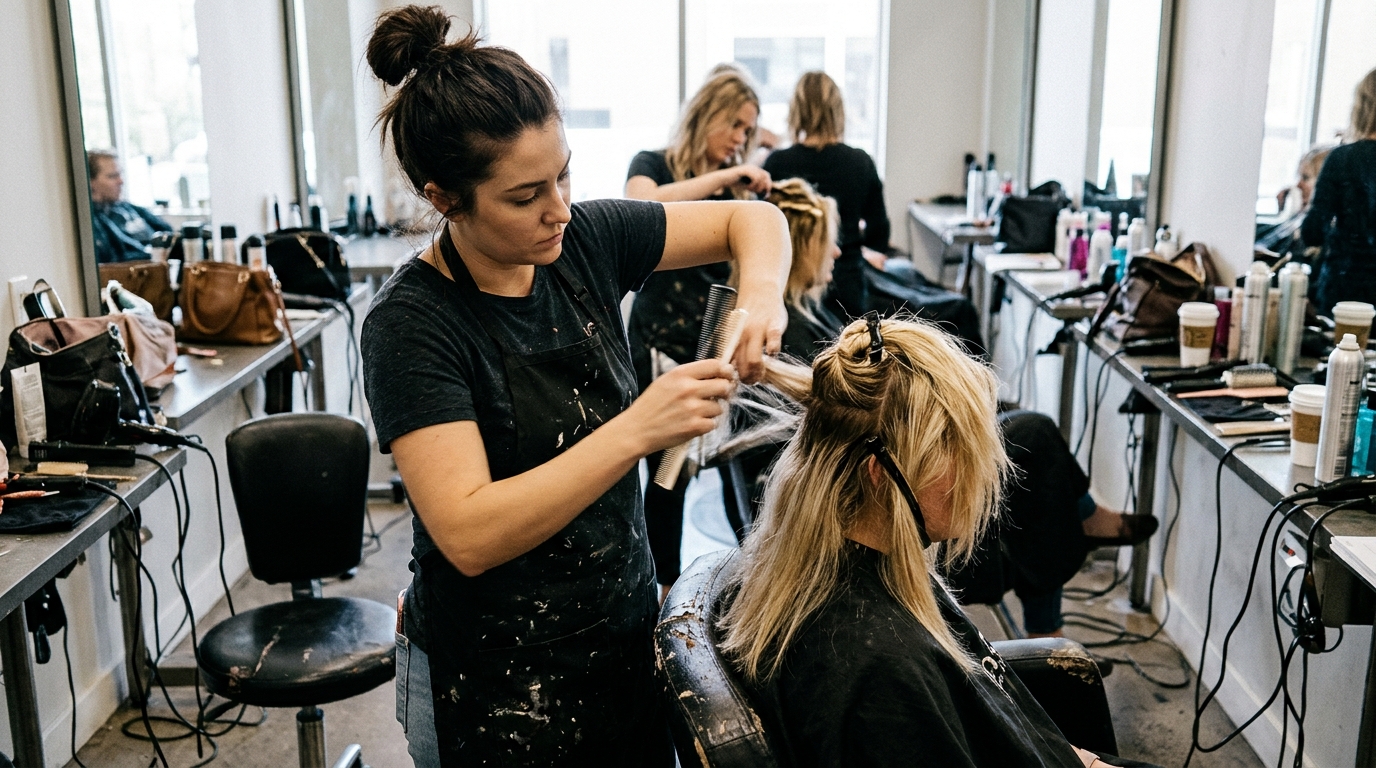
A cosmetology license is the legal permission to cut, color, style and chemically treat hair for pay. Every state requires barbers, hairstylists and cosmetologists to be licensed, and to complete a program at a state-licensed barber or cosmetology school first (U.S. Bureau of Labor Statistics, 2018 and undated).
The usual path is a postsecondary certificate from a licensed school (CareerOneStop, undated), then a written theory exam and a practical assessment for your state board. Required hours, minimum age, fees and renewal cycles are set by the board in the state where you plan to work.
Why This Credential Matters
There is no version of this job you can legally do unlicensed. The U.S. Bureau of Labor Statistics reported in 2018 that all states require barbers, hairstylists and cosmetologists to be licensed, and the same agency notes that every state requires completion of a program at a state-licensed barber or cosmetology school. A salon owner cannot put you on the floor without a current license number, and most booth-rental agreements ask for it before you sign.
The credential is issued by a state body, not a national one. In New Jersey that is the Division of Consumer Affairs, which sets the hour and age requirements for cosmetology and hairstyling applicants. In New York, the Department of State handles licensing and reciprocity. Your state's board is the only authority on what you need.
What ties the states loosely together is the examination. The National-Interstate Council of State Boards of Cosmetology (NIC) develops the National Cosmetology Theory Examination and the National Cosmetology Written Practical Examination, which many boards adopt. Passing an NIC exam does not by itself make you licensed; the board issues the license once you have also met the hours, age minimum and application requirements.
Related work is licensed separately. The Bureau of Labor Statistics reports that all states but Connecticut require licenses for manicurists and pedicurists, that licensure for skincare specialists varies by state, and that skincare specialists must complete a state-approved cosmetology or esthetician program and pass a state exam. O*NET OnLine lists Hairdressers, Hairstylists, and Cosmetologists under code 39-5012.00, with reported job titles including beautician, cosmetologist, hair stylist and lash technician — check which of those your license covers before you advertise a service.
Step-by-Step Path to Certification
- Read your state board's cosmetology rules first. Find the application packet on the board's site — the New Jersey Division of Consumer Affairs, the New York Department of State, or the agency where you will work — and write down the instruction hours, minimum age and exam your board uses. New Jersey requires 1,200 hours of instruction in cosmetology and hairstyling at an approved school and a minimum age of 17 (New Jersey Division of Consumer Affairs, undated).
- Finish high school or an equivalency. The U.S. Bureau of Labor Statistics notes a high school diploma or equivalent is required for some positions, and licensed schools commonly ask for a diploma or GED transcript at enrollment.
- Enroll at a state-licensed cosmetology or barber school and log your hours. CareerOneStop lists a postsecondary certificate as the typical entry-level education here. Ask admissions for the school's license number, check it against your board's approved-school list before paying a deposit, and keep your own copies of signed hour sheets.
- Submit the licensure application with proof of training. Boards require an official transcript or certificate of completion showing the required hours, plus identification and the application fee on the board's current fee schedule.
- Register with the testing vendor and schedule both exams. Once the board approves your eligibility, book the NIC National Cosmetology Theory Examination — 110 items, 100 of them weighted, with 90 minutes allowed (NIC, 2020-03) — and the practical assessment your board uses.
- Sit and pass theory and practical. The NIC National Cosmetology Written Practical Examination has 75 items, 65 of them weighted, with 120 minutes allowed (NIC, 2021-04). Study to the published content outline: Domain 1, Scientific Concepts, is weighted at 30% of theory items (NIC, 2020-03).
- Receive the license and diary the renewal date. The board issues it, not the testing vendor. Post it where required at your station and set a reminder before the printed expiration date.
Exam and License Details
| Detail | Specification |
|---|---|
| Theory exam name | National Cosmetology Theory Examination, developed by the National-Interstate Council of State Boards of Cosmetology (NIC, 2020-03) |
| Theory exam length | 110 items, 100 of them weighted toward your score (NIC, 2020-03) |
| Theory time limit | 90 minutes (NIC, 2020-03) |
| Practical exam | National Cosmetology Written Practical Examination: 75 items, 65 weighted, 120 minutes (NIC, 2021-04) |
| Largest content domain | Domain 1, Scientific Concepts, 30% of theory items (NIC, 2020-03) |
| Training hours | Set by each state board; New Jersey requires 1,200 hours at an approved school (New Jersey Division of Consumer Affairs, undated) |
| Minimum age | Set by each board; New Jersey requires applicants to be at least 17 (New Jersey Division of Consumer Affairs, undated) |
| Passing score | Set by your state board, which adopts the scoring standard for the exam it uses; confirm it in the board's candidate bulletin |
| Fees | Four separate charges: school tuition and kit, the board's application fee, the vendor's per-attempt exam fee, and license issuance. Current dollar amounts appear on the board's fee schedule and your enrollment agreement |
| Retake policy | Set by your board and its testing vendor, including the waiting period between attempts and any cap before retraining |
| Renewal | Set by your board, which prints the expiration date on the license and states the cycle length in years on its renewal notice |
| Reciprocity | Board to board; New York requires a current license from a state on its approved list, in some instances one or more years of licensure, plus certification from your current board (New York Department of State, undated) |
Realistic Timeline
This assumes a full-time program and an hour requirement near New Jersey's 1,200 hours (New Jersey Division of Consumer Affairs, undated). States with higher requirements stretch every stage.
- Month 1: Pull your board's application packet and approved-school list, confirm the age and hour requirements, gather your diploma or equivalency transcript, and tour two or three licensed schools.
- Months 1-2: Enroll, pay the deposit, start theory and sanitation coursework.
- Months 2-9: Log clinic hours on real clients. At about 30 hours a week, 1,200 hours takes roughly 40 weeks; at 20 hours a week, closer to 15 months. Ask for a running hour printout monthly.
- Month 9: Graduate and request the official transcript or certificate of completion.
- Months 9-10: File the application, pay the fee and wait for the eligibility notice that lets you book exams — budget 2 to 6 weeks, as boards process in batches.
- Month 10: Register with the testing vendor, schedule both parts, and study the content outline in the 3 to 4 weeks before your date.
- Month 11: Sit the theory and practical exams. If you pass one and fail the other, rebook the failed portion within the vendor's window.
- Months 11-12: Receive the license, start work, and record the expiration date the day it arrives.
Part-time study, a higher hour requirement or a delayed exam seat can push the finish to 18 to 24 months from your first school visit.
Frequently asked questions
What should I budget for, beyond tuition?
Ask the school whether the student kit, textbooks and a first exam attempt are bundled into the tuition figure or billed on top. Schools must give you an enrollment agreement with those costs in writing before you sign, and boards publish their charges on a current fee schedule. Build in travel to the test centre, since practical sites are often concentrated in one or two cities per state.
Can I use my license if I move to another state?
Not automatically — you apply to the new state's board for a license by endorsement or reciprocity. The New York Department of State requires a current license from a state on its approved list, in some instances one or more years of licensure, and certification sent directly from the board where you are licensed (New York Department of State, undated). Start the request before you move, because the certification letter travels on your old board's schedule.
What happens if my license expires while I am not working?
Most boards allow a late renewal with an added fee for a defined window, after which the license becomes inactive or lapsed and reinstatement rules take over. Depending on how long it has been expired, you may face continuing education, a reinstatement application or re-examination. Call the board before the expiration date rather than after it.
Do I need a separate license to do nails or facials?
Usually yes. The U.S. Bureau of Labor Statistics reports that all states but Connecticut require licenses for manicurists and pedicurists, and that licensure requirements for skincare specialists vary by state, with those specialists completing a state-approved cosmetology or esthetician program and passing a state exam. Confirm with your board whether your cosmetology license already covers nail and skin services or whether a specialty credential applies.
Sources
- U.S. Bureau of Labor Statistics — Focusing on style: Careers in personal appearance (2018)
- U.S. Bureau of Labor Statistics — Barbers, Hairstylists, and Cosmetologists : Occupational Outlook Handbook

Written by
Priya tracks wages, layoffs, and the slow shifts in what counts as a stable job. She writes for readers trying to make sense of numbers that rarely match their own experience.