Dental Assistant Job Description: Duties, Skills, and Salary
Chairside work in a dental practice — sterilizing instruments, seating patients, taking x-rays and keeping records — and what it takes to qualify.
Quick answer
- Median pay was $48,070 a year, or $23.11 an hour (U.S. Bureau of Labor Statistics, 2025).
- Typical entry-level education is a postsecondary nondegree award; many programs take about 1 year and lead to a certificate or diploma (U.S. Bureau of Labor Statistics, 2025).
- Employment is projected to grow 7 percent from 2025 to 2035, with about 53,000 openings a year on average (U.S. Bureau of Labor Statistics, 2025).
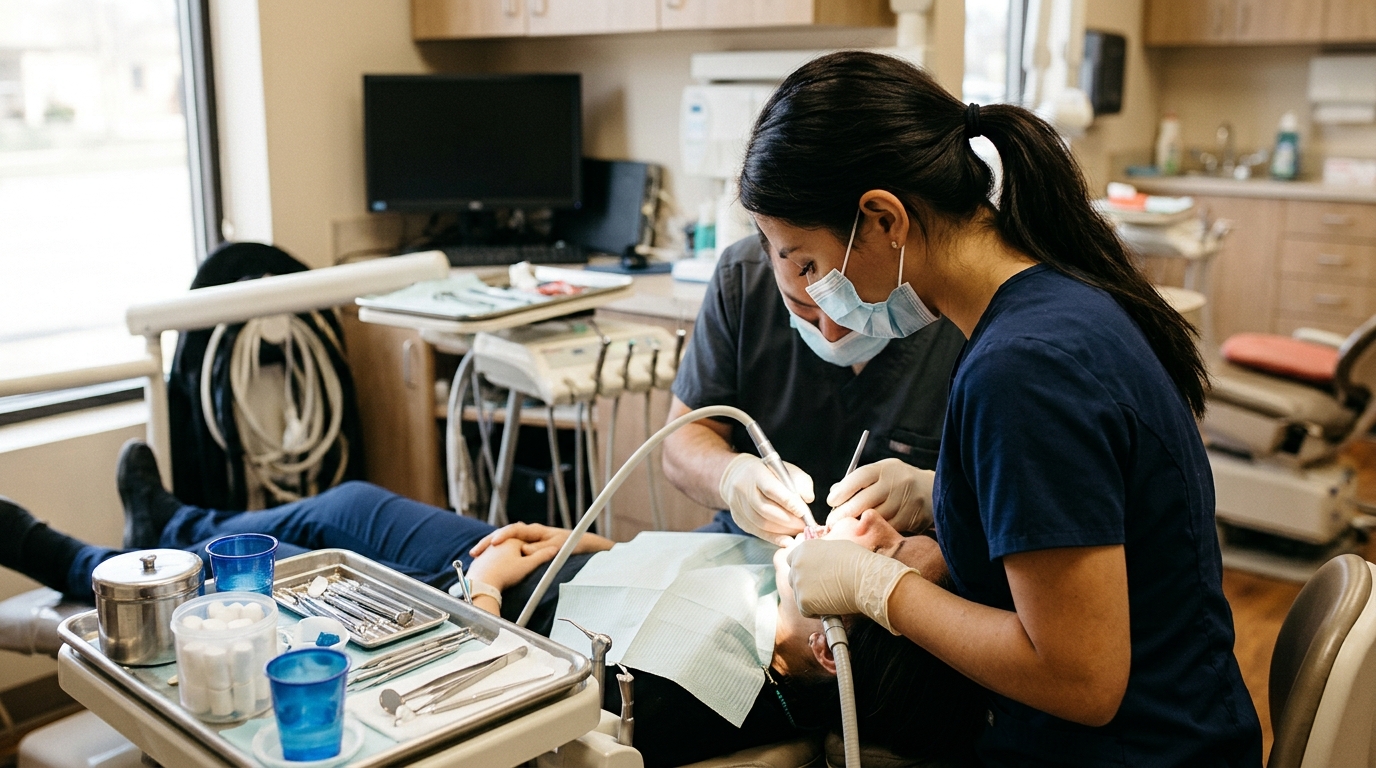
A dental assistant prepares patients and treatment rooms, works chairside while the dentist treats, sterilizes instruments, and keeps records and schedules moving. Almost all of the work happens in dentists' offices, which employed 91 percent of dental assistants, with smaller numbers in outpatient care centers, offices of physicians and government settings (U.S. Bureau of Labor Statistics, 2025).
Entry requirements vary sharply by state: some require graduation from an accredited program and a passing exam score, while others have no formal educational requirement and allow on-the-job training (U.S. Bureau of Labor Statistics, 2025).
What a Dental Assistant Does
A dental assistant keeps the treatment room running so the dentist can concentrate on the patient. The work splits between clinical tasks at the chair and administrative tasks at the front desk, and in a small practice one person often does both.
Clinically, dental assistants make patients comfortable in the chair, prepare patients and work areas, sterilize instruments, set up instrument trays, hand instruments to the dentist, and dry patients' mouths with a suction hose. They instruct patients on oral hygiene, process x-rays under a dentist's direction, and keep records of dental treatments (U.S. Bureau of Labor Statistics, 2025). ONET adds taking medical and dental histories and vital signs, applying fluoride, giving postoperative instructions, assisting the dentist in managing medical or dental emergencies, and ordering and monitoring dental supplies (ONET OnLine, U.S. Department of Labor). Administrative duties can include scheduling appointments and handling billing and payment (U.S. Bureau of Labor Statistics, 2025).
The setting is overwhelmingly private dental practice: offices of dentists employed 91 percent of dental assistants, with outpatient care centers, offices of physicians and government employing smaller shares (U.S. Bureau of Labor Statistics, 2025). Duties differ by experience and by state. Specially trained assistants take x-rays themselves, and in states that permit expanded duties such as coronal polishing, those assistants must be licensed, registered or certified (U.S. Bureau of Labor Statistics, 2025).
A Typical Day
- Opens the operatories before the first patient: lays out sterilized instrument trays, checks suction lines and confirms the day's schedule in dental practice management software such as Dentrix, SOFTDENT or EagleSoft (O*NET OnLine, U.S. Department of Labor).
- Seats the first patient and takes or updates the medical and dental history and vital signs in the patient record (O*NET OnLine, U.S. Department of Labor).
- Exposes diagnostic x-rays where trained and permitted: places the protective apron, positions the x-ray machine, places the sensor or film, and takes the images under the dentist's direction (U.S. Bureau of Labor Statistics, 2025).
- Works chairside through restorative appointments — handing instruments to the dentist, drying the patient's mouth with the suction hose, and watching for signs the patient is uncomfortable (U.S. Bureau of Labor Statistics, 2025).
- Breaks down the room between patients: removes contaminated instruments, disinfects surfaces, sterilizes instruments and resets a fresh tray (O*NET OnLine, U.S. Department of Labor).
- Gives postoperative instructions, demonstrates brushing, flossing and plaque control, and applies fluoride where state rules and training allow (O*NET OnLine, U.S. Department of Labor).
- Records treatment details in the chart and books the recall appointment at checkout, which in many offices means taking payment or posting it to billing (U.S. Bureau of Labor Statistics, 2025).
- Counts stock at the end of the day and orders supplies that are running low (O*NET OnLine, U.S. Department of Labor).
Newer assistants spend more of the day on sterilization, room turnover and front-desk support; assistants with x-ray training or an expanded-duties credential take on imaging and, where state rules allow, procedures such as coronal polishing (U.S. Bureau of Labor Statistics, 2025).
Salary and Job Outlook
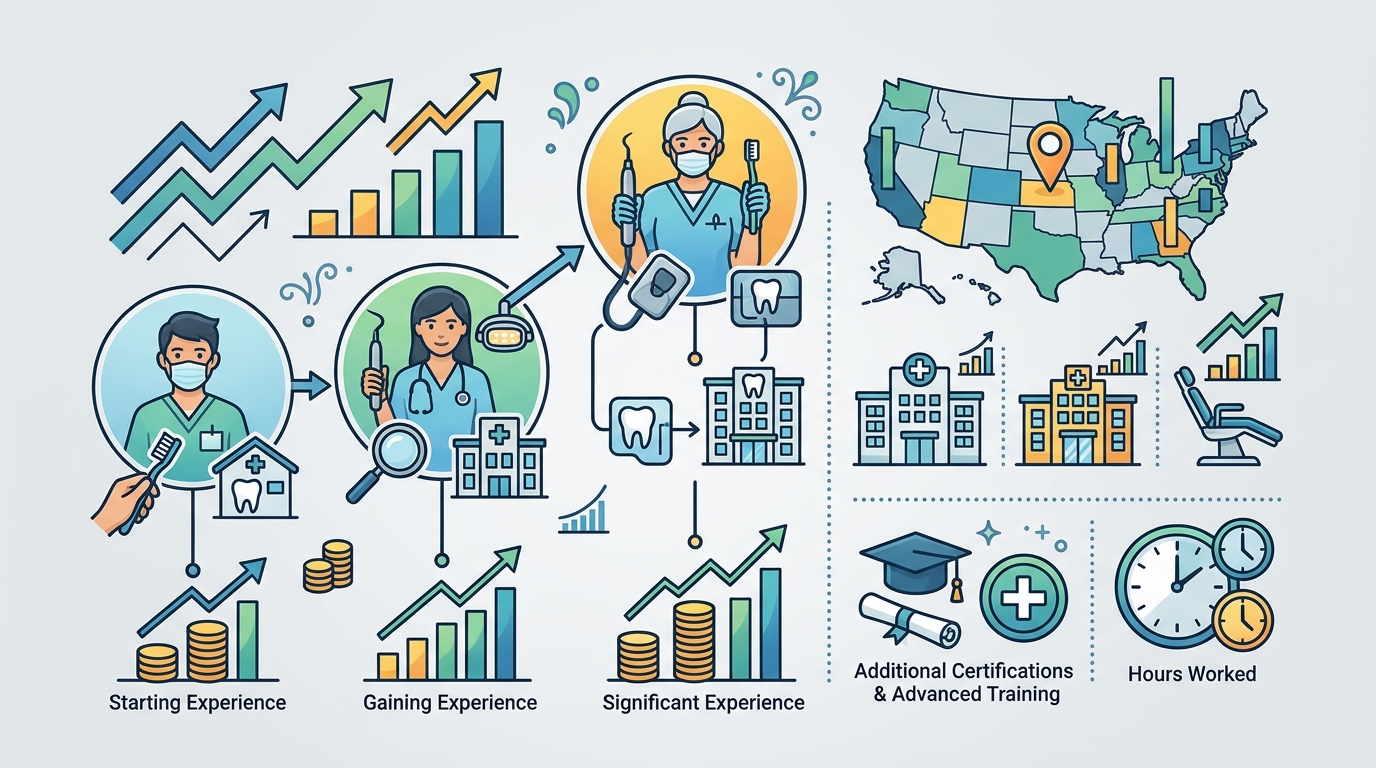
All figures below are from the U.S. Bureau of Labor Statistics, 2025. Pay is usually hourly in private practice, with full-time schedules common and some evening or weekend hours (U.S. Bureau of Labor Statistics, 2025). Rates vary by state, metro area and employer, so check the current BLS Occupational Employment and Wage Statistics page for your state before you negotiate.
| Level or setting | Annual pay | Source and year |
|---|---|---|
| Lowest 10 percent (typically entry level) | Less than $37,130 | BLS, May 2025 |
| National median, all dental assistants | $48,070 ($23.11 per hour) | BLS, May 2025 |
| Highest 10 percent (typically experienced or credentialed) | More than $62,250 | BLS, May 2025 |
| Offices of dentists (91 percent of jobs) | $48,000 median | BLS, 2025 |
| Outpatient care centers | $49,090 median | BLS, 2025 |
| Offices of physicians | $47,310 median | BLS, 2025 |
| Government, excluding state and local education and hospitals | $55,270 median | BLS, 2025 |
There were about 388,600 dental assistant jobs in 2025, and employment is projected to grow 7 percent from 2025 to 2035, much faster than the average for all occupations. About 53,000 openings are projected each year on average, largely because workers transfer to other occupations or leave the labor force (U.S. Bureau of Labor Statistics, 2025).
Skills and Qualifications
Hard skills and credentials you can obtain or verify
- A postsecondary nondegree award in dental assisting, the typical entry-level education for the occupation. Many programs take about 1 year and lead to a certificate or diploma; 2-year associate's degree programs are less common (U.S. Bureau of Labor Statistics, 2025).
- State licensure, registration or certification where required. Some states require graduation from an accredited program and a passing exam; others have no formal educational requirement (U.S. Bureau of Labor Statistics, 2025).
- Dental Assisting National Board (DANB) exams: the Certified Dental Assistant (CDA) exam and its components — Radiation Health and Safety (RHS), Infection Control (ICE) and General Chairside Assisting (GC) — plus the National Entry Level Dental Assistant (NELDA) certification, made up of the ICE, RHS and Anatomy, Morphology and Physiology (AMP) exams (DANB). The RHS exam is recognized or required in many states (DANB).
- Current CPR certification, which states requiring an expanded-duties credential such as coronal polishing also require (U.S. Bureau of Labor Statistics, 2025).
- Radiographic technique: positioning the machine, placing the sensor or film, and using a protective apron (U.S. Bureau of Labor Statistics, 2025).
- Infection control: sterilizing and disinfecting instruments and setting up trays (O*NET OnLine, U.S. Department of Labor).
- Practice management software such as Dentrix, SOFTDENT, EagleSoft or TDOCS, plus office suite, email and browser software (O*NET OnLine, U.S. Department of Labor).
Soft skills
- Detail orientation, dexterity, interpersonal skills, listening skills and organizational skills, which BLS lists as important qualities for the occupation (U.S. Bureau of Labor Statistics, 2025).
- Composure under pressure, since assistants help the dentist manage medical or dental emergencies (O*NET OnLine, U.S. Department of Labor).
How to Get Started
- Check your state's rules first. Some states require dental assistants to graduate from an accredited program and pass an exam; others allow on-the-job training with no formal educational requirement (U.S. Bureau of Labor Statistics, 2025). Your state dental board sets the rule, and it determines everything below.
- Finish high school, then enroll in a dental assisting program if your state requires it or you want the credential. Many take about 1 year and lead to a certificate or diploma; associate's degree programs run about 2 years and are less common (U.S. Bureau of Labor Statistics, 2025).
- Get CPR certified and keep it current. States that allow expanded functions such as coronal polishing require a licensed, registered or certified assistant with current CPR certification (U.S. Bureau of Labor Statistics, 2025).
- Sit the exams your state recognizes. DANB offers the Radiation Health and Safety, Infection Control, General Chairside Assisting and Anatomy, Morphology and Physiology exams, the NELDA certification and the CDA exam (DANB). The Radiation Health and Safety exam is recognized or required in many states (DANB), so it is often worth taking first.
- Build chairside hours. ONET places dental assisting in Job Zone Three, where employees usually need one or two years combining on-the-job experience with informal training (ONET OnLine, U.S. Department of Labor). Expect early months to lean on sterilization and room turnover.
- Apply to dentists' offices first, since they employ 91 percent of dental assistants, then widen to outpatient care centers, physicians' offices and government clinics (U.S. Bureau of Labor Statistics, 2025). On your resume, name the practice management software you have used and list each exam you have passed with its date.
Frequently asked questions
Do you need a degree to be a dental assistant?
No. The typical entry-level education is a postsecondary nondegree award, not a degree (U.S. Bureau of Labor Statistics, 2025). Many programs take about 1 year and award a certificate or diploma, while 2-year associate's degree programs are less common. Some states have no formal educational requirement and allow on-the-job training, so check your state dental board before enrolling.
How long does it take to become a dental assistant?
If your state requires an accredited program, expect about 1 year for a certificate or diploma, or about 2 years for an associate's degree (U.S. Bureau of Labor Statistics, 2025). O*NET places the occupation in Job Zone Three, where employees usually need one or two years of combined on-the-job experience and informal training (O*NET OnLine, U.S. Department of Labor). In states allowing on-the-job training you may start sooner, but still need exams before taking x-rays or expanded duties.
Is being a dental assistant stressful?
The pressures are specific: back-to-back appointments on a tight schedule, long stretches leaning over a chair doing fine-motor work with sharp instruments, and direct contact with patients who may be anxious or in pain. That is why BLS lists dexterity, listening and interpersonal skills as important qualities (U.S. Bureau of Labor Statistics, 2025). Assistants also help the dentist manage medical or dental emergencies when they occur (O*NET OnLine, U.S. Department of Labor).
Can dental assistants take x-rays?
Some can. Specially trained dental assistants take x-rays of teeth — placing the protective apron, positioning the machine and placing the sensor or film — and others process x-rays under a dentist's direction (U.S. Bureau of Labor Statistics, 2025). Whether you may expose images depends on your state, and DANB's Radiation Health and Safety exam is recognized or required in many states (DANB).
What hours do dental assistants work?
Most dental assistants work full time, and some work evenings or weekends (U.S. Bureau of Labor Statistics, 2025). Schedules follow the practice's patient hours, so an office offering early-morning or Saturday appointments will staff them. Part-time roles exist, particularly where two assistants split coverage.
Sources
- U.S. Bureau of Labor Statistics — Dental Assistants : Occupational Outlook Handbook (2025)
- O*NET OnLine (U.S. Department of Labor) — 31-9091.00 - Dental Assistants

Written by
Priya tracks wages, layoffs, and the slow shifts in what counts as a stable job. She writes for readers trying to make sense of numbers that rarely match their own experience.