Dental Assistant vs. Dental Hygienist: Key Differences Explained
Both roles sit in the same operatory, but they split on training length, licensing, pay and whether you work full time or a few days a week.
Quick answer
- Pay: hygienist wins, with a median of $98,100 against $48,070 for assistants (U.S. Bureau of Labor Statistics, 2025-05).
- Training time: assistant wins — many programs run about 1 year, against about 3 years for hygiene programs (U.S. Bureau of Labor Statistics, 2025).
- Schedule flexibility: hygienist wins, because many work part time and dentists may hire for only a few days a week, while most assistants work full time (U.S. Bureau of Labor Statistics, 2025).
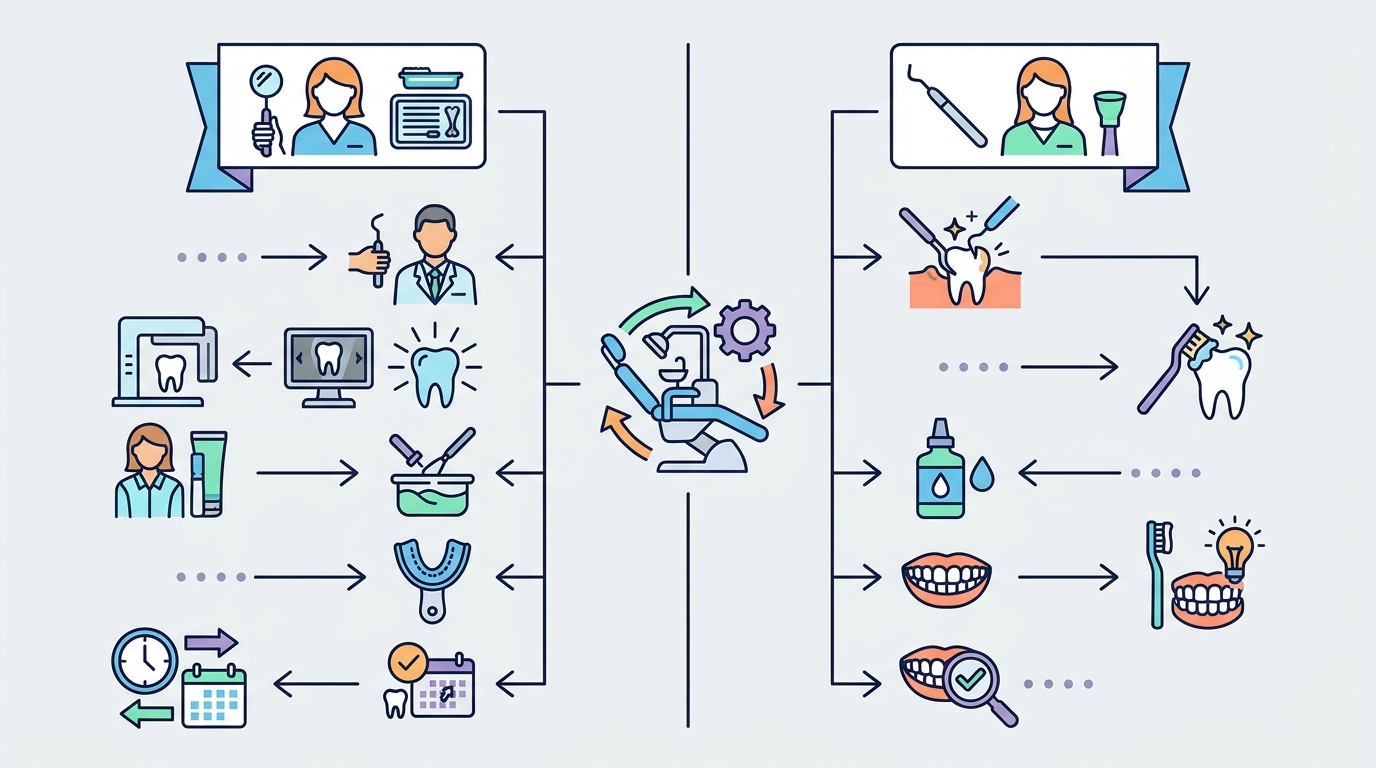
Dental assisting usually takes about a year of training and no license in most states, with a median annual wage of $48,070 (U.S. Bureau of Labor Statistics, 2025-05). Dental hygiene takes an associate's degree, a program of about three years, and a license in every state, with a median annual wage of $98,100 (U.S. Bureau of Labor Statistics, 2025-05).
If you are switching careers in your 40s or 50s, the deciding questions are how many months you can live on reduced income, and whether you want to support a dentist's work or run your own column of patients.
Side-by-Side Comparison
Both fields hire people with no prior dental experience. What separates them for a career changer is time, licensing and money.
| Dimension | Dental assistant | Dental hygienist |
|---|---|---|
| Entry education | Postsecondary nondegree award (U.S. Bureau of Labor Statistics, 2025) | Associate's degree (U.S. Bureau of Labor Statistics, 2025) |
| Time to job-ready | Many programs take about 1 year, leading to a certificate or diploma; 2-year associate's options are less common (U.S. Bureau of Labor Statistics, 2025) | Programs typically take about 3 years, with classroom, laboratory and clinical instruction (U.S. Bureau of Labor Statistics, 2025) |
| Median annual wage | $48,070 (U.S. Bureau of Labor Statistics, 2025-05) | $98,100 (U.S. Bureau of Labor Statistics, 2025-05) |
| Licensing | Most states do not license entry-level assistants, though some require licensing, registration or certification for entry, advancement or expanded duties such as coronal polishing (U.S. Bureau of Labor Statistics, 2025) | All states require a license, and requirements vary by state (U.S. Bureau of Labor Statistics, 2025) |
| Prior experience | None in a related occupation (U.S. Bureau of Labor Statistics, 2025) | None beyond the degree program (U.S. Bureau of Labor Statistics, 2025) |
| Schedule | Most work full time; some work evenings or weekends (U.S. Bureau of Labor Statistics, 2025) | Many work part time, and dentists may hire for a few days a week (U.S. Bureau of Labor Statistics, 2025) |
| Physical demands | Standing, bending and reaching all day; repetitive instrument handling and sterilizing | Long stretches seated in fixed postures; sustained hand and wrist loading from scaling |
| Field size and openings | About 388,600 jobs, roughly 53,000 openings a year (U.S. Bureau of Labor Statistics, 2025) | About 225,300 jobs, roughly 15,000 openings a year (U.S. Bureau of Labor Statistics, 2025) |
| Growth, 2025–35 | 7 percent, much faster than average (U.S. Bureau of Labor Statistics, 2025) | 8 percent, much faster than average (U.S. Bureau of Labor Statistics, 2025) |
| Typical starting age | Commonly entered in the late teens and 20s; programs set no upper age limit and classes routinely include people in their 30s, 40s and 50s | Same mix, though the 3-year commitment tends to skew career-changer entrants older |
The financial tradeoff is what people underestimate. Assisting can put you back on a payroll roughly 12 to 18 months after you enrol, counting the year of program time plus a job search, but at a median of $48,070 (U.S. Bureau of Labor Statistics, 2025-05) it may be a pay cut if you are leaving a supervisory job. Hygiene roughly doubles that median, at $98,100 (U.S. Bureau of Labor Statistics, 2025-05), but the 3-year program means three to four years door to door, much of it on reduced hours, plus tuition, instrument kits and exam fees that vary by school and state. Ask each program for its published total cost in writing before you commit.
What Each Job Looks Like Day to Day
A dental assistant works beside the dentist and keeps the practice moving. You seat and drape patients, pass instruments in sequence during fillings and extractions, and use suction to keep the field clear while the dentist works. Between appointments you break down the operatory, run instruments through the autoclave and reset trays. Depending on state rules you may take X-rays, take impressions, or perform expanded duties such as coronal polishing if you hold the certification your state requires (U.S. Bureau of Labor Statistics, 2025). Most assistants work full time, and some practices run evening or weekend hours (U.S. Bureau of Labor Statistics, 2025).
A dental hygienist works through a column of patients largely alone, with the dentist dropping in to examine. You review medical histories, screen for signs of oral disease, then remove plaque and calculus with hand scalers and ultrasonic instruments. You take and interpret radiographs, apply fluoride or sealants, chart your findings, and spend part of every appointment coaching patients on brushing and flossing. Appointments run on a fixed clock, so the pace is steady rather than reactive. Many hygienists work part time, and some cover two or three practices because a dentist may need chair coverage only a few days a week (U.S. Bureau of Labor Statistics, 2025).
Which Fits Your Background
- Retail or restaurant manager — start as a dental assistant. You already run a floor under time pressure and calm upset people, and you can be earning in about a year rather than three.
- Elementary teacher — dental hygiene suits you. Patient education fills part of every appointment, and you already hold a degree, which may cover some general-education requirements.
- Certified nursing assistant, phlebotomist or medical assistant — dental assistant is the shorter hop. Infection control, charting and hands-on patient contact transfer directly, and no related work experience is required for entry (U.S. Bureau of Labor Statistics, 2025).
- Massage therapist, hairstylist or jeweler — look at dental hygiene. Fine motor control and tolerance for long static postures are the core physical demands of scaling.
- Bookkeeper leaving a desk job — dental assistant tests you quickly. If standing all day inside someone's mouth does not suit you, you spent about a year finding out, not three.
- Parent returning to work after years out — dental hygiene is worth the longer road if you need part-time hours later, since many hygienists work part time and dentists often hire for a few days a week (U.S. Bureau of Labor Statistics, 2025).
- Career changer aged 45 to 60 worried about hiring bias — assisting is the softer landing, with about 53,000 openings projected a year against roughly 15,000 for hygienists (U.S. Bureau of Labor Statistics, 2025). Expect some interviewers to assume a 55-year-old cannot keep the physical pace; answer with the shift lengths you already work and your program's clinical hours.
How to Decide and Test the Waters
- Shadow both roles in the same practice. Ask an office manager for a half-day observation. Watch how long the assistant stays on their feet and how long the hygienist holds one posture. Do this before you pay tuition.
- Read your state dental board's rules. All states license hygienists and requirements vary by state (U.S. Bureau of Labor Statistics, 2025), while most states do not license entry-level assistants, though some require registration or certification, including for expanded duties such as coronal polishing (U.S. Bureau of Labor Statistics, 2025).
- Take one modular credential while still employed. The Dental Assisting National Board offers the Radiation Health and Safety (RHS) and Infection Control (ICE) exams separately, so you can sit one evening-study exam before committing to the full Certified Dental Assistant (CDA) route.
- Enrol part-time in hygiene prerequisites, not the whole program. Anatomy, chemistry and microbiology are usually taken before the 3-year hygiene program (U.S. Bureau of Labor Statistics, 2025) and can often be done at night while you keep your job. If the coursework does not hold you, you have lost a semester, not a career.
- Volunteer or work in a dental setting before you resign. Front-desk, sterilization-tech and community clinic shifts put you in the building, and many assistants reach the chair this way.
- Price the income gap on paper. List your current monthly pay, the months you expect to be out of full-time work, and the tuition and instrument costs each program quotes. Weigh that against the two medians, $48,070 and $98,100 (U.S. Bureau of Labor Statistics, 2025-05).
Frequently asked questions
Can I start as a dental assistant and become a hygienist later?
Yes, and it is a common route. Assisting programs take about 1 year, while hygiene programs typically take about 3 years (U.S. Bureau of Labor Statistics, 2025). The upside is earning at the assistant median of $48,070 while you confirm the field suits you; the downside is that the combined timeline runs four to five years before you reach the hygienist median of $98,100 (U.S. Bureau of Labor Statistics, 2025-05).
Am I too old to start either one at 50?
Neither field sets an age limit, and the hiring volume is the reason that is more than encouragement: about 53,000 assistant openings and about 15,000 hygienist openings are projected each year from 2025 to 2035 (U.S. Bureau of Labor Statistics, 2025). At 50 to 60, assisting is usually the more realistic entry, needing no related work experience and about 1 year of training, while hygiene asks for roughly 3 years of schooling first.
Which job is harder on the body?
They strain different things. Assistants stand, bend and reach most of the day, and most work full time with some evening or weekend shifts (U.S. Bureau of Labor Statistics, 2025). Hygienists sit in fixed postures with sustained hand and wrist loading. If back or shoulder problems are a factor, note that many hygienists work part time and dentists may hire for only a few days a week (U.S. Bureau of Labor Statistics, 2025).
Sources
- U.S. Bureau of Labor Statistics — Dental Assistants : Occupational Outlook Handbook (2025-05)
- U.S. Bureau of Labor Statistics — Dental Hygienists : Occupational Outlook Handbook (2025-05)

Written by
Wyatt covers work outside the office: construction, logistics, repair, and the people who keep things running. He's skeptical of career advice that assumes everyone sits at a desk.