Graphic Designer or UX Designer: A Second-Career Comparison
Two design paths that look alike from the outside but split on pay, entry route and outlook — what each asks of someone switching mid-career.
Quick answer
- Pay goes to UX: $104,000 median for web and digital interface designers against $62,960 for graphic designers (U.S. Bureau of Labor Statistics, 2025).
- Training time goes to UX: the Google UX Design Professional Certificate is seven courses at about 5–10 hours a week with no prior experience required (Google), while graphic design roles typically expect a bachelor's degree (U.S. Bureau of Labor Statistics, 2025).
- Outlook goes to UX: web and digital interface designers are projected to grow 6% from 2025 to 2035, while graphic design employment is projected to decline 2% (U.S. Bureau of Labor Statistics, 2025).
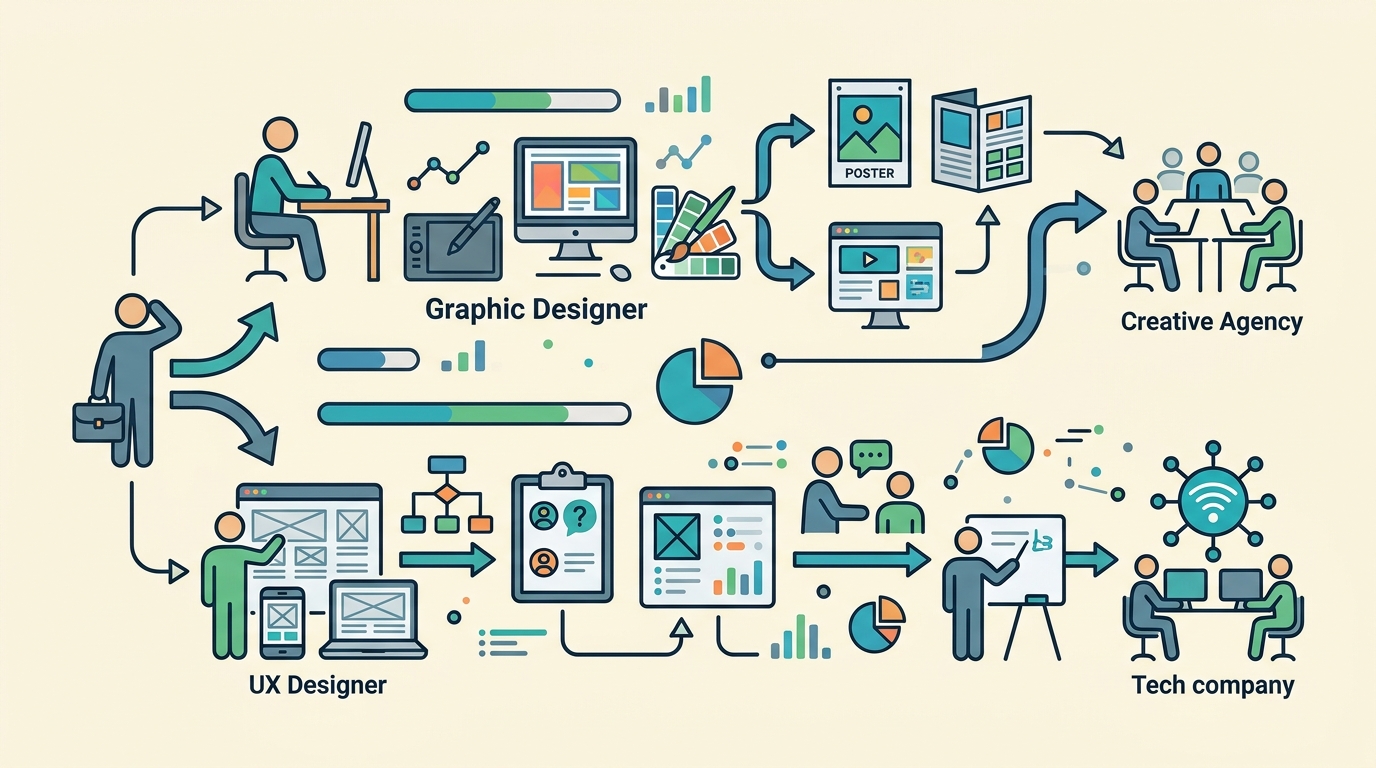
If you are moving into design later in your working life, the two paths differ most on money and on how you get in. Web and digital interface designers — the group federal data uses for UX work — had a median annual wage of $104,000 in 2025, while graphic designers' median was $62,960 (U.S. Bureau of Labor Statistics, 2025). Graphic design typically expects a bachelor's degree in design or a related fine arts field, while education requirements for web and digital designers vary by work setting (U.S. Bureau of Labor Statistics, 2025).
Both hire on portfolio. The real question is whether you want to make things look right or make things work right — and how long you can fund the gap before the switch pays for itself.
Side-by-Side Comparison
One naming note: there is no Standard Occupational Classification titled "UX Designer." Federal data tracks the work under SOC 15-1255, Web and Digital Interface Designers, profiled jointly with web developers (U.S. Bureau of Labor Statistics, via O*NET Code Connector). Job ads will still say UX.
| Dimension | Graphic Designer | UX / Web and Digital Interface Designer |
|---|---|---|
| Median annual pay | $62,960 (U.S. Bureau of Labor Statistics, 2025) | $104,000; $99,520 for the combined web developers and digital designers group (U.S. Bureau of Labor Statistics, 2025) |
| Size and direction | About 253,100 jobs, projected to decline 2% from 2025 to 2035 (U.S. Bureau of Labor Statistics, 2025) | 113,330 wage-and-salary jobs, mean wage $117,490 in the May 2025 national estimate (AIGA Design Careers citing BLS OEWS, 2025); projected 6% growth 2025–2035 (U.S. Bureau of Labor Statistics, 2025) |
| Typical entry requirement | Bachelor's degree in graphic design or a related fine arts field; 10% of ONET survey respondents said a master's is required (U.S. Bureau of Labor Statistics, 2025; ONET OnLine) | Varies based on work setting and other factors (U.S. Bureau of Labor Statistics, 2025) |
| Realistic transition time | If you already hold a bachelor's in any subject, the work is portfolio-building; if you need the degree, add the years it takes (U.S. Bureau of Labor Statistics, 2025) | Students complete the Google UX Design Certificate in six months on average (ITCareerFinder); add a job search on top, so plan on 12 to 18 months end to end |
| Up-front cost | Tuition if you enrol, plus Adobe software; Adobe Certified Associate credentials in Photoshop, Illustrator and InDesign appear on ONET's certification list for the role (ONET OnLine) | About $49 per month on Coursera, roughly $294 in total (ITCareerFinder); the American Council on Education recommends 10 college credits for it (ITCareerFinder) |
| Schedule and physical demands | Desk and screen work; schedules vary with workloads and deadlines, so expect crunch around launches (U.S. Bureau of Labor Statistics, 2025) | Desk and screen work; most web developers and digital designers work full time (U.S. Bureau of Labor Statistics, 2025) |
| Typical starting age range | Portfolio-led entry, so changers arrive anywhere from their 30s to their 50s | Same portfolio-led entry; the Google certificate requires no prior experience (Google) |
On age: if you are between 45 and 60, the risk is not an outright no. It is that junior design roles are pitched at someone much younger, and a long résumé reads as expensive. Portfolio hiring helps, because reviewers judge the work rather than the graduation year. So does saying plainly that client, clinical or management experience maps onto UX research and stakeholder work.
The financial tradeoff is concrete either way. The UX certificate itself is small money, about $294 in total (ITCareerFinder); the cost is six months of evening study plus a job search you may have to fund. On the graphic design side, entry roles sit below the $62,960 median (U.S. Bureau of Labor Statistics, 2025), so if you currently out-earn that figure, budget for a pay cut lasting a year or more.
What Each Job Looks Like Day to Day
A graphic designer spends the day making visual decisions and producing files. ONET's sample tasks include determining the size and arrangement of illustrative material and copy, selecting the style and size of type, and developing graphics and layouts for product illustrations, company logos and websites (ONET OnLine). In practice that is a morning laying out a brochure to a brand guide, an afternoon redrawing a logo for signage, and a stream of small production requests. Adobe Illustrator and Adobe Photoshop are the two most commonly requested software skills in postings for the role (ONET OnLine). You demonstrate creativity through a professional portfolio, and the week bends around deadlines (U.S. Bureau of Labor Statistics, 2025). Reported titles include Brand Designer, Graphic Artist and Production Artist (ONET OnLine).
A UX or web and digital interface designer works on how something functions and whether people can use it. The federal description is developing, creating and testing website or interface layout, functions and navigation for usability (U.S. Bureau of Labor Statistics, 2025). ONET's tasks include collaborating with front-end or back-end developers, creating web models or prototypes, and developing and documenting style guidelines for website content (ONET OnLine). A day might mean wireframing a checkout flow in Figma, sitting in on a usability session and writing up what broke, then making the case to a product manager with the recording as evidence. The Google certificate teaches Figma and Adobe XD (Google). Most people in this group work full time (U.S. Bureau of Labor Statistics, 2025), and the rhythm is meeting-heavy.
Which Fits Your Background
- Prepress operator, sign maker or photo retoucher. You already have file-handling instincts and Illustrator and Photoshop hours. Graphic design is the shorter hop, and Adobe Certified Associate credentials appear on ONET's certification list for the role (ONET OnLine).
- Elementary or secondary teacher. You explain things to people who do not share your vocabulary and watch where they get stuck. That is usability testing. Point yourself at UX.
- Retail or restaurant manager. You have run service flows, watched customers fail at them and fixed the signage or the queue. UX research reads directly from that.
- Marketing coordinator or small-business owner who has made your own flyers and decks. You may be closer to a graphic design portfolio than you think, though the field is projected to decline 2% from 2025 to 2035 (U.S. Bureau of Labor Statistics, 2025), so expect competition.
- Registered nurse, case manager or social worker. Interviewing people in difficult circumstances and documenting what you found is the core of UX research, and the documentation habit suits writing style guidelines.
- Software QA tester, business analyst or support agent. You live in bug reports and specs already, so the developer-collaboration tasks on ONET's UX list will come fast (ONET OnLine).
- Fine artist, illustrator or photographer. Graphic design is the closer relative, and the field expects a fine arts or design background (U.S. Bureau of Labor Statistics, 2025).
How to Decide and Test the Waters
- Spend a weekend doing one task from each job. Redraw a local business's logo and lay out a one-page flyer for the graphic design side. For UX, take an app you dislike, sketch a better version of one screen in Figma, and write down why. Notice which one you wanted to keep doing.
- Shadow or interview two people in each role. Ask graphic designers about deadline weeks, since schedules vary with workloads and deadlines (U.S. Bureau of Labor Statistics, 2025), and ask UX designers how much of the week is meetings rather than design.
- Buy one month of the cheap path before the expensive one. The Google UX Design Professional Certificate is a seven-course program at $49 a month that requires no prior experience (Google; ITCareerFinder), and the American Council on Education recommends 10 college credits for the full certificate (ITCareerFinder). One month tells you whether the subject holds you.
- Take real briefs while still employed. Redesign a nonprofit's newsletter template, or run usability sessions on a community group's donation page. Graphic designers often gain experience through internships (U.S. Bureau of Labor Statistics, 2025); as a changer, real briefs with real stakeholders do the same job.
- Do the arithmetic before you resign. Set your current pay against the $62,960 graphic design median and the $104,000 web and digital interface design median (U.S. Bureau of Labor Statistics, 2025), then check current rates for your state and metro on the BLS Occupational Employment and Wage Statistics pages, because pay varies widely by area and industry.
- Set a review date six months out. By then you should have portfolio pieces and a direction. If neither portfolio exists, that is information about commitment, not talent.
Frequently asked questions
Which career pays more for someone starting over in their 40s or 50s?
UX, on the national medians: $104,000 for web and digital interface designers against $62,960 for graphic designers (U.S. Bureau of Labor Statistics, 2025), with a mean of $117,490 for web and digital interface designers in the May 2025 national estimate (AIGA Design Careers citing BLS OEWS, 2025). Entry pay in either field sits below those medians, so expect a catching-up period whichever you pick, and check your own metro's figures.
Do I have to go back for a four-year degree to do either?
For graphic design, usually yes — the occupation typically needs a bachelor's degree in graphic design or a related fine arts field, and 10% of O*NET survey respondents said a master's is required (U.S. Bureau of Labor Statistics, 2025; O*NET OnLine). For UX, requirements vary by work setting (U.S. Bureau of Labor Statistics, 2025), which is why a six-month certificate route exists, with 10 college credits recommended by the American Council on Education (ITCareerFinder). Hold a bachelor's in any subject and both paths shorten to portfolio-building.
Is it too late to start at 50?
Not on entry requirements: the Google UX Design Certificate requires no prior experience and costs about $294 across six months (Google; ITCareerFinder), and graphic design hiring turns on a professional portfolio rather than a graduation year (U.S. Bureau of Labor Statistics, 2025). Competing for junior roles is the harder part between 45 and 60, and UX gives more room, since it is projected to grow 6% from 2025 to 2035 while graphic design declines 2% (U.S. Bureau of Labor Statistics, 2025).
Which field has more openings to aim at?
Graphic design is larger in headcount — about 253,100 jobs against 113,330 wage-and-salary jobs for web and digital interface designers (U.S. Bureau of Labor Statistics, 2025; AIGA Design Careers citing BLS OEWS, 2025) — but it is contracting 2% over 2025 to 2035 while UX grows 6% (U.S. Bureau of Labor Statistics, 2025). Weigh direction alongside size.
Sources
- U.S. Bureau of Labor Statistics — Graphic Designers : Occupational Outlook Handbook (2025)
- U.S. Bureau of Labor Statistics — Web Developers and Digital Designers : Occupational Outlook Handbook (2025)

Written by
Noor writes personal essays and interviews about career changes, burnout, and starting over. She's interested in the stories people tell themselves about what a job is supposed to mean.