How to Become a Dental Assistant Without a Degree
In many states you can train chairside on the job first, then use DANB's work-experience pathway to certify — here is how that route actually runs.
Quick answer
- A degree is not the entry standard for dental assistants; among formal programs, the one-year certificate or diploma is common and two-year associate's degree programs are less common (U.S. Bureau of Labor Statistics, 2025).
- The no-degree route runs on hours, not semesters: DANB's CDA Pathway 2 requires a high school diploma or equivalent plus at least 3,500 hours of approved work experience, typically earned over two to four years (Dental Assisting National Board, via U.S. Department of Defense COOL; Mometrix Test Preparation).
- Medical assistants sit at the same preparation level as dental assistants in O*NET's Job Zone Three, which makes clinical back-office experience one of the strongest backgrounds to transfer in with (O*NET OnLine).
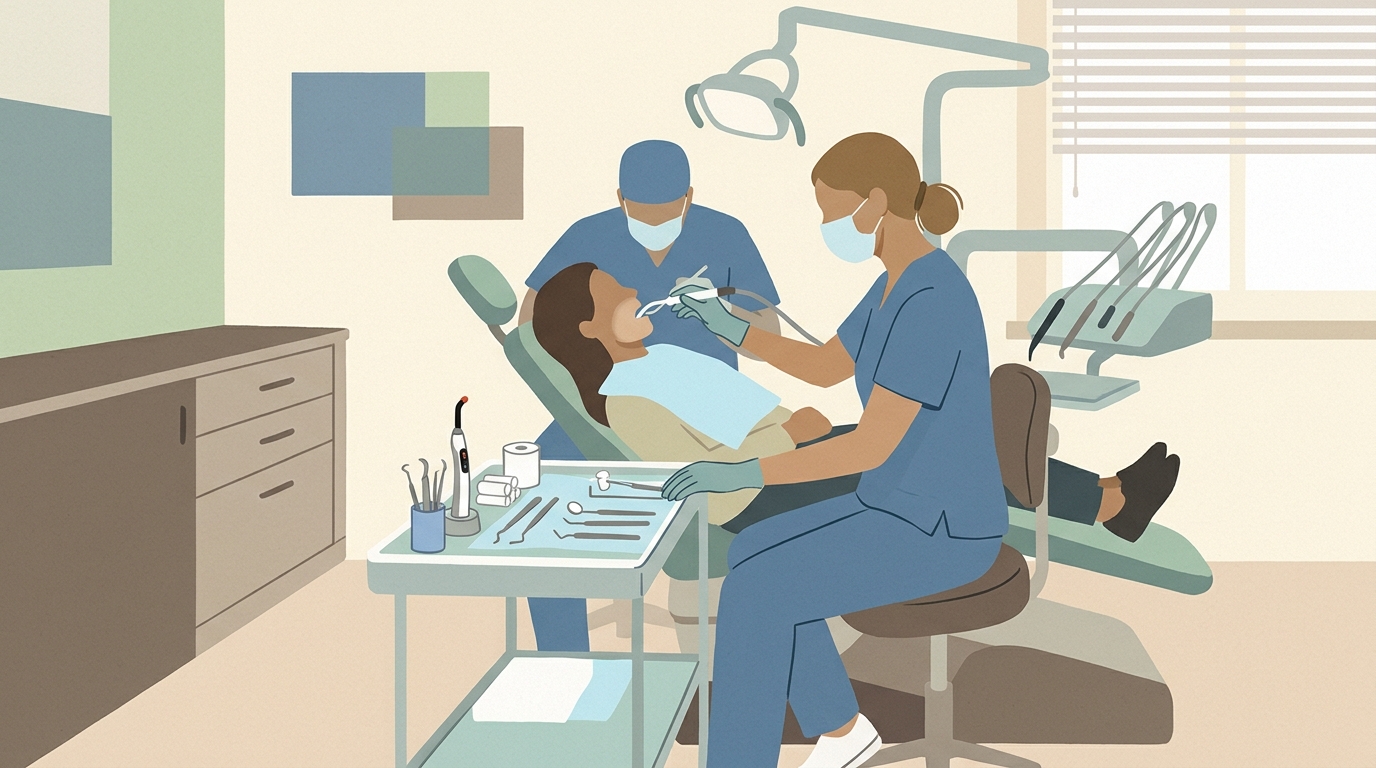
Whether you need formal schooling to assist chairside depends entirely on where you work. The U.S. Bureau of Labor Statistics (2025) notes that some states require dental assistants to graduate from an accredited program and pass an exam, while in other states there are no formal educational requirements and assistants learn through on-the-job training.
Where on-the-job entry is allowed, a high school diploma or equivalent plus 3,500 hours of approved dental assisting work experience can qualify you to sit for the Dental Assisting National Board's Certified Dental Assistant (CDA) exam through Pathway 2 (Dental Assisting National Board, via U.S. Department of Defense COOL). That is the no-degree route, and it is a recognized one.
Who Successfully Makes This Transition
Medical assistants. ONET OnLine lists medical assistants as an example occupation at the same preparation level as dental assistants — Job Zone Three, where employees usually need one or two years of training that combines on-the-job experience with informal training alongside experienced workers. A dentist hiring a medical assistant is not gambling on someone who has never touched a patient, charted vitals, run an autoclave cycle, or followed infection-control protocol. What is missing is dental-specific: instrument names, four-handed technique, dental software, and chairside suction. Those are taught in the operatory, which is exactly the kind of supervised, informal training ONET describes.
Dental front-desk and treatment coordinators. If you already schedule hygiene recall, read treatment plans, and talk patients through insurance, you know the practice's vocabulary and its patients. Many practices promote from the front desk into chairside because the training cost is low and the cultural risk is zero. This works best in states where, as the U.S. Bureau of Labor Statistics (2025) describes, assistants may learn through on-the-job training rather than an accredited program.
Caregiving and patient-facing service roles. Nursing assistants, home health aides, pharmacy technicians, veterinary assistants and even high-volume hospitality workers transfer in on a different strength: steady hands, calm with frightened people, and tolerance for repetitive precision work on a tight schedule. The Bureau of Labor Statistics (2025) lists work experience in a related occupation along with on-the-job training as typical for entering this job, which is precisely why employers accept these histories in place of classroom credit.
The common thread is that employers are buying reliability and trainability. O*NET OnLine puts one to two years of combined on-the-job experience and informal training behind full competence in this occupation, and notes that a recognized apprenticeship program may be associated with it.
Traditional Path vs. Alternative Path
| Path | Time to Entry | Upfront Cost | Credential Required | Typical Starting Pay |
|---|---|---|---|---|
| Accredited program (CODA-accredited certificate or diploma) | About 1 year for most certificate and diploma programs; associate's degree programs run about 2 years and are less common (U.S. Bureau of Labor Statistics, 2025) | Roughly $3,000 for a 12-week certificate up to more than $30,000 for an associate degree at a private college (Dreambound); community college is the low end — a 42-unit certificate at $20 per unit came to about $850 in California (CostHelper) | Program completion, plus a state exam where the state requires it (U.S. Bureau of Labor Statistics, 2025); opens CDA Pathway 1 immediately | Hourly. Entry rates sit well below the $62,250 that the top 10 percent of dental assistants exceeded in May 2025 (U.S. Bureau of Labor Statistics, 2025); check the BLS Occupational Outlook Handbook for the current median before you negotiate |
| On-the-job training plus DANB CDA Pathway 2 | No program to finish first where the state sets no formal educational requirement (U.S. Bureau of Labor Statistics, 2025); O*NET OnLine puts 1 to 2 years behind competence, and the 3,500 approved hours for Pathway 2 typically take 2 to 4 years (Mometrix Test Preparation) | $0 tuition. Costs are a hands-on CPR, BLS or ACLS course from a DANB-accepted provider and DANB exam fees — check danb.org for current amounts (Dental Assisting National Board, via U.S. Army COOL) | High school diploma or equivalent is the stated minimum for any CDA pathway (Kwikly); state registration or certification may be required for expanded duties such as coronal polishing or radiography (U.S. Bureau of Labor Statistics, 2025) | Hourly, and usually starts lower than a program graduate's while you are untrained. Pay moves with your state, practice type (private general practice, specialty practice, group practice or community health center) and whether you hold expanded-function certification; the same $62,250 top-decile figure (U.S. Bureau of Labor Statistics, 2025) marks the upper end either way |
States typically do not require a license for entry-level dental assistants, so the credential gap at the door is often smaller than it looks (U.S. Bureau of Labor Statistics, 2025).
Step-by-Step Alternative Path
- Confirm what your state allows before anything else. DANB publishes state-by-state dental assisting requirements at danb.org, and your state board of dentistry publishes the binding version. Some states require graduation from an accredited program and an exam; others have no formal educational requirement (U.S. Bureau of Labor Statistics, 2025). If yours is the first kind, the on-the-job route is closed for general chairside duties and a CODA-accredited program is your route in.
- Get a hands-on CPR, BLS or ACLS certification from a DANB-accepted provider. It is a stated prerequisite for the CDA credential (Dental Assisting National Board, via U.S. Army COOL), and practices will ask for it at interview regardless.
- Get hired into a trainee or chairside-assistant role. Apply directly to private general practices, multi-site group practices, pediatric and oral surgery specialty offices, and federally qualified community health centers, which hire and train steadily. Also check registered apprenticeship listings through the U.S. Department of Labor — O*NET OnLine notes a recognized apprenticeship program may be associated with this occupation. Dental temp-staffing apps are a second route into practices that need cover at short notice.
- Log your hours deliberately toward 3,500. CDA Pathway 2 requires a minimum of 3,500 hours of approved dental assisting work experience, usually accumulated over two to four years (Dental Assisting National Board, via U.S. Department of Defense COOL; Mometrix Test Preparation). Keep a dated log and have your supervising dentist sign it as you go, not at the end.
- Pick up your state's expanded-duty permissions as soon as you are eligible. Some states require licensing, registration or certification for expanded functions such as coronal polishing or radiography (U.S. Bureau of Labor Statistics, 2025). These are the duties that change what you are worth to a practice, and the requirements are listed by your state dental board.
- Apply to DANB and sit the Certified Dental Assistant examination under Pathway 2. You will submit the high school diploma or equivalent, the signed work-experience hours, and current CPR, BLS or ACLS certification from a DANB-accepted provider (Trade-Schools.net).
- Renew on schedule. The CDA credential carries a one-year renewal period (Dental Assisting National Board, via U.S. Army COOL). Diary the date the week you pass.
What to Have Ready Instead of a Degree
- High school diploma or GED. Stated as the minimum requirement for any CDA certification pathway (Kwikly). Order a sealed copy now rather than when DANB asks.
- A signed, dated work-hour log showing progress toward the 3,500 approved hours (Dental Assisting National Board, via U.S. Department of Defense COOL), with the supervising dentist's name and license number on each block of employment.
- Current hands-on CPR, BLS or ACLS card from a DANB-accepted provider, in date (Trade-Schools.net).
- Your state board printout showing which duties you are permitted to perform and any registration you already hold for radiography or coronal polishing (U.S. Bureau of Labor Statistics, 2025).
- A short skills sheet listing procedures you have assisted on by name — crown and bridge seats, endodontic cases, extractions, sealants, impressions or scans — with approximate case counts.
- Dentist references, ideally one who supervised you directly and one from a practice where you temped or covered.
- Proof of practice-management software you can run (scheduling, charting, imaging), since this removes training cost for the hiring office.
- The CDA certificate once earned, plus your renewal date, since the credential carries a one-year renewal period (Dental Assisting National Board, via U.S. Army COOL).
Frequently asked questions
Will dentists take me seriously if I never attended a dental assisting program?
In states with no formal educational requirement, many practices prefer to train chairside their own way and will interview you on attitude, attendance and hand skills (U.S. Bureau of Labor Statistics, 2025). What closes the credibility gap afterwards is the CDA, because DANB applies the same exam to Pathway 2 candidates as to accredited-program graduates. Until you hold it, lead with your CPR card, your state permissions and the procedures you have assisted on.
Does the no-degree route pay less in the long run?
Early on, yes — an untrained new hire is a training cost, and offers reflect that. Once you hold the CDA and your state's expanded-function permissions, employers are looking at the credential and the duties you can legally perform rather than how you got there. Look up the current median and percentile wages for dental assistants in the BLS Occupational Outlook Handbook, then compare them against postings in your own metro area.
Is there enough hiring to make this realistic?
The Bureau of Labor Statistics (2025) projects about 53,000 openings for dental assistants per year on average over the 2025-35 decade, largely from workers moving on or retiring. That volume is what makes on-the-job entry possible at all, because practices filling a seat quickly will often train rather than wait. Turnover is highest in group practices and community clinics, which is where untrained applicants usually get their first yes.
What if my state requires an accredited program after all?
Then the hours route will not substitute for it, and your cheapest option is usually a community college certificate rather than a private vocational school. Public tuition can be a fraction of private-college pricing — one California community college's 42-unit certificate worked out at about $850 at $20 per unit (CostHelper), against figures reaching past $30,000 at a private college (Dreambound). Confirm the program is accredited by the Commission on Dental Accreditation before you pay anything.
Sources
- U.S. Bureau of Labor Statistics — Dental Assistants : Occupational Outlook Handbook (2025)
- O*NET OnLine (National Center for O*NET Development) — 31-9091.00 - Dental Assistants

Written by
Marisol steers Jobladderhq's coverage of hiring trends and the strange rituals of modern recruiting. She's drawn to the gap between what job ads promise and what the work actually feels like. Her editing hand favors clarity over jargon, always.