How to Become a Massage Therapist
A look at licensing boards, the MBLEx, program length and the paperwork spas and clinics ask for before they will put you on the schedule.
Quick answer
- The fastest route is a diploma or certificate program at a private massage school or community college, which takes several months to a couple of years depending on the required hours (U.S. Bureau of Labor Statistics, 2025).
- The minimum education to enroll is normally a high school diploma or equivalent; a college degree is not the standard entry credential for this occupation (U.S. Bureau of Labor Statistics, 2025).
- Licensing is mandatory in most states, and requirements typically include graduating from an approved program and passing an exam such as the MBLEx, administered by the Federation of State Massage Therapy Boards (U.S. Bureau of Labor Statistics, 2025; Massage Magazine).
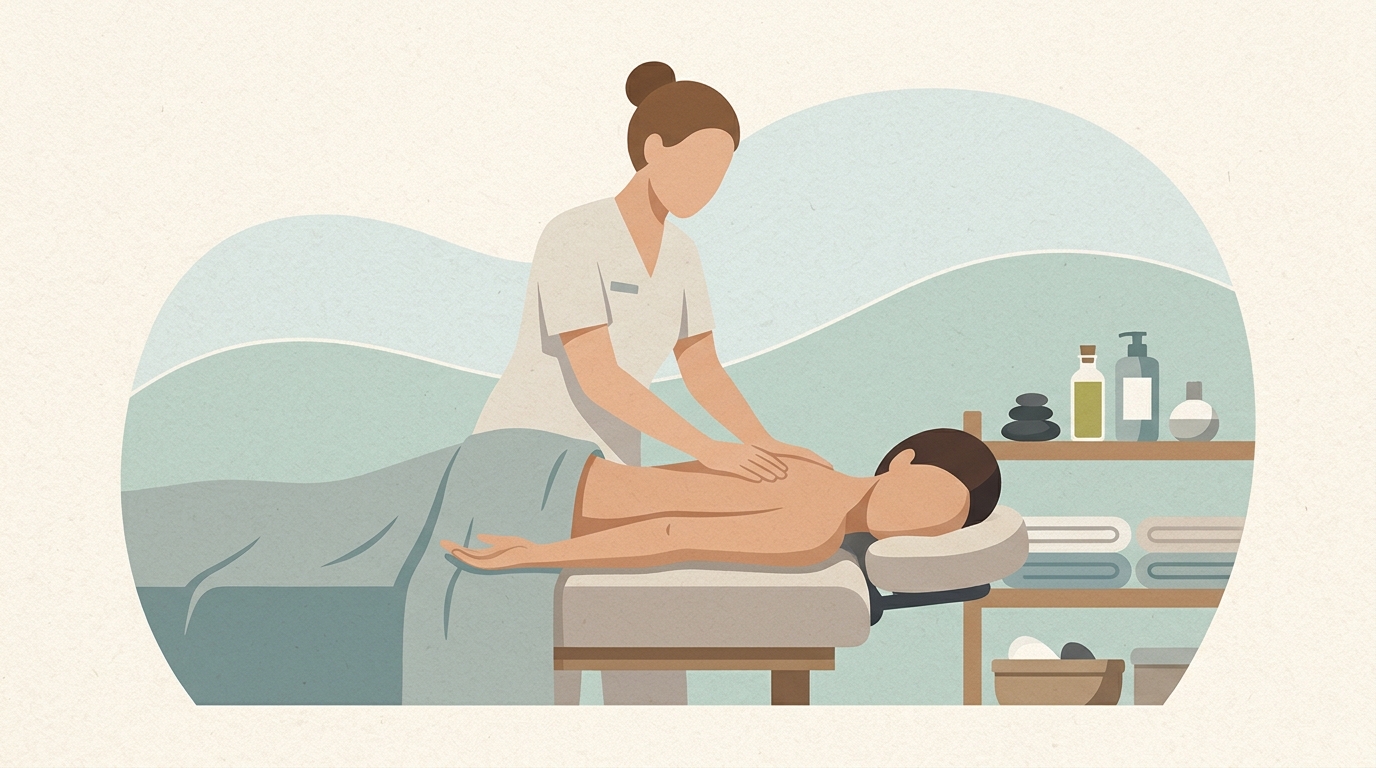
Becoming a massage therapist means finishing a postsecondary massage therapy program, then meeting your state's rules — which in most states include passing an exam and holding a license (U.S. Bureau of Labor Statistics, 2025). Programs sit in private, independent schools and in community colleges or other public institutions, and take several months to a couple of years depending on the required hours (U.S. Bureau of Labor Statistics, 2025).
The entry credential is a diploma or certificate rather than a degree, and applicants typically need at least a high school diploma or equivalent to enroll (U.S. Bureau of Labor Statistics, 2025). Because standards differ by state, read your own state board's rules before you pay any tuition.
What This Job Involves Day to Day
Most of your day is spent one client at a time, in a treatment room you set up and reset between appointments.
- Intake and consultation. You talk with each client about symptoms, medical history and treatment goals, then evaluate them to locate painful or tense areas (U.S. Bureau of Labor Statistics, 2025).
- Hands-on treatment. You massage and knead muscles and soft tissue for injuries, medical conditions or general wellness, and apply finger and hand pressure to specific points of the body (O*NET OnLine, U.S. Department of Labor).
- Joint mobilization. You use techniques intended to increase a client's range of motion, often the measurable goal in rehabilitation-style work (U.S. Bureau of Labor Statistics, 2025).
- Notes and room turnover. You document each client's condition and progress, then sanitize equipment and restock supplies such as linens and lotion (U.S. Bureau of Labor Statistics, 2025; O*NET OnLine).
Settings differ. Therapists work in places such as spas and the offices of other health practitioners, and some travel to local events, clients' offices or clients' homes (U.S. Bureau of Labor Statistics, 2025; O*NET OnLine). Part-time schedules are common and many massage therapists are self-employed, so you may handle booking, supplies and taxes alongside the hands-on work (U.S. Bureau of Labor Statistics, 2025). Evening and weekend appointments are normal, because that is when clients are free.
Step-by-Step Path to Get Started
- Finish high school or earn an equivalent credential. Programs typically require at least a high school diploma or its equivalent for admission (U.S. Bureau of Labor Statistics, 2025). If you need a GED or HiSET, allow several months of study and testing.
- Read your state board's rules before enrolling — set aside one afternoon. Most states regulate massage therapy and require a license or certification, and required training hours and approved-school lists are set at state level (U.S. Bureau of Labor Statistics, 2025). Write down the exact hour requirement from your state massage therapy board or health licensing agency; enrolling in a program that falls short of it is the costliest mistake in this field.
- Enroll in an approved massage therapy program — several months to about two years. These sit in private, independent schools and in community colleges or other public postsecondary institutions, and combine classroom study with supervised hands-on experience, so expect scheduled clinic hours with real clients (U.S. Bureau of Labor Statistics, 2025).
- Get CPR certified and clear a background check — 1 day for the class, 2 to 6 weeks for a background check to process. Requirements may include passing a background check and holding current CPR certification (U.S. Bureau of Labor Statistics, 2025). Ask your board which CPR format it accepts; some reject online-only cards without a hands-on skills check.
- Pass the MBLEx — plan 4 to 8 weeks of review after graduation. The Massage & Bodywork Licensing Examination is administered by the Federation of State Massage Therapy Boards and accepted in most regulated U.S. jurisdictions (Massage Magazine). Register through FSMTB and confirm the current fee, question format and passing score on its site before booking a test date.
- Submit your state license application — commonly 2 to 8 weeks of processing. Typical requirements are graduation from an approved program plus a passing exam score (U.S. Bureau of Labor Statistics, 2025). Expect to supply transcripts, your exam result, fingerprints and proof of CPR.
- Arrange liability insurance before your first paying client — 1 to 3 days. Liability coverage is a common requirement and is often demanded by employers and landlords as well as boards (U.S. Bureau of Labor Statistics, 2025).
- Apply for your first role — 2 to 8 weeks of searching. Target day spas, resort and hotel spas, franchised massage clinics, and offices of other health practitioners such as chiropractors (U.S. Bureau of Labor Statistics, 2025). Also check the U.S. Department of Labor's Registered Apprenticeship system, which has approved apprenticeship titles for this occupation (O*NET OnLine, U.S. Department of Labor).
Education, Certification, and Cost Requirements
Costs are set by individual schools, state boards and test providers. Confirm each one in writing before you pay.
| Requirement | Where to Get It | Typical Cost | Typical Time |
|---|---|---|---|
| High school diploma or equivalent | Public high school, or a GED/HiSET testing center in your state | Public high school is free; equivalency testing fees are set by each state's testing agency and published on your state education department's page | Several months if testing for an equivalency credential |
| Massage therapy diploma or certificate | Private, independent massage schools; community colleges and other public postsecondary institutions (U.S. Bureau of Labor Statistics, 2025) | Tuition is set per school and driven by required clock hours in your state, public versus private institution, and whether kit, linens and textbooks are billed separately — ask for a written cost sheet covering all four | Several months to about two years (U.S. Bureau of Labor Statistics, 2025) |
| MBLEx | Federation of State Massage Therapy Boards (Massage Magazine) | FSMTB publishes the current exam fee and any retake fee on its site | 4 to 8 weeks to prepare; one scheduled testing appointment |
| State license or certification | Your state massage therapy board or health licensing agency (U.S. Bureau of Labor Statistics, 2025) | Application, fingerprinting and license fees are listed on each board's fee schedule | 2 to 8 weeks of processing after a complete file |
| CPR certification | A CPR provider accepted by your state board or employer (U.S. Bureau of Labor Statistics, 2025) | Set by the training provider; hands-on skills sessions cost more than online-only modules | Half-day to full-day class, typically valid 2 years |
| Liability insurance | Professional liability insurers and associations serving massage therapists (U.S. Bureau of Labor Statistics, 2025) | Priced per year by coverage limit, employed versus self-employed status, and modalities practiced | 1 to 3 days to quote and bind |
| NCBTMB Board Certification (optional) | National Certification Board for Therapeutic Massage & Bodywork (My Next Move, U.S. Department of Labor) | NCBTMB publishes its application cost on its own site | Several weeks to assemble the application |
| Continuing education and renewal | CE providers approved by your state board (U.S. Bureau of Labor Statistics, 2025) | Priced per course hour; live in-person courses generally cost more than recorded ones | Many states require CE hours every 1 to 2 years |
Before You Apply
Have these ready before you send an application. Spa and clinic hiring managers ask for most of them at the first interview.
- Your license or certification number and its expiry date. In regulated states, employers cannot schedule you without it (U.S. Bureau of Labor Statistics, 2025).
- Your MBLEx pass confirmation from the Federation of State Massage Therapy Boards, saved as a PDF (Massage Magazine).
- Your transcript or diploma, showing total clock hours and supervised clinic hours (U.S. Bureau of Labor Statistics, 2025).
- A current CPR card you can photograph and attach (U.S. Bureau of Labor Statistics, 2025).
- Background check clearance or fingerprint receipt (U.S. Bureau of Labor Statistics, 2025).
- A liability insurance certificate, or a quote you can activate on your start date (U.S. Bureau of Labor Statistics, 2025).
- A one-page resume organised by modality and hours — deep tissue, sports, prenatal, trigger point — rather than by job title, plus the number of supervised client sessions you have performed.
- A sample treatment note with identifying details removed, showing how you document condition and progress (U.S. Bureau of Labor Statistics, 2025).
- Readiness for a practical interview. Many employers ask for a working massage on a manager. Bring your own lotion and explain your intake questions and pressure checks aloud as you work.
- Your availability in writing, including evenings, weekends and whether you want part-time hours, which are common in this field (U.S. Bureau of Labor Statistics, 2025).
Frequently asked questions
Do I need a license everywhere in the US?
Most states regulate the practice and require a license or certification, but not every jurisdiction does, and some cities add their own permit on top of the state rule (U.S. Bureau of Labor Statistics, 2025). Check both your state board and your city or county clerk's office before you start practising. If you plan to move, transferring in is usually easier when your original program met or exceeded the new state's hour requirement.
How long does it take from starting school to seeing your first client?
The training is the longest piece, running from several months to around two years depending on the program (U.S. Bureau of Labor Statistics, 2025). After graduation, budget roughly two to four more months for exam preparation, the testing appointment and licence processing. Full-time students in short programs sometimes get there in under a year; evening and weekend students usually take closer to two.
What should I budget for beyond tuition?
The recurring extras are exam registration with the Federation of State Massage Therapy Boards, state application and fingerprint fees, CPR training, liability insurance, and your own table, bolster, linens and lotion if an employer does not supply them (U.S. Bureau of Labor Statistics, 2025; Massage Magazine). Each charge is published by the organisation collecting it, so build your budget from current fee pages rather than older figures in forums.
How is the pay structured in this job?
Earnings commonly combine an hourly or per-session rate with client gratuities, and self-employed therapists instead keep session fees minus room rent, supplies and insurance (U.S. Bureau of Labor Statistics, 2025). Because part-time work is common, weekly hours matter as much as the rate. The U.S. Bureau of Labor Statistics publishes the current median annual wage and the range between the lowest and highest tenth of earners in its Occupational Outlook Handbook.
Sources
- U.S. Bureau of Labor Statistics — Massage Therapists : Occupational Outlook Handbook (2025)
- O*NET OnLine (U.S. Dept. of Labor) — 31-9011.00 - Massage Therapists - Summary Report

Written by
Priya tracks wages, layoffs, and the slow shifts in what counts as a stable job. She writes for readers trying to make sense of numbers that rarely match their own experience.