How to Become a Paralegal
Paralegal work is legal research, drafting and document control under attorney supervision — here is what the training, exams and first job really ask of you.
Quick answer
- Fastest common route: a paralegal studies certificate on top of an existing bachelor's degree, usually measured in months rather than years.
- Typical timeline from no college to a first paralegal job: roughly 18 months to 3 years, depending on the certificate or associate degree route.
- Minimum credential: an associate's degree or certificate in paralegal studies is the typical entry-level education (U.S. Bureau of Labor Statistics, 2026-08-27); certification is voluntary, not licensure.
Most people enter this occupation with an associate's degree or a certificate in paralegal studies, the typical entry-level education the U.S. Bureau of Labor Statistics lists for paralegals and legal assistants (BLS, 2026-08-27). There is no mandatory certification examination for paralegals anywhere in the United States, according to the American Bar Association's position as described in secondary reporting, so credentials like NALA's Certified Paralegal are voluntary signals to employers rather than licences.
From a standing start, a full-time associate degree commonly runs about two academic years; a post-baccalaureate certificate is shorter if you already hold a bachelor's degree. Hiring norms vary by state, by employer type and by practice area, so read postings in your own market before you enroll.
Is This Career Right for You?
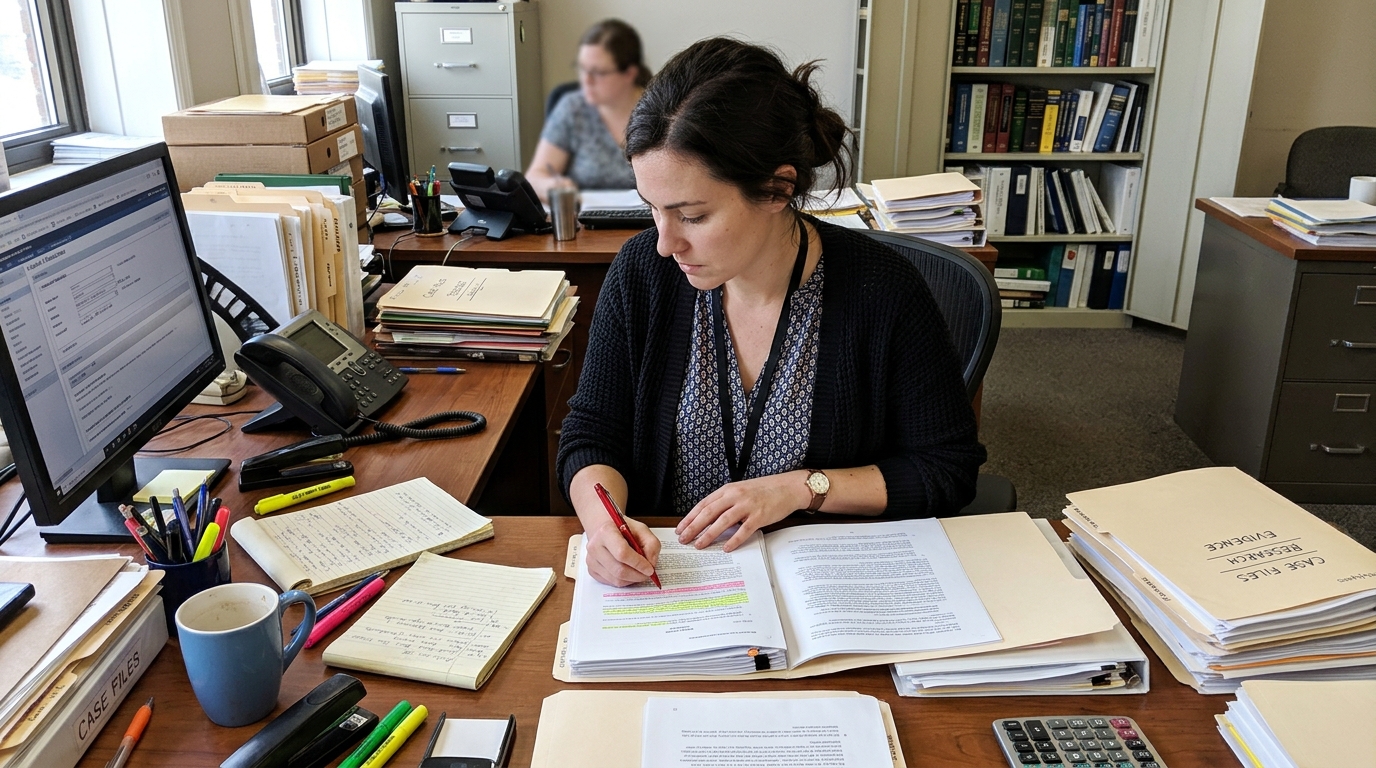
Most paralegals and legal assistants work full time (U.S. Bureau of Labor Statistics, 2026-08-27). The work is desk-based: long stretches reading statutes, decisions, legal articles, codes and documents, analyzing them, and preparing legal documents such as pleadings, discovery responses and exhibit binders (O*NET OnLine). You will work inside document management and e-filing systems, e-discovery review platforms and court calendaring software, and handle physical files, exhibits and service copies.
The pressure comes from two specific sources. Court and filing deadlines are fixed, so trial preparation and discovery cutoffs can mean long evenings. And you may be responsible for many cases at one time, which requires organizational skills (BLS, 2026-08-27), along with precision in gathering, organizing and filing documents and case information (BLS, 2026-08-27). You also have to document your research and present it clearly to attorneys (BLS, 2026-08-27) — memos someone else will rely on in court.
It suits people who like detailed written work, can hold several deadlines at once, and are comfortable supporting someone else's case strategy. It does not suit people who want to advise clients or appear in court, since paralegals work under attorney supervision, or who need part-time, flexible hours.
BLS projects little or no change in employment for paralegals and legal assistants over the decade, while still projecting a yearly average number of openings over that period (BLS, 2026-08-27). For pay, check current BLS wage data for the occupation against live postings in your metro area; rates differ sharply by state, city and employer type.
Steps to Becoming a Paralegal
- Finish high school or earn an equivalent credential. It matters later: NALA's Category 3 eligibility for the Certified Paralegal exam is a high school diploma or equivalent plus five years of experience as a paralegal (NALA, 2025).
- Choose your education route (6 months to 4 years). An associate's degree or certificate in paralegal studies is the typical entry-level education for the occupation (U.S. Bureau of Labor Statistics, 2026-08-27). A full-time associate degree is commonly about two academic years; a post-baccalaureate certificate is usually shorter. Ask each school for its published total program cost, and whether the program is ABA-approved, since some employers screen for that.
- Build the technical skills during your program. Legal research in case and statute databases, correct citation form, drafting pleadings and discovery, document indexing. These map to the core tasks O*NET lists: gathering and analyzing research data such as statutes, decisions, legal articles, codes and documents, and preparing legal documents.
- Get supervised experience before you graduate (a semester or a summer). An internship or a clerk role gets you inside real case files. Entry-level paralegals mostly organize and index documents, calendar deadlines, cite-check and assemble exhibits; experienced paralegals draft discovery, summarize depositions, manage e-discovery review and run trial logistics. Say which of those you have done when you apply.
- Decide on voluntary certification (3 to 12 months of preparation). There is no mandatory certification examination for paralegals anywhere in the United States, per the ABA's position as described in secondary reporting, so treat it as a hiring signal.
- Sit the NALA Certified Paralegal exam, or the NFPA alternative. Category 1 covers graduates of a qualifying paralegal program, including an ABA-approved program, an associate degree in paralegal studies, a post-baccalaureate certificate, a bachelor's degree in paralegal studies, or a program of at least 60 semester hours; Category 2 is a bachelor's degree in any field plus one year of paralegal experience, or at least 15 semester hours of substantive paralegal courses (NALA, 2025). You must pass the multiple-choice Knowledge Exam before the essay-based Skills Exam, and both to earn the CP credential (NALA via Credly). The Knowledge Exam is offered on demand year-round; the Skills Exam runs in four testing windows a year (NALA). Alternatively, NFPA's Paralegal CORE Competency Exam (PCCE) establishes that your education has prepared you for many types of paralegal work, and those who pass may use the CRP designation (NFPA). Check each body's published fee schedule.
- Specialize, then advance (2 to 6 years in), and keep the credential current. Pick a practice area — litigation, corporate, immigration, estates, real estate. NFPA's Paralegal Advanced Competency Exam (PACE) targets paralegals with comprehensive paralegal education plus years of practical experience; it is 200 multiple-choice questions lasting around four hours (NFPA). One described pathway to sit for PACE is an associate's degree in paralegal studies plus six years of professional experience, or a bachelor's degree plus a paralegal certification program plus two years (Lorman, describing NFPA PACE eligibility). NALA Certified Paralegals must renew every five years (NALA via Credly), so budget for continuing legal education.
Education and Certification Options
| Path | Typical time | Approximate cost | Required or preferred |
|---|---|---|---|
| Associate's degree in paralegal studies | About two academic years full time | Varies widely; community college per-credit rates are generally lower than private providers — ask for total program cost | One of the two typical entry-level credentials (U.S. Bureau of Labor Statistics, 2026-08-27); required by many employers |
| Certificate in paralegal studies | Months to about a year | Varies by provider; request full published tuition and materials cost | The other typical entry-level credential (BLS, 2026-08-27); often preferred if you already hold a bachelor's degree |
| Bachelor's degree in paralegal studies | About four years full time | Standard undergraduate tuition at your institution | Not universally required; satisfies NALA Category 1 eligibility (NALA, 2025) |
| Legal support experience with a high school diploma | Five years of paralegal experience | Lowest tuition cost; the cost is time | Meets NALA Category 3 eligibility (NALA, 2025); many firms still prefer a formal credential |
| NALA Certified Paralegal, or NFPA PCCE/PACE | Knowledge Exam on demand, Skills Exam in four windows a year (NALA); PACE is 200 questions over roughly four hours (NFPA) | Check NALA and NFPA published exam and renewal fees | Voluntary — no mandatory certification exam exists for paralegals in the US, per the ABA as described in secondary reporting |
Where to Find Paralegal Jobs
- NALA's career resources and local affiliated associations. The body that administers the Certified Paralegal exam also runs member networks where firms post openings.
- The National Federation of Paralegal Associations and its member associations. Good for postings and for connecting with paralegals holding the CRP or PACE credential in your practice area.
- State and local bar association job boards. Nearly every state bar and many county bars run a careers page used by small and mid-size firms that never post nationally. Start with the bar in the state where you intend to work.
- Career services at your paralegal program. ABA-approved and college-based programs keep employer relationships and alumni lists; ask the director which firms hired last year's graduates.
- Legal staffing and contract document-review agencies. Short litigation-support assignments are a common first paid entry point and build the case-file experience employers ask about.
- Government legal offices. Prosecutor and public defender offices, county clerk and court administration, city attorney offices and federal agency legal divisions hire paralegals; they post on their own careers pages and often require a background check.
- Corporate and in-house legal departments. Banks, insurers, hospital systems and large retailers hire for contracts, compliance and subpoena response; search using the sample reported job titles O*NET lists for the occupation so you catch postings labeled "legal assistant" too.
- Direct applications to small firms in a chosen practice area. In immigration, estates, family law and personal injury, a one- or two-attorney firm will often hire a new graduate who arrives with a writing sample and knowledge of local court filing procedure.
Frequently asked questions
Do I need a license to work as a paralegal?
No. There is no mandatory certification examination for paralegals anywhere in the United States, according to the American Bar Association's position as described in secondary reporting. What you need is the education employers ask for — typically an associate's degree or certificate in paralegal studies (U.S. Bureau of Labor Statistics, 2026-08-27). Some states and courts have their own rules on what non-attorneys may do, so check the state where you plan to work.
How long does it take if I already have a bachelor's degree?
A post-baccalaureate certificate in paralegal studies is the shortest common route and typically runs months rather than years. It also satisfies NALA's Category 1 eligibility for the Certified Paralegal exam (NALA, 2025). Alternatively, a bachelor's degree in any field plus one year of paralegal experience, or at least 15 semester hours of substantive paralegal courses, meets NALA Category 2 (NALA, 2025).
Can I become a paralegal without any college?
It is possible but slower, and fewer employers will consider you. NALA allows a high school diploma or equivalent plus five years of experience as a paralegal to sit for the CP exam under Category 3 (NALA, 2025), which usually means working up from a file clerk or legal secretary role. Because an associate's degree or certificate is the typical entry-level education (BLS, 2026-08-27), expect to compete against credentialed applicants.
What does certification cost and how often must I renew it?
NALA and NFPA each publish current application, examination and renewal fees on their own sites, and those change, so check before you budget. NALA Certified Paralegals must renew every five years (NALA via Credly), which means planning for continuing education hours as well as the renewal fee. Budget study time too: the Knowledge Exam must be passed before you can take the essay-based Skills Exam (NALA via Credly).
Should I expect a background check?
Often, yes. Law firms, courts, prosecutor and public defender offices and corporate legal departments handle confidential client and case material, and many screen before you start. Government legal offices in particular commonly require it, and the specific requirements vary by agency and by state.
Sources
- U.S. Bureau of Labor Statistics — Paralegals and Legal Assistants : Occupational Outlook Handbook (2026-08-27)
- NALA — Certified Paralegal (CP) Exam FAQs (2025)

Written by
Wyatt covers work outside the office: construction, logistics, repair, and the people who keep things running. He's skeptical of career advice that assumes everyone sits at a desk.