How to Become a Pharmacy Technician
A high school diploma opens the door; what changes the timeline is your state board's rules, which certification exam you sit, and how you train.
Quick answer
- The minimum education is a high school diploma or equivalent, and new technicians typically go through 1 to 12 months of on-the-job training (CareerOneStop).
- Most, but not all, states require licensure and certification for pharmacy technicians (CareerOneStop), so whether certification is mandatory depends on your state board of pharmacy.
- The fastest route is a retail or hospital trainee position under a state registration, with certification earned during the first year; an ASHP-accredited program takes at least 15 weeks and 600 hours of instruction (U.S. Bureau of Labor Statistics).
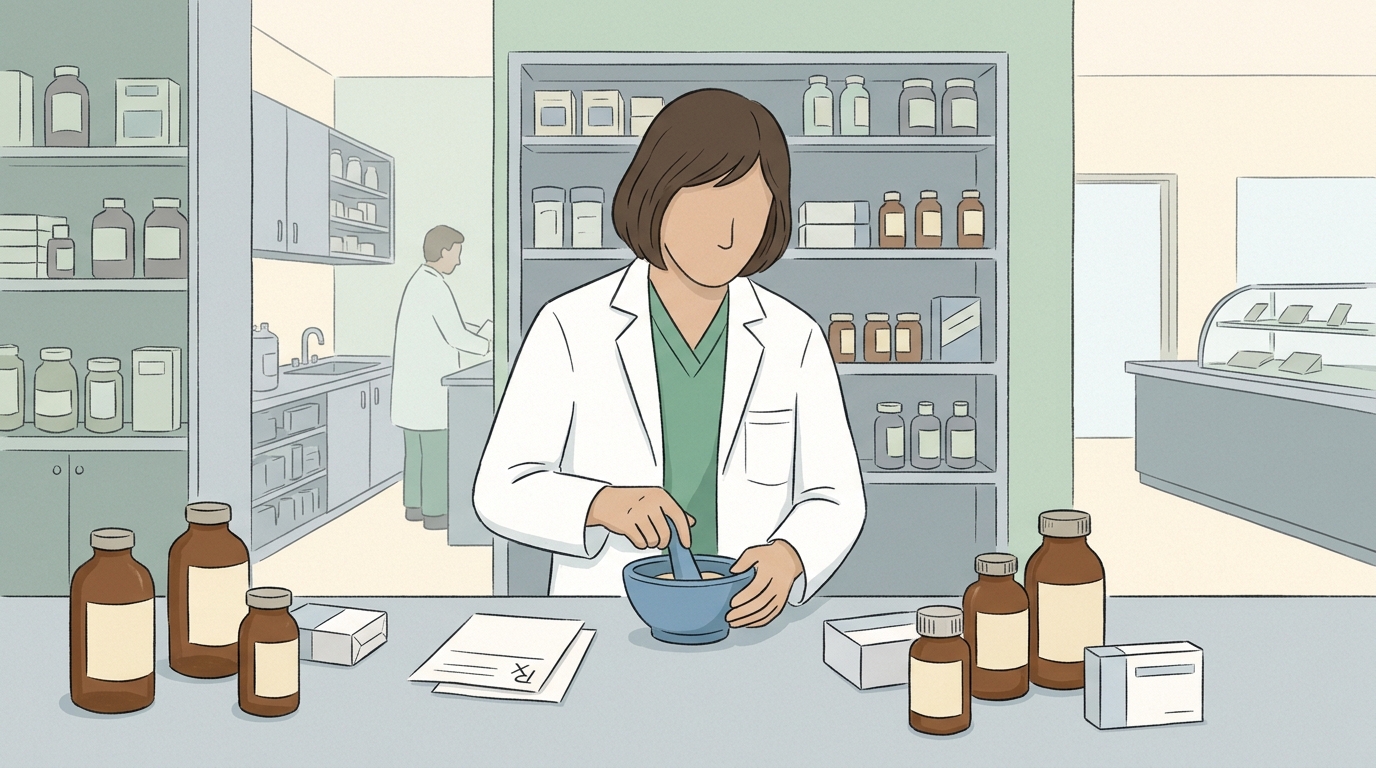
Pharmacy technicians usually need a high school diploma or equivalent and learn the work through on-the-job training, though many complete a postsecondary pharmacy technology program instead (U.S. Bureau of Labor Statistics). Most states regulate the role in some way, and requirements in regulating states typically include some or all of a diploma or GED, a formal training program, an exam, fees, continuing education, and a criminal background check (U.S. Bureau of Labor Statistics).
That means there is no single national path. Your first move is to read your own state board of pharmacy's technician rules, then choose between learning on the job and enrolling in an accredited program.
What This Job Involves Day to Day
You work behind the counter or in a back-of-house prep area under a licensed pharmacist's supervision. Most jobs are in retail and drug store pharmacies, hospital pharmacies, and mail-order or specialty pharmacies, and the pace of a chain drugstore window is very different from a hospital IV room.
A typical shift includes a short list of repeating, concrete tasks (O*NET OnLine, U.S. Department of Labor):
- Receiving and storing incoming supplies, verifying quantities against invoices, checking shelves for outdated medications, and telling the supervising pharmacist what needs reordering.
- Prepacking bulk medicines, filling bottles, and typing and affixing labels.
- Pricing and filing filled prescriptions, and entering inventory data as stock is ordered, labeled, and counted.
- Mixing pharmaceutical preparations according to written prescriptions.
You are on your feet for most of the shift, working to a queue, and you handle patient information and controlled substances, which is why background checks feature in most state rules. Retail pharmacies run evenings and weekends; hospital pharmacies run around the clock, so night and rotating shifts are normal for inpatient roles. Accuracy matters more than speed: every count, label, and data entry is checked by a pharmacist before a prescription leaves the counter.
Step-by-Step Path to Get Started
- Finish high school or earn a GED (4 years, or 2–6 months of GED prep). Pharmacy technicians usually need a high school diploma or equivalent (U.S. Bureau of Labor Statistics), and it is a stated requirement for both Pharmacy Technician Certification Board (PTCB) and National Healthcareer Association (NHA) certification.
- Read your state board of pharmacy's technician rules (1–2 hours). Most states regulate pharmacy technicians in some way, and requirements typically include some or all of a diploma or GED, a formal education or training program, an exam, fees, continuing education, and a criminal background check (U.S. Bureau of Labor Statistics). Find your board through the National Association of Boards of Pharmacy member directory.
- Choose your training route. Either apply for a trainee or technician-in-training position with a retail chain or hospital pharmacy and learn on the job — typically 1 to 12 months of training (CareerOneStop) — or enroll in a postsecondary pharmacy technology program. Programs accredited by the American Society of Health-System Pharmacists (ASHP) include at least 600 hours of instruction over a minimum of 15 weeks (U.S. Bureau of Labor Statistics).
- Complete the program if you took that route (1 year or less for most). Most postsecondary pharmacy technician programs award a certificate after 1 year or less, although some last longer and lead to an associate's degree (U.S. Bureau of Labor Statistics).
- Register or apply for a license with your state board, if required (allow 4–8 weeks for processing). A typical state application is submitted online with a signed and notarized declaration of citizenship, a copy of valid government-issued identification, a criminal background check, and a license fee (CareerOneStop).
- Sit a certification exam (schedule 2–6 weeks out). The Pharmacy Technician Certification Exam (PTCE) has 90 multiple-choice questions — 80 scored and 10 unscored — a time limit of 1 hour 50 minutes, and is administered in person at Pearson VUE test centers (PTCB, as reported by RxTechExam, 2026). Passing it earns the Certified Pharmacy Technician (CPhT) credential (PTCB, as reported by RxTechExam, 2026). The alternative is NHA's Certified Pharmacy Technician (ExCPT) exam.
- Apply to pharmacies with your credential number in hand (2–8 weeks to first offer). Retail chain pharmacies, grocery and big-box in-store pharmacies, hospital pharmacy departments, long-term care pharmacies, and mail-order pharmacies all hire directly through their own careers sites.
- Keep the credential current. Technicians must recertify every 2 years by completing 20 hours of continuing education courses (U.S. Bureau of Labor Statistics).
Education, Certification, and Cost Requirements
| Requirement | Where to Get It | Typical Cost | Typical Time |
|---|---|---|---|
| High school diploma or GED | Public or private high school; state-approved GED testing centers | GED testing fees are set state by state by the state education agency and its testing vendor — check your state's GED page before booking | 4 years of high school; 2–6 months of GED prep |
| ASHP-accredited pharmacy technician program | Community colleges, vocational and technical schools, some hospital pharmacy departments | Tuition is set by the institution and depends on in-district, in-state or out-of-state residency and credit hours; request the program's published tuition schedule | At least 600 hours over a minimum of 15 weeks (BLS); most certificates finish in 1 year or less |
| Associate's degree in pharmacy technology (optional) | Community colleges | Priced per credit hour by the college and by residency status | Longer than 1 year (BLS); commonly 2 years |
| On-the-job training (alternative to a program) | Retail chain, hospital, long-term care and mail-order pharmacies | Paid by the employer | 1 to 12 months (CareerOneStop) |
| PTCB certification (CPhT) via the PTCE | Application through PTCB; exam at Pearson VUE test centers | Application and exam fee set by PTCB — check the current fee on the PTCB site before applying | Exam is 1 hour 50 minutes; allow 2–6 weeks to schedule |
| NHA ExCPT certification | National Healthcareer Association | $129 exam fee (NHA, as reported by Stepful) | Allow 2–6 weeks from application to test date |
| State technician license or registration | Your state board of pharmacy | Application fee set by the board, plus notary and background check fees charged by the state's screening vendor | 4–8 weeks typical processing; renewal every 2 years (CareerOneStop) |
| Criminal background check and fingerprinting | State-designated livescan or screening vendor named by your board | Fee set by the state vendor and billed per applicant | 1–3 weeks for results |
| Recertification | PTCB or NHA continuing education providers | NHA renewal is $55 plus the cost of CE courses (NHA, as reported by Stepful) | 20 hours of continuing education every 2 years (BLS) |
Before You Apply
Have these ready before you send the first application:
- Your high school diploma or GED certificate, or an official transcript, since both PTCB and NHA certification require it (U.S. Bureau of Labor Statistics).
- Your state license or registration number, if your board issues one, printed on the top of your resume next to your name.
- Your CPhT or ExCPT certification number and expiration date — employers verify these directly with PTCB or NHA.
- Proof you meet the NHA eligibility rule if that is your route: you must be at least 18, hold a high school diploma, and have completed a training program or have 1 year of work experience (U.S. Bureau of Labor Statistics). The ExCPT route also accepts 1,200 supervised hours of pharmacy-related work in the last 3 years (NHA, as reported by Stepful).
- A completed background check, plus a copy of valid government-issued identification and a notarized declaration of citizenship if your state's application calls for them (CareerOneStop).
- A one-page reverse-chronological resume naming the pharmacy software you have used, whether you have done sterile or non-sterile compounding, and your insurance claim and third-party billing experience.
- A short list of measurable details from any prior work: daily prescription volume handled, inventory cycle counts completed, and whether you worked a drive-through, drop-off or will-call window.
- Availability in writing, including evenings, weekends and overnights — hospital pharmacies staff 24 hours and ask about this at screening.
- Two supervisor references, ideally including a licensed pharmacist who signed off your training hours.
- Current wage ranges for your metro area from the BLS Occupational Employment and Wage Statistics tables for SOC 29-2052, which publish 10th percentile, median and 90th percentile annual wages, so you can answer a pay expectation question with a researched number.
Frequently asked questions
Do I have to complete a training program, or can I start working first?
Both routes exist. The Bureau of Labor Statistics describes on-the-job training and postsecondary pharmacy technology programs as alternatives, and CareerOneStop reports that people entering the field usually start with no work experience. Whether a trainee can be hired before formal training depends entirely on your state board's rules, so confirm with the board before you apply.
Which exam should I choose, the PTCE or the ExCPT?
The PTCB route asks for a high school diploma and a passing exam score, which makes it workable if you are coming straight from a program. The NHA route sets a minimum age of 18 and accepts a year of work experience in place of a program, which suits someone already employed in a pharmacy. Check which credential your state board and your target employers accept before you pay a fee.
How long does the whole process take from start to first job?
If you train on the job, you can be earning from day one and reach full competence within 1 to 12 months. If you enroll in an accredited program first, plan on at least 15 weeks of instruction, then 4 to 8 weeks for state processing and 2 to 6 weeks to schedule and sit an exam. A realistic end-to-end window for the program route is 6 to 14 months.
What ongoing costs should I budget for after I am certified?
Expect a renewal cycle every 2 years covering both your state credential and your national certification, each billed separately. Continuing education courses are priced by the provider, and some employers pay for them or run approved in-house training. Ask about CE reimbursement during the interview rather than after you accept.
Will a past criminal record stop me from being registered?
A criminal background check is a standard part of state technician applications (CareerOneStop), and boards review records case by case rather than applying one blanket rule. Contact your state board of pharmacy directly before paying application fees and ask how they handle prior convictions. Do not rely on secondhand accounts from other states, because the rules differ.
Sources
- U.S. Bureau of Labor Statistics — Pharmacy Technicians : Occupational Outlook Handbook
- CareerOneStop — Occupation Profile for Pharmacy Technicians

Written by
Marisol steers Jobladderhq's coverage of hiring trends and the strange rituals of modern recruiting. She's drawn to the gap between what job ads promise and what the work actually feels like. Her editing hand favors clarity over jargon, always.