How to Become a Plumber
Most plumbers train through a paid, multi-year registered apprenticeship, then sit a journey-level licensing exam written by their state or city.
Quick answer
- The fastest route is a registered apprenticeship entered straight after high school; a diploma or equivalent is the typical entry-level education and no prior experience in a related occupation is required (U.S. Bureau of Labor Statistics, 2025).
- Apprenticeships combine paid on-the-job training hours each year with classroom technical instruction and typically run about four to five years before you reach journey level (U.S. Bureau of Labor Statistics, 2025).
- Licensing is mandatory in most states and localities and requires experience plus a passing exam score; certifications beyond the license, such as in plumbing design, are optional (U.S. Bureau of Labor Statistics, 2025).
Plumbing is an apprenticeship trade. You enter with a high school diploma or equivalent, no prior related work experience, and learn the job through paid on-the-job training combined with classroom instruction (U.S. Bureau of Labor Statistics, 2025). After the apprenticeship you sit a journey-level licensing exam, and most employers expect you to hold that license (U.S. Bureau of Labor Statistics, 2025).
The path is slow but front-loaded with earnings rather than tuition: you are paid while you train. The rules that matter most — who licenses you, how long your hours must be, what the exam covers — are set at state or local level, so check your own licensing board before you commit to a program.
What This Job Involves Day to Day
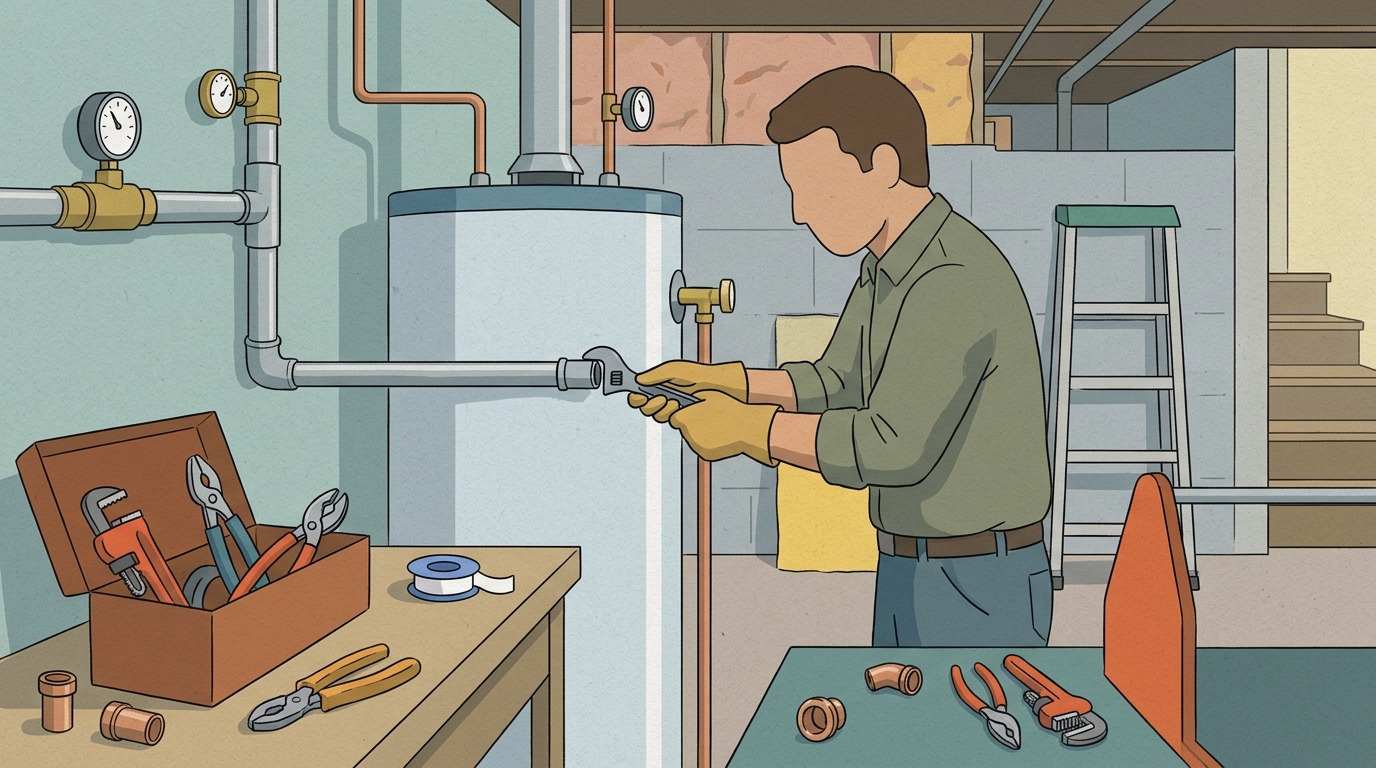
You install and repair the pipe systems that carry water, gas, steam and waste in homes, businesses and industrial plants (U.S. Bureau of Labor Statistics, 2025). A typical day mixes service calls with longer installation work.
Concrete tasks you can expect:
- Shutting off valves and isolating a system before you open it, then locating a leak, blockage or failed fixture (O*NET OnLine).
- Assembling sections of pipe, tube and fittings using methods such as threading, soldering, solvent welding or mechanical couplings, and testing the finished run for leaks and pressure (O*NET OnLine).
- Laying out pipe routes from drawings and specifications, marking walls, floors and ceilings for openings, and installing underground piping on new construction (O*NET OnLine).
- Inspecting and testing existing systems, diagnosing faults, and replacing worn parts in fixtures, water heaters and drainage lines (U.S. Bureau of Labor Statistics, 2025).
The setting is rarely a desk. You work in occupied homes, on construction sites, in mechanical rooms and in trenches, often kneeling, crouching or working overhead. Full-time hours are standard, and because burst pipes and blocked drains do not wait, evening, weekend and on-call emergency work is common in service plumbing (U.S. Bureau of Labor Statistics, 2025). ONET places the occupation in a medium-preparation Job Zone, where most people enter through vocational school, on-the-job experience or an associate's degree rather than a bachelor's degree (ONET OnLine).
Step-by-Step Path to Get Started
- Finish high school or earn a GED, and meet the basic entry bar. A high school diploma or equivalent is the typical entry-level education for the occupation (U.S. Bureau of Labor Statistics, 2025). Apprenticeship sponsors commonly also require you to be at least 18, hold a valid driver's license, and pass a drug screen (SkillUp Coalition). Timeframe: completing a GED usually takes 2 to 6 months of study if you left school early.
- Build the math and shop basics, or take a short pre-apprenticeship. Algebra, measurement and blueprint reading are the skills screening tests actually measure. A community college or trade school plumbing course, or the first level of the four-level NCCER Plumbing credential, gives you that foundation and is a recognized starting point in many training programs (SkillUp Coalition). Timeframe: 3 to 12 months part-time.
- Pick your apprenticeship route. There are three common ones: a union program through a United Association local, a non-union contractor program run through groups such as PHCC or ABC, or trade school first and apprenticeship afterwards (SkillUp Coalition). Apprenticeships for this occupation are generally sponsored by unions and by contractor associations (U.S. Bureau of Labor Statistics, 2025). Timeframe: 2 to 8 weeks of research and local calls.
- Apply to registered programs and sit the entry test. Search the U.S. Department of Labor's apprenticeship.gov listings for registered programs titled 'Plumber' or 'Pipe Fitter (Construction)' (O*NET OnLine), then apply during the sponsor's open intake window. Expect an aptitude test, an interview and a physical. Timeframe: intakes often run once or twice a year, so allow 1 to 6 months between applying and starting.
- Complete the apprenticeship. You work for a contractor under a journey-level plumber and attend related classroom instruction, with paid on-the-job training hours logged each year (U.S. Bureau of Labor Statistics, 2025). Keep your own copy of every signed hour sheet — your licensing board will want it. Timeframe: typically about four to five years.
- Apply to your state or local licensing board and pass the journey-level exam. After completing an apprenticeship you must pass a licensing exam to work as a journey-level plumber (U.S. Bureau of Labor Statistics, 2025). The exam typically tests plumbing code, safety and practical system knowledge, and the license is usually renewed on a fixed cycle, commonly every one to two years (SkillUp Coalition). Timeframe: 4 to 12 weeks from application to results in most jurisdictions.
- Apply for your first journey-level job. Service and repair companies, mechanical and new-construction contractors, facilities and maintenance departments, and public utilities all hire licensed plumbers. Your union local's hiring hall or your training contractor is usually the first call. Timeframe: start applying 4 to 6 weeks before your apprenticeship ends.
- Plan the master plumber step. Master status requires several years of work as a journey-level plumber plus passing another exam, and it is what lets you pull permits and run work in most jurisdictions (U.S. Bureau of Labor Statistics, 2025). Optional certification, such as in plumbing design, sits alongside the license rather than replacing it (U.S. Bureau of Labor Statistics, 2025).
Education, Certification, and Cost Requirements
Costs for this trade are unusually low because the apprenticeship pays you rather than charging you. The figures that do apply — application fees, exam fees, license and renewal fees, tool costs — are set by your state or local licensing board, your apprenticeship sponsor and the program provider, and are published on their fee schedules. Check those pages for current amounts before you apply, because they change between renewal cycles and differ from state to state.
| Requirement | Where to Get It | Typical Cost | Typical Time |
|---|---|---|---|
| High school diploma or GED | Public high school, adult education center, or state GED testing program | Free in public school; GED testing fees are set per state by the testing provider | 4 years of high school, or 2 to 6 months of GED prep |
| Pre-apprenticeship or trade school plumbing course | Community college or technical school | Per-credit tuition published in the college's course catalog; community college rates are lower for in-district residents | 3 to 12 months part-time |
| NCCER Plumbing credential, Levels 1 to 4 | NCCER-accredited training sponsors, including many trade schools and contractor associations | Charged by the training sponsor as course tuition plus module and assessment fees; often covered by employer-sponsored programs | 1 level per training year, stackable over up to 4 years |
| Registered apprenticeship (Plumber or Pipe Fitter, Construction) | United Association locals, PHCC or ABC contractor programs, listed on apprenticeship.gov | No tuition in most registered programs — you are paid for on-the-job hours; expect an application fee and your own hand tools | About 4 to 5 years |
| Journey-level plumber license | State or local plumbing licensing board | Application and exam fees on the board's published fee schedule, plus a renewal fee each cycle | Exam and processing usually 4 to 12 weeks |
| Master plumber license | Same state or local licensing board | Separate application and exam fee on the same schedule | Several years at journey level, plus one exam sitting |
| Driver's license | State DMV | Standard state licensing fee | 1 to 3 months including testing |
Before You Apply
Have these ready before you send an apprenticeship or job application:
- Proof of your high school diploma or GED, and a government-issued ID showing you are 18 or older (SkillUp Coalition).
- A valid driver's license with a clean enough record to be insured on a company service van (SkillUp Coalition).
- Willingness to pass a pre-employment drug screen and, for many commercial and government sites, a background check (SkillUp Coalition).
- Your most recent high school or college math transcript, since aptitude tests lean on algebra, fractions and measurement.
- A one-page resume in reverse-chronological order, led by any physical, mechanical or construction work, with lifting, ladder and confined-space experience spelled out.
- Signed hour sheets from your apprenticeship, totaled by year, if you are applying after training — licensing boards and employers both ask for them.
- Your license or apprentice registration number, the issuing board's name, and the expiry date, written at the top of the resume.
- Any NCCER Plumbing level completions, OSHA construction safety card, or first aid certificate, with the issue dates.
- A short list of tools you already own; service employers often ask what you bring on day one.
- Two references who have supervised you, with current phone numbers — a shop teacher or site foreman counts.
If you are deciding whether the trade is worth the four-to-five-year commitment, read the current projected employment growth and annual openings for plumbers, pipefitters and steamfitters in the Bureau of Labor Statistics Occupational Outlook Handbook (U.S. Bureau of Labor Statistics, 2025).
Frequently asked questions
Can I work as a plumber without doing an apprenticeship?
Some states allow you to log qualifying hours as a registered apprentice or helper under a licensed plumber outside a formal program, but the hours still have to be documented and signed off before you can sit the journey-level exam. A registered apprenticeship is the cleaner route because the sponsor keeps the paperwork the board will ask for. Ask your state licensing board which forms of experience it accepts in writing before you take an unregistered helper job.
How long does it take to go from zero to a paid plumbing job?
You can be earning within weeks of being accepted, because apprentices are paid from their first on-the-job hour rather than after graduation. The longer timeline is to journey level, which is the point at which your pay band and job options change significantly. If you add a trade school course first, add 3 to 12 months before the apprenticeship starts.
What does the journeyman exam cost and what happens if I fail?
Exam and application fees are published by the state or local board that administers the test, and most boards list a separate re-examination fee for retakes. Boards usually set a waiting period of a few weeks before you can retake, and some cap the number of attempts within a 12-month window. Check the candidate handbook on your board's website, which also lists the code edition the exam is based on.
Do I need to buy my own tools before starting an apprenticeship?
Most sponsors issue a required tool list after you are accepted rather than before you apply, and many union locals let first-year apprentices build the kit gradually over 6 to 12 months. Employers normally supply power tools, pipe machines and specialty equipment; you supply hand tools, a tape, levels and personal protective gear. Budget for safety boots and prescription-rated safety glasses in your first month.
Is a license from one state valid in another?
Plumbing licenses are issued by state or local authorities, so moving usually means applying to the new jurisdiction. Some states have reciprocity agreements that accept an equivalent out-of-state license, often requiring proof of hours and a state-specific code exam. Contact the receiving state's licensing board early, since reciprocity applications can take several weeks to process.
Sources
- U.S. Bureau of Labor Statistics — Plumbers, Pipefitters, and Steamfitters : Occupational Outlook Handbook (2025)
- O*NET OnLine — Summary Report for: 47-2152.00 - Plumbers, Pipefitters, and Steamfitters

Written by
Desmond writes about the mechanics of job searching: resumes, interviews, the long silence after applying. He's fascinated by how much of getting hired depends on luck dressed up as skill.