
How to Become a Surgical Technologist
A look at accredited programs, the CST exam, clinical case requirements and what hospitals check before they put you in an operating room.
Quick answer
- The common fastest path is a surgical technology certificate from a program accredited by CAAHEP or ABHES, followed by the CST exam through the National Board of Surgical Technology and Surgical Assisting (NBSTSA).
- Minimum education is a postsecondary nondegree award, and no prior work experience in a related occupation is needed to enter the job (U.S. Bureau of Labor Statistics, 2025).
- Certification is not federally mandated, but employers may require or prefer it and some states regulate surgical technologists, so you must contact your own state licensing agency (U.S. Bureau of Labor Statistics, 2025).
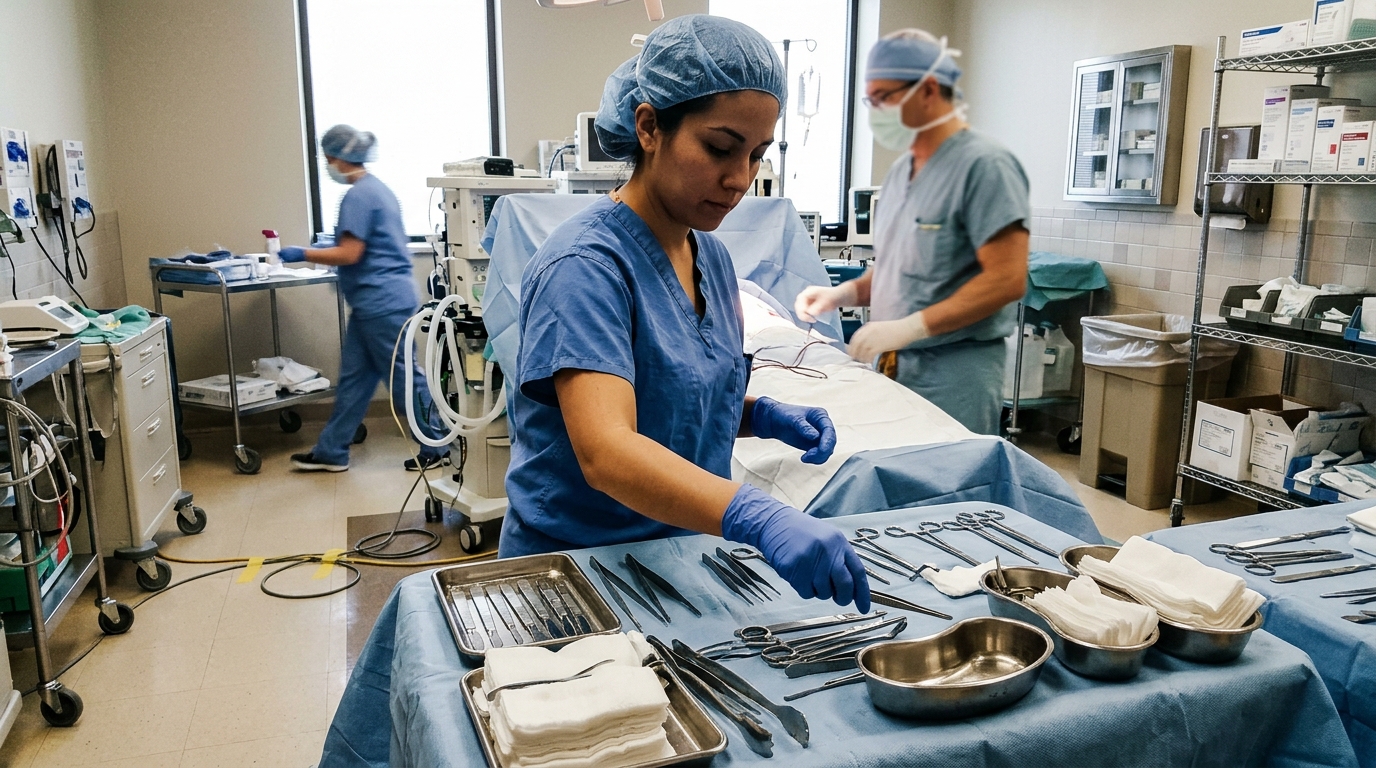
Becoming a surgical technologist usually means completing a certificate or an associate's degree from an accredited surgical technology program, then sitting a certification exam. The U.S. Bureau of Labor Statistics (2025) lists a postsecondary nondegree award as the typical entry-level education, with no prior work experience in a related occupation required, and O*NET OnLine (U.S. Department of Labor, 2025) places the job in Job Zone Three, where preparation usually takes one or two years.
Certification is not mandatory everywhere, but employers may require or prefer it, and some states regulate the work (U.S. Bureau of Labor Statistics, 2025). The practical route is an accredited program, a Certified Surgical Technologist credential, and current basic life support certification.
What This Job Involves Day to Day
You arrive before the first case and set up the operating room: opening sterile supplies, assembling instrument trays and checking that equipment works. Between cases you sterilize and prepare instruments so the room can be turned over for the next procedure (U.S. Bureau of Labor Statistics, 2025).
You also prepare patients for surgery — this includes washing and disinfecting incision sites — and then scrub in to pass instruments and supplies to the surgeon during the procedure (U.S. Bureau of Labor Statistics, 2025). Maintaining the sterile field is a core task, as is counting sponges, needles and instruments before and after an operation so nothing is left behind (O*NET OnLine, U.S. Department of Labor, 2025).
The setting is almost always a hospital operating room. Surgical technologists held about 118,400 jobs in 2025, with the largest share employed in state, local and private hospitals (U.S. Bureau of Labor Statistics, 2025). Outpatient surgery centers and physician and dentist offices make up much of the rest.
Expect scrubs, sterile gowns, gloves, caps and masks, and long periods on your feet (U.S. Bureau of Labor Statistics, 2025). The job carries one of the highest rates of injuries and illnesses of all occupations, largely from sharps, lifting and standing (U.S. Bureau of Labor Statistics, 2025). Many hospital roles include evening, weekend or on-call shifts, because surgery does not stop at the end of the business day.
Step-by-Step Path to Get Started
- Finish high school or earn a GED (weeks to years, depending on where you are starting). If you are still in school, take biology, chemistry and any health science electives. If you need the GED or HiSET, candidates commonly prepare for several weeks to a few months before sitting the subject tests at a state-approved testing center.
- Choose a program accredited by CAAHEP or ABHES (allow a few weeks for research and applications). Graduates of a surgical technology program accredited by the Commission on Accreditation of Allied Health Education Programs or the Accrediting Bureau of Health Education Schools are eligible to sit the CST exam (NBSTSA, as reported by Vivian Health). Search the CAAHEP and ABHES program directories yourself; a program outside those two accreditors can leave you unable to certify. An approved alternative is the Registered Apprenticeship Program titled "Surgical Technologist," vetted by industry and approved by the U.S. Department of Labor and searchable at apprenticeship.gov (O*NET OnLine, U.S. Department of Labor, 2025).
- Clear admission requirements (several weeks). Programs typically ask for a criminal background check, a drug screen, immunization records and a physical exam before any clinical placement begins.
- *Complete the didactic coursework (the classroom portion of a program that ONET OnLine, U.S. Department of Labor, 2025, says usually runs one or two years in total).** Surgical technology education includes anatomy, microbiology and physiology, alongside sterile technique, surgical instrumentation and procedures (U.S. Bureau of Labor Statistics, 2025).
- Complete supervised hands-on clinical training (months of rotations, usually overlapping the coursework). Accredited programs require you to scrub a set number of logged cases across specialties such as general surgery, orthopedics and obstetrics (U.S. Bureau of Labor Statistics, 2025). Keep your own copy of the case log.
- Get CPR or basic life support certification (a course you can finish in one day). Many jobs require CPR or basic life support certification (U.S. Bureau of Labor Statistics, 2025); American Heart Association BLS Provider and American Red Cross Basic Life Support courses are offered at training sites nationwide.
- Apply for and pass the CST exam (apply weeks before you intend to test). The National Board of Surgical Technology and Surgical Assisting grants exam eligibility to graduates of an NBSTSA-recognized surgical technology program, to CSTs renewing by exam, and to graduates of a military surgical technology training program; once approved, the authorization-to-test window is six months (NBSTSA). Many programs let you test in your final term.
- Check your state, then apply (weeks). Some states have regulations governing surgical technologists, so contact your state licensing agency before applying (U.S. Bureau of Labor Statistics, 2025). Then apply directly through hospital system career portals and to ambulatory surgery centers, where most jobs sit (U.S. Bureau of Labor Statistics, 2025); new-graduate OR postings often open months ahead of a cohort start date.
Education, Certification, and Cost Requirements
Cost depends on factors you can price before you enrol: whether you attend a public community college at in-district rates or a private career school, whether you take the certificate or the associate's degree route, and whether an apprenticeship sponsor covers tuition. Pull the current numbers from the school's published tuition and fee schedule, the NBSTSA fee page, and your state licensing agency's fee list before you commit.
| Requirement | Where to Get It | Typical Cost | Typical Time |
|---|---|---|---|
| High school diploma or GED | Public high school; state GED or HiSET testing centers | No tuition for public high school; state testing agencies publish the per-subject GED or HiSET fee | Weeks to years, depending on your starting point |
| Surgical technology certificate (CAAHEP- or ABHES-accredited) | Community colleges, technical colleges, private career schools listed in the CAAHEP and ABHES directories | Tuition and fees on the college's current schedule; in-district community college rates are lowest, private career schools highest | Part of the one-to-two-year preparation O*NET OnLine (U.S. Department of Labor, 2025) describes |
| Associate's degree in surgical technology (alternative route) | Community and technical colleges | Per-credit tuition on the college's schedule, plus general education credits the certificate route skips | Longer than the certificate; usually the upper end of one to two years |
| Registered Apprenticeship — "Surgical Technologist" | Employer sponsors listed at apprenticeship.gov (O*NET OnLine, U.S. Department of Labor, 2025) | Apprentices earn wages while training; ask the sponsor what share of tuition it covers | One to two years of combined training |
| Background check, drug screen and immunizations | Program-designated vendor or your own clinic | Vendor fees billed per screen; immunization costs depend on insurance coverage | Weeks, before clinical placement |
| BLS or CPR certification | American Heart Association or American Red Cross training sites | Course fee set by the individual training center | One day; cards carry a fixed renewal cycle |
| CST exam | National Board of Surgical Technology and Surgical Assisting | Exam fee published by NBSTSA, with a reduced rate for Association of Surgical Technologists members | Apply weeks ahead; six-month authorization-to-test window (NBSTSA) |
| State registration or licensure, where required | Your state licensing agency (U.S. Bureau of Labor Statistics, 2025) | Application fee set by the state | Weeks to process |
| Scrubs, OR shoes, eye protection, textbooks | School bookstore or uniform suppliers | Listed on the program's supply list each term | Before clinicals start |
Before You Apply
Have these ready before you send the first application:
- Your CST certification number and expiration date, placed near the top of your resume, not buried at the bottom. If you have applied but not yet tested, write "CST exam scheduled" with the month.
- A single-page clinical case log summary: total cases scrubbed, cases as first scrub, and a breakdown by specialty such as general, orthopedic, obstetric and vascular. OR managers read this before they read anything else.
- A current BLS or CPR card from the American Heart Association or American Red Cross, with the issue date visible (U.S. Bureau of Labor Statistics, 2025).
- Immunization and health records: hepatitis B series, MMR, varicella, Tdap, annual TB screening and influenza documentation. Hospital occupational health will ask for all of them.
- A completed criminal background check and drug screen, or the readiness to complete one within days of an offer.
- Clinical references — your program's clinical coordinator and a preceptor who watched you scrub — with their current direct phone numbers.
- Proof of graduation from a CAAHEP- or ABHES-accredited program, since that accreditation is what makes you eligible to sit the CST exam (NBSTSA, as reported by Vivian Health) and what many hospital HR screens check first.
- A skills line on your resume naming sterile field maintenance, instrument and sponge counts, specimen handling and room turnover, using the same words the job posting uses (O*NET OnLine, U.S. Department of Labor, 2025).
- An answer to the availability question: whether you can take call, weekends and holidays, and how quickly you can reach the hospital when called in.
- Confirmation from your state licensing agency on whether registration is required before you can work (U.S. Bureau of Labor Statistics, 2025).
Frequently asked questions
Do I need work experience in healthcare before I start?
No. The U.S. Bureau of Labor Statistics (2025) reports that no prior work experience in a related occupation is required to enter this job, and no on-the-job training is typically listed as needed at entry. That said, hospital roles such as sterile processing technician or patient transporter can strengthen a program application and get you familiar with the surgical department.
Is the CST credential legally required to work?
It is not required nationwide, but employers may require or prefer certification, and a number of states have their own regulations for surgical technologists (U.S. Bureau of Labor Statistics, 2025). Because the rules differ by state, ask your state licensing agency directly rather than relying on what a school tells you. Many hospital postings also list CST as a condition of hire or require it within a set number of months after your start date.
How long until I am actually working in an operating room?
O*NET OnLine (U.S. Department of Labor, 2025) classifies this occupation in Job Zone Three, where one or two years of combined training is standard, so that is the span to plan for from your first day of class. Clinical rotations put you in a live OR well before graduation, once you have cleared health and background screening. Add a further stretch of weeks after graduation for applications, interviews and hospital onboarding.
What happens if I fail the CST exam?
You can test again, but eligibility is time-limited: the NBSTSA authorization-to-test window runs six months from approval, and the exam fee applies to each attempt. Budget for a second sitting so a retake does not stall your job search, and check the NBSTSA fee page for the current amount. Most programs run a review course or practice exam in the final term, which is worth using before your window opens.
Can military training count instead of a college program?
Yes. The NBSTSA grants CST exam eligibility to graduates of a military training program in surgical technology, as well as to graduates of NBSTSA-recognized civilian programs. Keep your service training records and case documentation, because you will need them to verify eligibility when you apply to test.
What does this lead to after a few years?
Many technologists move into specialty teams, surgical first assisting, or sterile processing leadership. The U.S. Bureau of Labor Statistics (2025) notes that surgical assistants and technologists may advance to other healthcare occupations such as registered nurse, which usually requires additional education, training, and certification or licensure. If nursing is the goal, check early whether your anatomy, microbiology and physiology credits transfer to a nursing degree.
Sources
- U.S. Bureau of Labor Statistics — Surgical Assistants and Technologists : Occupational Outlook Handbook: : U.S. Bureau of Labor Statistics (2025)
- O*NET OnLine (U.S. Department of Labor) — 29-2055.00 - Surgical Technologists (2025)

Written by
Wyatt covers work outside the office: construction, logistics, repair, and the people who keep things running. He's skeptical of career advice that assumes everyone sits at a desk.