How to Become a Welder Without a Degree
A high school diploma, an employer apprenticeship or a short certificate, and a passed performance weld test can put you on a shop floor without college.
Quick answer
- No degree is required: welders typically need a high school diploma or equivalent plus technical and on-the-job training, and some employers hire inexperienced entry-level workers and train them (U.S. Bureau of Labor Statistics, undated).
- The alternative path runs 10 to 24 weeks for a trade school certificate, 6 to 18 months for a community college certificate, or 3 to 4 years for a registered apprenticeship that pays you while you learn (Western Welding Academy, undated; Welding Headquarters, undated).
- Hands-on metal trades backgrounds transfer best: auto and collision repair, pipefitting or construction labor, and machine operation build the torch control, blueprint reading and fit-up skills employers test for.
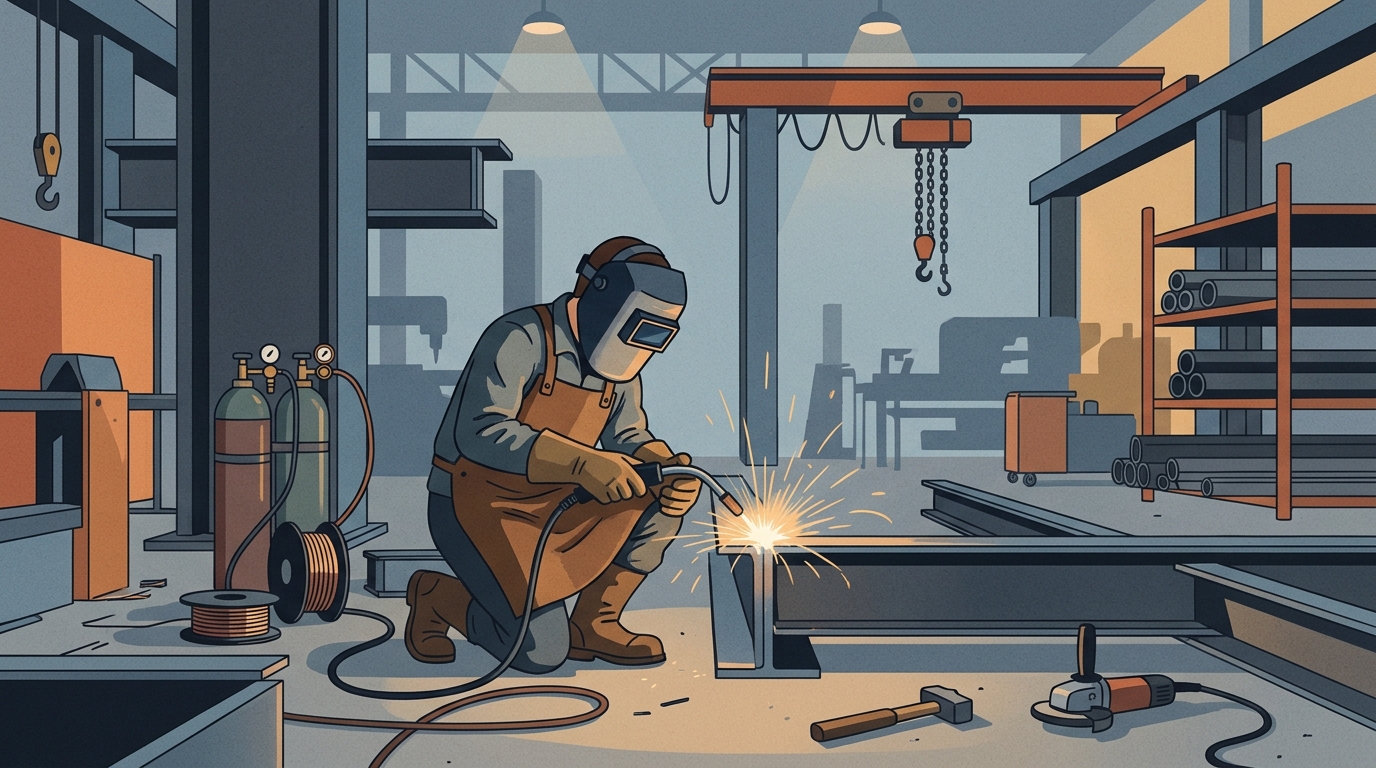
You do not need a college degree to work as a welder. The U.S. Bureau of Labor Statistics (undated) reports that welders, cutters, solderers and brazers typically need a high school diploma or equivalent plus technical and on-the-job training, and ONET classifies the occupation as Job Zone 2: Some Preparation Needed (ONET 31.0 Database, undated).
The realistic no-degree route is a short certificate, an employer-based apprenticeship, or both, finished with a performance-based credential such as the AWS Certified Welder. Employers hire on what you can lay down in a test booth, not on transcripts.
Who Successfully Makes This Transition
Hiring in this trade usually ends with a weld test rather than a transcript review. The U.S. Bureau of Labor Statistics (undated) notes that although some employers hire inexperienced entry-level workers and train them on the job, many prefer applicants who have completed training or credentialing programs — so a hands-on background plus a short credential often outperforms a degree with no shop time.
Auto mechanics and collision repair technicians. You already cut, grind, fit and run a MIG gun on sheet metal, and you read repair diagrams. Fabrication and manufacturing employers accept that because heat control on thin material and clean fit-up are the parts you have drilled for years. The gap is structural plate and pipe, which a certificate program or apprenticeship closes.
Construction laborers, pipefitter helpers and ironworker apprentices. You bring site safety habits, rigging exposure and blueprint familiarity, plus a history of working outdoors in awkward positions. Pipe and structural shops value that, because vertical and overhead work in the 3G, 4G and 6G positions is where most new welders wash out.
Machine operators and maintenance workers. Tolerances, fixtures, quotas and quality rejects are already your vocabulary, and a shop putting you on a repetitive production weld cares that you can hit the same joint hundreds of times without drifting. Add an AWS Certified Welder qualification — which the American Welding Society (undated) says has no educational, certification or minimum experience requirements — and you have documented proof of skill in place of a diploma.
Traditional Path vs. Alternative Path
| Path | Time to Entry | Upfront Cost | Credential Required | Typical Starting Pay |
|---|---|---|---|---|
| Four-year college degree | 4 years (Western Welding Academy, undated) | $30,000 to $160,000 (Western Welding Academy, undated) | Bachelor's degree, plus a passed weld test before production work | Same national scale as everyone else: median $53,750 a year, May 2025 (U.S. Bureau of Labor Statistics) |
| Associate degree in welding technology | About 2 years, 90 to 93 credits (Clackamas Community College, undated) | $10,000 to $30,000 (Western Welding Academy, undated); one listed example is $136 per credit plus fees (Clackamas Community College, undated) | AAS degree, plus a performance qualification for coded work | No separate pay band; entry work starts near the 10th percentile of $36,830 a year (national OEWS estimates, May 2023) |
| Community college welding certificate | 6 to 18 months (Western Welding Academy, undated) | $2,000 to $10,000 (Western Welding Academy, undated) | Certificate of completion, then an AWS Certified Welder qualification or in-house test | Commonly between $36,830 and the $53,750 median, by process, shift and whether work is structural, pipe or production (BLS figures above) |
| Private welding trade school certificate | 10 to 24 weeks (Western Welding Academy, undated) | $5,000 to $35,800 (Western Welding Academy, undated) | Certificate plus a performance qualification test | Same entry range; pipe and rig work sits higher, where the 90th percentile is $72,970 a year (national OEWS estimates, May 2023) |
| Employer-based registered apprenticeship | 3 to 4 years, about 6,000 to 8,000 hours (Welding Headquarters, undated; Trade-Schools.net, undated) | Near zero tuition; you buy boots, hood, gloves and hand tools | Program completion certificate; many sponsors also test you to AWS Certified Welder | Paid from day one as a percentage of the journey rate, stepping up at set hour milestones toward the $53,750 median (U.S. Bureau of Labor Statistics, May 2025) |
Western Welding Academy (undated) notes that welding school graduates start earning full wages three to four years before a four-year college graduate, and an apprentice earns from the first week rather than paying tuition.
Step-by-Step Alternative Path
- Finish the high school diploma or GED. This is the near-universal requirement, since BLS (undated) lists a high school diploma or equivalent as typical entry-level education. If you do not have one, enroll in a GED or HiSET preparation class through your state adult education office or a community college, usually at low or no cost to residents.
- Complete OSHA-required electrical safety training. The Occupational Safety and Health Administration requires welders to complete training on electrical safety (U.S. Bureau of Labor Statistics, undated). An OSHA 10-hour Outreach Training Program card for construction or general industry, taken through an OSHA-authorized trainer, is the version shops recognize.
- Buy supervised torch time with a certificate program. A community college certificate runs 6 to 18 months at $2,000 to $10,000; a private trade school certificate runs 10 to 24 weeks at $5,000 to $35,800 (Western Welding Academy, undated). Ask which processes you will log hours in — SMAW (stick), GMAW (MIG), FCAW (flux-cored) and GTAW (TIG) — and in which positions.
- Apply to registered apprenticeships through CareerOneStop. CareerOneStop, a U.S. Department of Labor resource, is the place to search registered welding apprenticeship programs (Welding Headquarters, undated). Expect at least 144 hours of classroom instruction and at least 2,000 hours of on-the-job instruction per year over 3 to 4 years. BLS (undated) notes some apprenticeships accept entry-level workers with no prior experience or training, so apply even if your only welding has been in a garage.
- Pass the AWS Certified Welder performance test. The program is performance-based with no prerequisite courses (American Welding Society, undated). Book a welder performance qualification test at an AWS-Accredited Testing Facility, then submit the Certified Welder Application (American Welding Society, undated). AWS describes the credential as transferrable and accepted by any welder employer.
- Check licensing where you plan to work. Welders must be licensed in some states and localities, requirements vary, and you should contact the individual state or local licensing agency to confirm (U.S. Bureau of Labor Statistics, undated). BLS also points readers to CareerOneStop's certification finder tool.
- Build a physical portfolio before you apply. Cut and polish test coupons showing penetration, photograph finished projects, and write a one-page list of processes, positions (1G through 6G), base metals and thicknesses you have welded.
What to Have Ready Instead of a Degree
- High school diploma or GED certificate, scanned and ready to attach — the baseline entry education for the occupation (U.S. Bureau of Labor Statistics, undated).
- AWS Certified Welder documentation, including the performance qualification test record from the AWS-Accredited Testing Facility and the processed Certified Welder Application (American Welding Society, undated).
- An OSHA Outreach Training Program 10-hour card, covering the electrical safety training OSHA requires of welders (U.S. Bureau of Labor Statistics, undated).
- Apprenticeship hour records if you are mid-program: on-the-job hours against the 2,000-per-year standard and classroom hours against the 144-per-year standard (Welding Headquarters, undated).
- A process-and-position sheet listing SMAW, GMAW, FCAW and GTAW experience, positions welded, base metals, thickness ranges and any WPS numbers you have worked to.
- Cut and etched test coupons in at least two positions, plus photos of finished fabrication or repair work.
- Two supervisor references from any hands-on job who can speak to attendance, rework rate and safety behavior.
- State or local license documentation where the jurisdiction requires it; confirm directly with that licensing agency (U.S. Bureau of Labor Statistics, undated).
Frequently asked questions
Do employers actually treat a certificate or apprenticeship as equal to a degree?
For production, structural and pipe work the decision usually comes down to a hood test, and the American Welding Society (undated) calls its Certified Welder credential transferrable and accepted by any welder employer. BLS (undated) notes many employers prefer applicants who have finished training or credentialing programs over untrained ones. A degree matters more if you later move toward welding inspection, engineering support or plant management.
Will I earn less long term than a welder who went to college?
Pay tracks process, position, industry and shift rather than diploma type, and everyone draws from the same national scale — a median of $53,750 a year in May 2025 (U.S. Bureau of Labor Statistics). The higher-paying coded pipe, alloy and field jobs are ones you qualify for by passing tests, not by schooling. Skipping tuition also means you are not repaying a $30,000 to $160,000 balance while you build hours.
Is it still worth entering welding if job growth is slow?
Employment is projected to grow 2 percent from 2025 to 2035, slower than the average for all occupations, yet about 40,300 openings are projected each year on average (U.S. Bureau of Labor Statistics, undated). Most come from workers transferring occupations or leaving the labor force, so turnover rather than expansion creates the vacancies. That favors candidates already qualified and able to start quickly.
Can I get hired with no training at all and learn on the job?
It happens: BLS (undated) notes some employers hire inexperienced entry-level workers and train them, and some apprenticeships take people with no prior experience or training. Expect to start on grinding, fit-up, material handling and tacking before running production welds. Turning up with safety training and your own gear improves your odds in that applicant pool.
Sources
- U.S. Bureau of Labor Statistics — Welders, Cutters, Solderers, and Brazers : Occupational Outlook Handbook
- U.S. Bureau of Labor Statistics — Occupational Employment and Wages, May 2023: 51-4121 Welders, Cutters, Solderers, and Brazers (2023-05)

Written by
Priya tracks wages, layoffs, and the slow shifts in what counts as a stable job. She writes for readers trying to make sense of numbers that rarely match their own experience.