How to Get Your CDL
Commercial driving is licensed state by state under federal rules, so the order you work in — medical card, permit, training, road test — sets your pace.
Quick answer
- Heavy and tractor-trailer truck drivers usually have a high school diploma and attend a professional truck driving school, and the entry-level education listed for the job is a postsecondary nondegree award (U.S. Bureau of Labor Statistics, undated and 2025).
- CDL knowledge tests contain at least 30 items and require at least 80 percent correct to pass, and the skills test has three parts: Vehicle Inspection, Basic Controls and Road Test (FMCSA, undated and 2025-12-08).
- CDLs are issued by state governments rather than FMCSA, so fees, renewal cycles and retest rules come from your own state licensing agency (FMCSA, 2025-12-08).
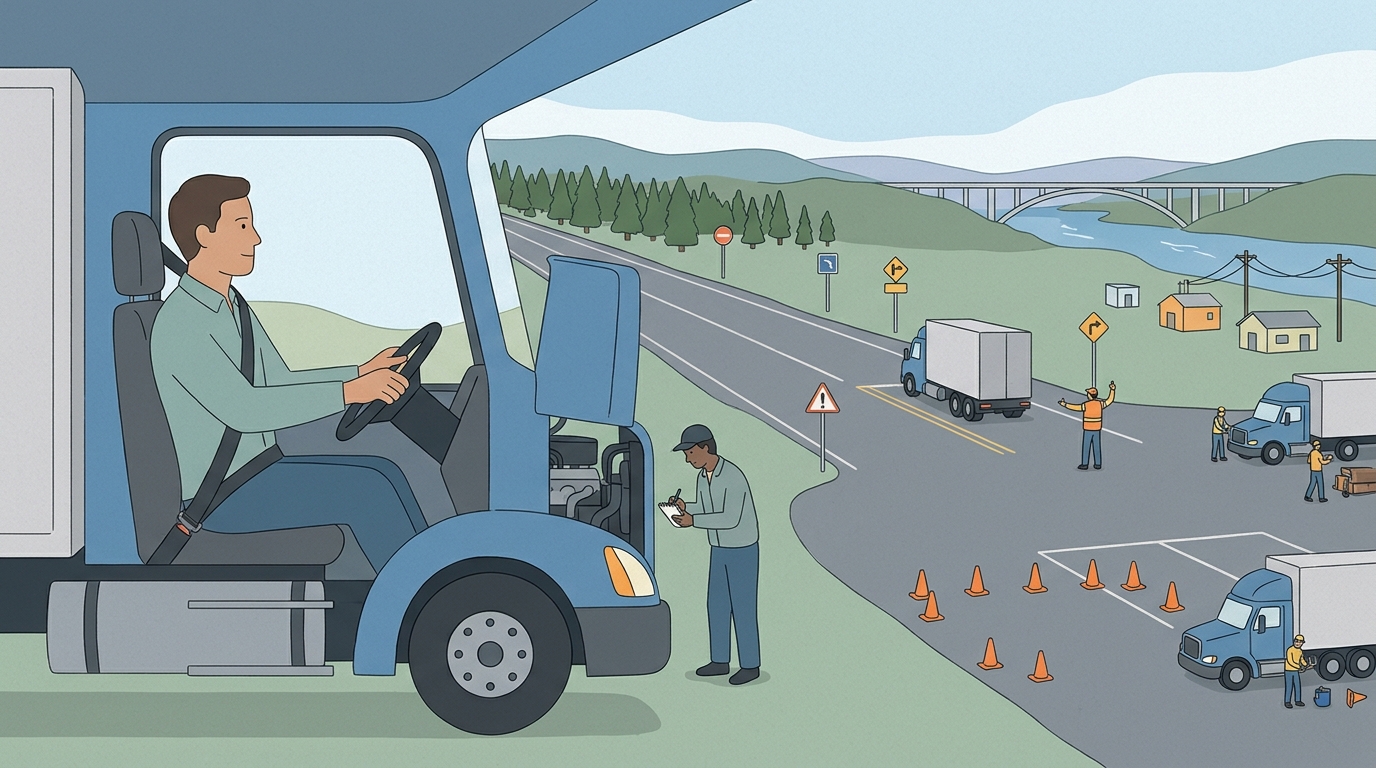
A commercial driver's license is issued by your state licensing agency, not by the federal government — FMCSA sets the rules, but state governments issue CDLs (FMCSA, 2025-12-08). The path runs in a fixed order: qualify medically, pass the knowledge test to get a commercial learner's permit, complete entry-level driver training with a provider on FMCSA's Training Provider Registry, hold the permit at least 14 days, then pass a three-part skills test (FMCSA, 2025-12-08).
There are three classes of CDL plus endorsements for vehicles like school buses, tank trucks and tractor-trailers, and each class and endorsement has its own testing requirement (FMCSA, 2025-12-08).
Why This Credential Matters
A CDL is the legal gate to over-the-road and regional trucking, local heavy delivery, construction and dump work, transit and motorcoach driving, school bus routes, fuel and chemical hauling, and refuse collection. Employers in those fields cannot put you behind the wheel without it.
The rules come from the Federal Motor Carrier Safety Administration, but FMCSA does not issue the license — state governments are responsible for issuing Commercial Driver's Licenses (FMCSA, 2025-12-08). You test and apply through your own state's driver licensing agency, which sets fees, retest waiting periods and the renewal cycle, while the testing and training standards are federal.
To a hiring manager, the license signals three things at once. You cleared a driving record check covering the last 10 years in all 50 states and the District of Columbia (FMCSA, 2025-12-08). You hold a current DOT medical card, which most commercial driving requires, and federal regulations do not allow people with a medical condition such as high blood pressure or epilepsy that may interfere with operating a truck to drive commercially (FMCSA, 2025-12-08; U.S. Bureau of Labor Statistics, undated). And a first-time Class A or Class B license issued since February 7, 2022 means you completed entry-level driver training with a provider on FMCSA's Training Provider Registry (FMCSA, 2025-12-08).
The classroom side is short by design. Heavy and tractor-trailer truck drivers usually have a high school diploma and attend a professional truck driving school, and the listed entry-level education is a postsecondary nondegree award (U.S. Bureau of Labor Statistics, undated and 2025).
Step-by-Step Path to Certification
- Get a DOT physical and your medical certificate. Eligibility for a commercial learner's permit requires proof of medical qualification, and most commercial driving requires a DOT medical card from a DOT physical (FMCSA, 2025-12-08). Book with a medical examiner listed on FMCSA's National Registry of Certified Medical Examiners and bring the card to the DMV.
- Decide the class and endorsements before you test. There are three classes of CDL, with endorsements for specialized vehicles like school buses, tank trucks and tractor-trailers, and each class and endorsement requires a skills test and, in some cases, a written test (FMCSA, 2025-12-08). T for double/triple trailers, N for tank vehicles and H for hazardous materials are knowledge-test-only; P for passenger and S for school bus require both knowledge and skills tests (FMCSA, undated).
- Pass the knowledge test and obtain the commercial learner's permit (CLP). This step also involves the 10-year driving record check across all 50 states and DC, plus payment of state fees (FMCSA, 2025-12-08). There is no federal requirement to complete ELDT theory training before applying for a CLP (FMCSA, 2025-12-08), so you can study the state CDL manual and test first.
- Complete entry-level driver training (ELDT) with a registered provider. Drivers issued a CLP on or after February 7, 2022 for a first Class A or Class B license must complete ELDT with a provider on the Training Provider Registry before testing (FMCSA, 2025-12-08). The program covers theory and behind-the-wheel instruction (J. J. Keller & Associates, undated); ELDT sets no minimum number of training hours, and the provider determines your proficiency (FMCSA Training Provider Registry, 2020-11).
- Hold the CLP at least 14 days and practice with a CDL holder. A CLP holder must wait at least 14 days — longer in some states — before skills testing, and must be accompanied to the testing site by a CDL holder (FMCSA, undated).
- Confirm your training record reached the Registry, then schedule the skills test. A state may schedule a skills test before training is finished, but it may not administer the skills or H knowledge test until the provider submits your training-completion record to the Training Provider Registry and the state accesses it (FMCSA Training Provider Registry, undated).
- Pass the three-part skills test and collect the license. The parts are the Vehicle Inspection Test, the Basic Controls Test and the Road Test (FMCSA, 2025-12-08), performed in a vehicle representative of the type you operate or expect to operate (FMCSA, undated). Test in a manual-transmission vehicle to avoid the 'E' restriction, which is placed on the license when the skills test is taken in a vehicle with automatic transmission (FMCSA, undated).
Exam and License Details
| Detail | Specification |
|---|---|
| Knowledge test | CDL general knowledge test at your state licensing agency; the CLP knowledge test described by FMCSA is a 50-question test (FMCSA, undated) |
| Number of questions | At least 30 items per knowledge test, general or endorsement (FMCSA, undated) |
| Passing score | At least 80 percent correct on general and endorsement knowledge tests (FMCSA, undated) |
| Skills test | Three parts — Vehicle Inspection, Basic Controls, Road Test — with all skills in 49 CFR 383.113 through 383.123 performed successfully (FMCSA, 2025-12-08 and undated) |
| Training requirement | ELDT from a Training Provider Registry provider, no minimum hour count, proficiency certified by the provider (FMCSA Training Provider Registry, undated and 2020-11) |
| Permit holding period | Minimum 14 days between CLP issuance and skills testing, longer in some states (FMCSA, undated) |
| Fees | Set by the state issuing agency, since FMCSA does not issue CDLs; expect separate charges for the CLP, the skills test, each endorsement knowledge test and the license card, plus the DOT physical and school tuition billed privately (FMCSA, 2025-12-08) |
| Retake policy | Set by each state's driver licensing agency, including waiting days between attempts and skills-test retries allowed on one permit — check your state CDL manual |
| Renewal | Term and renewal are handled by the issuing state; your DOT medical certification must be kept current, because medical qualification is a condition of commercial driving (FMCSA, 2025-12-08) |
| License classes | 3 classes, plus endorsements including T, P, N, H, X and S (FMCSA, 2025-12-08 and undated) |
Realistic Timeline
Your pace depends on DMV appointment availability in your state and how your school schedules behind-the-wheel hours, since ELDT sets no minimum number of training hours (FMCSA Training Provider Registry, 2020-11).
- Weeks 1–2: Pass the DOT physical with an examiner on FMCSA's National Registry, pull your own driving history, and start the state CDL manual. Choose your class and endorsements now.
- Week 2 to Month 1: Take the knowledge test and receive the CLP, including the 10-year, 50-state record check and state fees (FMCSA, 2025-12-08). The 14-day clock starts the day the permit is issued (FMCSA, undated).
- Month 1–2: Complete theory and behind-the-wheel instruction with a school on the FMCSA Training Provider Registry (J. J. Keller & Associates, undated). Full-time programs run several weeks; part-time and weekend formats stretch this stage to two or three months.
- Month 2–3: Your provider submits the training-completion record to the Registry. Confirm submission before you drive to the test site, because the state cannot administer the skills test until it accesses that record (FMCSA Training Provider Registry, undated).
- Month 2–4: Sit the three-part skills test in a representative vehicle, accompanied by a CDL holder (FMCSA, 2025-12-08 and undated). Retest scheduling after a failed part is the main reason this window stretches.
- Month 3–5: Receive the CDL from your state agency and add endorsements. First-time School Bus, Passenger or Hazardous Materials endorsements need ELDT before the skills test or the H knowledge test, so budget extra weeks (South Carolina Department of Motor Vehicles, undated).
A focused full-time route commonly lands between two and four months from first DOT physical to license in hand; part-time training pushes it toward five or six.
Frequently asked questions
What will the whole process cost me?
There is no single national price, because state governments issue the license and set their own charges for permits, each test and the card itself (FMCSA, 2025-12-08). Your other two costs are the DOT physical, billed by the certified medical examiner, and tuition at a registered school, which scales with program length. Call your state licensing agency for its current fee schedule and ask two or three registered schools for written tuition quotes before you commit.
I got my commercial learner's permit before February 7, 2022. Do the training rules apply to me?
An applicant who obtained a CLP before February 7, 2022 is not required to complete entry-level driver training, so long as the applicant obtains the CDL before that permit expires (South Carolina Department of Motor Vehicles, undated). If the permit lapses first, you re-enter the current system and the training requirement applies. Check the expiration date printed on the permit and ask your state agency how renewal affects your status.
Does my CDL work if I move to another state?
The license is recognized nationwide for driving, but it is tied to the state that issued it, and FMCSA does not issue CDLs itself (FMCSA, 2025-12-08). After a move you apply to your new state's driver licensing agency to transfer the license and surrender the old one; each state sets its own deadline and document list for that transfer. Contact the new agency before you move so you can bring your medical certificate and record with you.
Sources

Written by
Noor writes personal essays and interviews about career changes, burnout, and starting over. She's interested in the stories people tell themselves about what a job is supposed to mean.