
How to Get Your CNA License
What a state-approved nursing assistant program covers, how the competency exam and state registry fit together, and how long the whole path takes.
Quick answer
- A state-approved nursing assistant program combines instruction in nursing principles with supervised clinical work, and such programs run in high schools, community colleges, vocational and technical schools, hospitals, and nursing homes (U.S. Bureau of Labor Statistics, 2026).
- You earn the credential by passing your state's nursing assistant competency exam, which entitles you to use the state title — CNA in some states, Licensed Nursing Assistant or State Tested Nursing Assistant in others (U.S. Bureau of Labor Statistics, 2026; O*NET OnLine).
- The credential is state-specific: requirements including continuing education and background checks vary by state, and passing places you on that state's registry (U.S. Bureau of Labor Statistics, 2026).
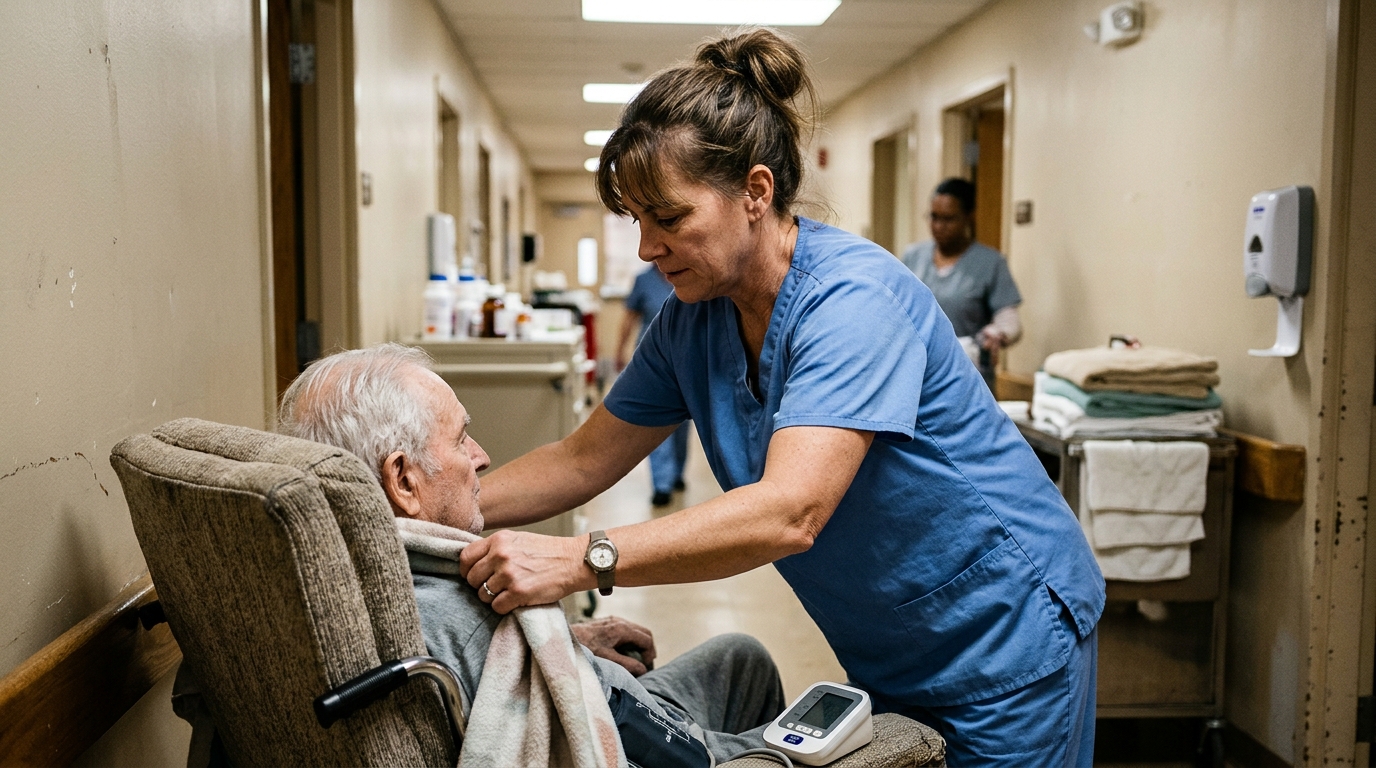
To work as a CNA you complete a state-approved nursing assistant education program and pass your state's competency exam, after which your name goes on the state nurse aide registry (U.S. Bureau of Labor Statistics, 2026). You must be on that registry to work in a nursing home (U.S. Bureau of Labor Statistics, 2026).
Everything else — the title, program length, fees, renewal cycle, and whether continuing education or a criminal background check applies — is set state by state (U.S. Bureau of Labor Statistics, 2026), so check your state registry before paying for anything.
Why This Credential Matters
Nursing assistants typically must complete a state-approved education program and pass their state's competency exam to become licensed or certified (U.S. Bureau of Labor Statistics, 2026). Those who pass are placed on a state registry, and you must be on it to work in a nursing home (U.S. Bureau of Labor Statistics, 2026).
There is no single national CNA board. Licensing is administered at the state level, and ONET points people to CareerOneStop's certification finder and its state-by-state license lookup to find the governing body (ONET OnLine). In practice that is the state agency maintaining the nurse aide registry, usually within the state department of health or public health. Start there, not with a school's advertising.
The title is a state decision too. In some states a nursing assistant is called a Certified Nursing Assistant (CNA), but titles vary by state (U.S. Bureau of Labor Statistics, 2026), and ONET lists reported titles including Certified Nurse Aide, Licensed Nursing Assistant (LNA), Patient Care Assistant (PCA), and State Tested Nursing Assistant (STNA) (ONET OnLine). Listings near you saying STNA or LNA describe the same occupation.
For a hiring manager, registry status answers one question: can this person be assigned direct resident care today. The largest employers are nursing care facilities, hospitals, and continuing care retirement communities and assisted living facilities (U.S. Bureau of Labor Statistics, 2026). In all of them you work under the supervision of licensed practical or vocational nurses and registered nurses (U.S. Bureau of Labor Statistics, 2026), so the credential also signals you have been taught your scope of practice.
By contrast, orderlies typically need a high school diploma or equivalent and short on-the-job training, and do not need a license, though jobs might require CPR or basic life support certification (U.S. Bureau of Labor Statistics, 2026).
Step-by-Step Path to Certification
- Confirm your state's rules first. Use CareerOneStop's state-by-state license lookup and certification finder, which ONET directs users to for Nursing Assistants (ONET OnLine), to identify the agency running your state's nurse aide registry. Download its candidate handbook before enrolling anywhere.
- Meet the entry prerequisites. States and individual programs commonly require a minimum age, proof of identity, and a criminal background check — some states require that check as an explicit condition (U.S. Bureau of Labor Statistics, 2026). Clear health screening and immunization paperwork at the same time, since clinical sites set their own entry conditions.
- Enroll in a state-approved nursing assistant education program. It must appear on your state agency's approved list. Approved programs include instruction on the principles of nursing plus supervised clinical work, offered in high schools, community colleges, vocational and technical schools, hospitals, and nursing homes (U.S. Bureau of Labor Statistics, 2026). A program run by a nursing home or hospital is worth a call, since employers that train often hire from their own cohorts.
- Complete the classroom and supervised clinical hours. Your program issues a completion certificate or training verification form, which the testing vendor or state agency accepts as proof of eligibility. Keep the original and a scan.
- Apply and schedule the nursing assistant competency exam. Submit through the channel your registry names, attach the training verification, pay the posted fee, and book a date and site. Passing is what allows you to use your state's title (U.S. Bureau of Labor Statistics, 2026).
- Pass and confirm your registry listing. Those who pass are placed on the state registry (U.S. Bureau of Labor Statistics, 2026). Look yourself up in the public registry search and keep a screenshot; employers verify it before your first shift.
- Complete employer on-the-job training, then keep the credential current. Nursing assistants typically complete a brief period of on-the-job training to learn their employer's policies and procedures (U.S. Bureau of Labor Statistics, 2026). Then track renewal and any continuing education your state requires (U.S. Bureau of Labor Statistics, 2026), and check whether your state offers the Certified Medication Assistant (CMA) add-on, which allows the holder to dispense medications (U.S. Bureau of Labor Statistics, 2026).
Exam and License Details
Each line below is set by your state's nurse aide registry and its contracted testing vendor, so confirm it against your own state's candidate handbook before applying.
| Detail | Specification |
|---|---|
| Exam name | Your state's nursing assistant competency exam; passing allows use of the state title, CNA in some states and another title elsewhere (U.S. Bureau of Labor Statistics, 2026) |
| Prerequisite | Completion of a state-approved program covering nursing principles plus supervised clinical work (U.S. Bureau of Labor Statistics, 2026) |
| Number of questions and format | Published by the state agency and its testing vendor in the candidate handbook, covering the knowledge and skills portions |
| Passing score | Set by the state and listed in the same handbook; both portions must be passed for registry placement |
| Fee amount | A set dollar amount published by your state registry or testing vendor, usually itemized for the knowledge portion, skills portion, retest, and registry processing; check the current fee schedule |
| Retake policy | Permitted attempts and waiting periods are set by the state; some cap how long after program completion you may test before retraining |
| Outcome of passing | Placement on the state nurse aide registry, required to work in a nursing home (U.S. Bureau of Labor Statistics, 2026) |
| Renewal requirement | State-specific; some states require continuing education, some a criminal background check (U.S. Bureau of Labor Statistics, 2026) |
| Optional add-on | Certified Medication Assistant (CMA), available in some states, allowing the holder to dispense medications (U.S. Bureau of Labor Statistics, 2026) |
Realistic Timeline
Program length is set by your state and your school, so treat this as a planning frame and replace each range with the dates your program publishes.
- Month 1: Identify your registry through the CareerOneStop lookups ONET points to (ONET OnLine), read the requirements page, and shortlist approved programs at community colleges, vocational and technical schools, hospitals, and nursing homes (U.S. Bureau of Labor Statistics, 2026). Apply, start the background check, and book health screening.
- Month 1–3: Complete classroom instruction in nursing principles and the supervised clinical hours (U.S. Bureau of Labor Statistics, 2026). Full-time programs often finish inside this window; part-time and evening cohorts run longer.
- Month 3–4: Collect your training verification, submit the exam application, pay the fee, and schedule a date. Allow 2 to 6 weeks between applying and sitting, since dates at a given site fill up.
- Month 4: Sit the knowledge and skills portions. Passing adds your name to the state registry (U.S. Bureau of Labor Statistics, 2026); if you do not pass, book a retake inside your state's permitted window.
- Month 4–5: Apply to nursing care facilities, hospitals, and assisted living and continuing care retirement communities, the industries employing the most nursing assistants (U.S. Bureau of Labor Statistics, 2026), and expect a brief period of on-the-job training on employer policies (U.S. Bureau of Labor Statistics, 2026).
- Month 6 onward: Work under the supervision of licensed practical or vocational nurses and registered nurses (U.S. Bureau of Labor Statistics, 2026), log continuing education, and diarize your renewal date. ONET places nursing assistants in Job Zone Three, where employees usually need one or two years of on-the-job experience and informal training with experienced workers (ONET OnLine).
Frequently asked questions
Can I transfer my CNA credential to another state?
There is no automatic nationwide transfer, because specific requirements differ from state to state (U.S. Bureau of Labor Statistics, 2026). The receiving state's nurse aide registry decides whether to accept your listing through reciprocity or endorsement, and may ask for a new background check or extra training. Contact that registry before you move and ask what proof of standing it wants.
What does the whole process cost?
Budget for three things: tuition for the approved program, the testing and registry charges published by your state, and incidentals such as immunizations, scrubs, and a watch with a second hand. Hospitals and nursing homes running their own approved programs sometimes cover training or testing costs for people they hire. Workforce agencies listed through CareerOneStop can point you to local funding.
What happens if my credential lapses?
Each state sets its own consequence, ranging from a reinstatement application to repeating the approved program and competency exam. States commonly tie renewal to a minimum amount of paid nursing-related work within the cycle, and some add continuing education or a criminal background check (U.S. Bureau of Labor Statistics, 2026). Review your registry's inactive-status rules before your expiry date, not after.
Do I need a separate certification to give medications?
In some states, nursing assistants may earn an additional credential, Certified Medication Assistant (CMA), which allows them to dispense medications (U.S. Bureau of Labor Statistics, 2026). It involves a separate course and assessment, and it is not offered everywhere. Ask your state registry whether the CMA exists where you work and what work history it requires first.
Sources
- U.S. Bureau of Labor Statistics — Nursing Assistants and Orderlies: How to Become One — Occupational Outlook Handbook (2026)
- O*NET OnLine (National Center for O*NET Development) — 31-1131.00 - Nursing Assistants

Written by
Wyatt covers work outside the office: construction, logistics, repair, and the people who keep things running. He's skeptical of career advice that assumes everyone sits at a desk.