
How to Prepare for a Medical Assistant Interview
Most medical assistant interviews test clinical skills and front-desk judgment in the same hour, so prepare for the exam room and the waiting room both.
Quick answer
- One week out, spend 40 minutes reading the job posting line by line against the employer's own website, and write one example from your work for each duty listed.
- Four days out, log in to your certifying body's portal (AAMA, AMT, NHA or NCCT) and write down your exact certification number and expiry date.
- The night before, print three résumé copies, lay out your outfit, and time the drive so you arrive 10 to 15 minutes early (CareerOneStop, U.S. Department of Labor, undated).
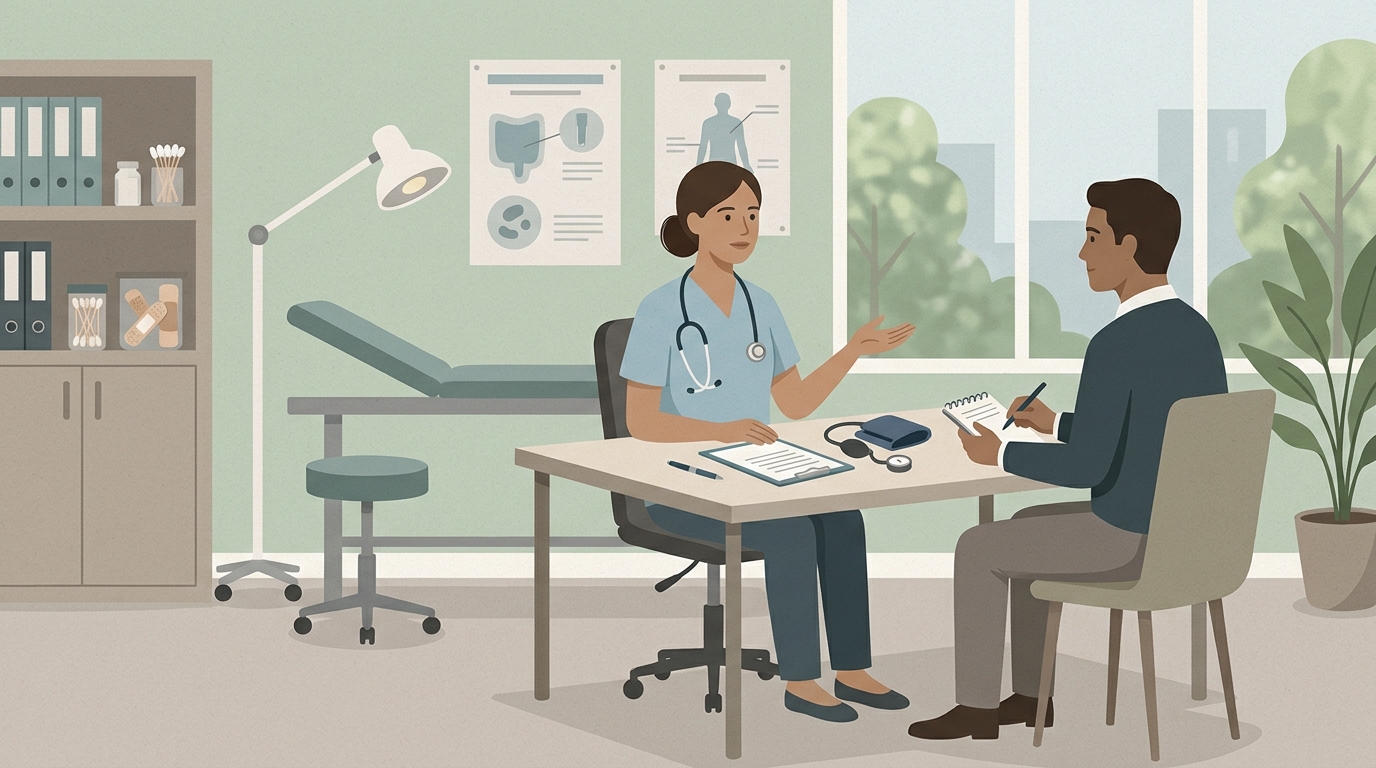
Preparing for a medical assistant interview comes down to three things: documented proof of your training and certification status, short stories that show how you handle patients and paperwork, and the logistics of the day itself. Medical assistants held about 833,900 jobs in 2025, and the job outlook for 2025-35 is much faster than average (U.S. Bureau of Labor Statistics, 2025) — but a busy clinic still interviews carefully, because the person they hire takes histories and vital signs for every patient who walks in (U.S. Bureau of Labor Statistics, undated).
This guide gives you a dated prep timeline, a physical checklist for the morning of, and wording for the moments that catch people out.
Your Prep Timeline
Work backwards from the interview date. Each step below is a task you can finish in one sitting.
- One week before — research the employer and the posting (40 minutes). CareerOneStop (U.S. Department of Labor, undated) advises researching the employer and job so you can answer questions, show enthusiasm, and form questions of your own. Open the job posting in one window and the practice's website in another. Write down the specialty, the number of providers listed on the staff page, the patient population, and the electronic health record named in the posting. Then list every duty in the posting and write one line beside each describing when you last did it.
- Six days before — confirm your credential in writing (20 minutes). Reported job titles for this occupation include Certified Medical Assistant (CMA) and Registered Medical Assistant (RMA) (ONET OnLine, undated). National certification exams include the CCMA from the National Healthcareer Association, the CMA (AAMA), the RMA from American Medical Technologists, and the NCMA from NCCT (U.S. Career Institute, undated). Renewal periods differ: the CMA (AAMA) renews every five years through continuing education or re-examination, the RMA renews every three years, and the CCMA is valid for two years (ONET OnLine and DOD COOL, undated). Log in, screenshot your status, and note the expiry date on your prep sheet.
- Four days before — draft six STAR stories (45 minutes). Situation, Task, Action, Result, each with a real number. Cover a difficult patient, a charting error, a back-to-back schedule, a sterile or clinical procedure, a phone or scheduling conflict, and a time you asked a provider for help. Medical assistants typically complete a postsecondary certificate program or an associate's degree (U.S. Bureau of Labor Statistics, undated), so if your examples come from an externship, say so plainly and give the hours.
- Two days before — rehearse scope-of-practice answers out loud (30 minutes). What you may do varies by state and by employer. Oregon, for example, does not license medical assistants, but most employers prefer certification and require it to give injections or medications (U.S. Career Institute, undated). Check your own state health or medical board's website for the current rule, and practise saying what you have done, under what supervision, and what you would confirm first.
- The day before — assemble the physical kit (45 minutes). Print three résumé copies, your certification card or printout, and your reference list. Pack a notebook and two pens (CareerOneStop, U.S. Department of Labor, undated). Lay out clean, pressed clothes appropriate to the job (CareerOneStop, undated). Drive or ride the route at roughly the same time of day and note the parking.
- The morning of — leave with a 15-minute buffer (90 minutes before). Plan your schedule so you arrive 10 to 15 minutes early in person, or are ready to sign on 10 to 15 minutes early if the interview is online (CareerOneStop, U.S. Department of Labor, undated). Go to the interview by yourself (CareerOneStop, undated); if someone drives you, have them wait in the car.
Day-Of Checklist
Tick each item physically before you leave the house.
- Three printed résumé copies in a folder, unfolded and uncreased.
- Your certification card or portal printout showing your number and expiry date.
- A printed reference list with three names, job titles, and current phone numbers you have confirmed this month.
- A notebook and two working pens (CareerOneStop, U.S. Department of Labor, undated).
- Photo ID and, if the posting asked for them, immunization or TB test records in a sealed envelope.
- Outfit laid out the night before: clean, pressed, closed-toe shoes, hair tied back, nails short and unpolished.
- Phone charged to full and switched to silent before you enter the building — not vibrate.
- Route timed and parking confirmed, with departure time set as an alarm so you arrive 10 to 15 minutes early (CareerOneStop, undated).
- The interviewer's name, the room or suite number, and a direct phone number written on paper, not only in your phone.
- Three written questions for the interviewer in your notebook, about the patient volume, the EHR, and the training period.
What to Say in Tricky Moments
Say these out loud twice before the day so the wording is already in your mouth.
Checking in at the front desk
"Good morning, I'm Dana Alvarez. I have a 10:30 interview with Ms. Reyes for the medical assistant position. I'm a little early, so I'm happy to wait here."
"Tell me about yourself."
"I've been a medical assistant in a four-provider family practice for two years. I room about 30 patients a day, take vitals, and chart in the EHR. I applied because you're expanding pediatrics."
"Tell me about a mistake you made."
Situation: I mislabeled a urine specimen during a busy flu clinic. Task: fix it fast. Action: I voided the label, recollected, and told the provider within five minutes. Result: no lab error, and we added a two-person label check.
"Can you give injections?"
"I've given intramuscular and subcutaneous injections under direct supervision during my externship, and I hold the CCMA. I'd confirm your protocols and this state's rules before working independently."
If pay comes up before an offer
"I'd rather focus today on whether I'm the right fit for the role. If you make an offer, I'm glad to talk through pay and benefits then."
CareerOneStop (U.S. Department of Labor, undated) advises avoiding questions about pay and benefits until a job is offered. Before that conversation happens, check the posted range on the employer's own careers page and the occupational pages published by the U.S. Bureau of Labor Statistics for current rates in your area.
Asking about next steps
"Thank you, this was helpful. What does your timeline look like for the next stage, and is there anything else you'd like from me — certification documents, references, or a skills check?"
Frequently asked questions
How early should I arrive?
Ten to fifteen minutes early (CareerOneStop, U.S. Department of Labor, undated). For an online interview, be ready to sign on 10 to 15 minutes early. If you arrive earlier than that, wait in the car and walk in at the 15-minute mark.
What should I bring?
A notebook and pens for writing down information (CareerOneStop, U.S. Department of Labor, undated), three printed résumé copies, your certification card or portal printout, photo ID, and a written reference list with three confirmed phone numbers.
Can my partner or a friend come with me?
No. Go to the interview by yourself (CareerOneStop, U.S. Department of Labor, undated). If someone drives you, ask them to wait in the car rather than in the waiting room, which is a clinical space for patients.
Should I wear scrubs or business clothes?
Dress in a manner appropriate to the job (CareerOneStop, U.S. Department of Labor, undated). Unless the scheduler tells you a hands-on skills check is planned, wear pressed business casual with closed-toe shoes. Call the office the week before and ask directly.
Sources
- U.S. Bureau of Labor Statistics — Medical Assistants : Occupational Outlook Handbook
- O*NET OnLine — 31-9092.00 - Medical Assistants

Written by
Marisol steers Jobladderhq's coverage of hiring trends and the strange rituals of modern recruiting. She's drawn to the gap between what job ads promise and what the work actually feels like. Her editing hand favors clarity over jargon, always.