How to Switch to a Career in Insurance Sales, Step by Step
A month-by-month route from first research to a licensed first year on commission, written for people making the move after 40 while still drawing a paycheck.
Quick answer
- Total timeline: 4 to 8 weeks to get licensed (Xcel Solutions), inside a realistic 6 to 12 months from first research to a steady first year.
- Total cost: four separate items for a life and health license — pre-licensing education, exam fee, state application fee, and fingerprinting/background check (PracticeTestGeeks) — plus 20 to 40 hours of pre-licensing education per line of authority (SmartChoice Agents) and 24 hours of continuing education every two years, including ethics (Ritter Insurance Marketing).
- Biggest risk: the income gap. Commission-only roles (U.S. Bureau of Labor Statistics, May 2025) mean renewals are months away, so bank at least 6 months of fixed expenses before you resign.
Switching into insurance sales is one of the shorter licensed-career transitions available to someone already working: the U.S. Bureau of Labor Statistics (2025) says agents must hold a license in the states where they work, and most people go from a standing start to licensed and working in 4 to 8 weeks once they choose a line of authority, finish any pre-licensing education, and pass the state exam (Xcel Solutions). The longer part is income. Pay is commonly commission-only for independent agents, or salary, salary plus commission, or salary plus bonus for agents employed by an agency or carrier (U.S. Bureau of Labor Statistics, May 2025) — so the realistic plan runs 6 to 12 months from research to a stable first year, not 8 weeks.
This guide maps the stages, the steps you can do while still employed, what to confirm before you resign, and what the credential path costs in time.
The Transition Timeline
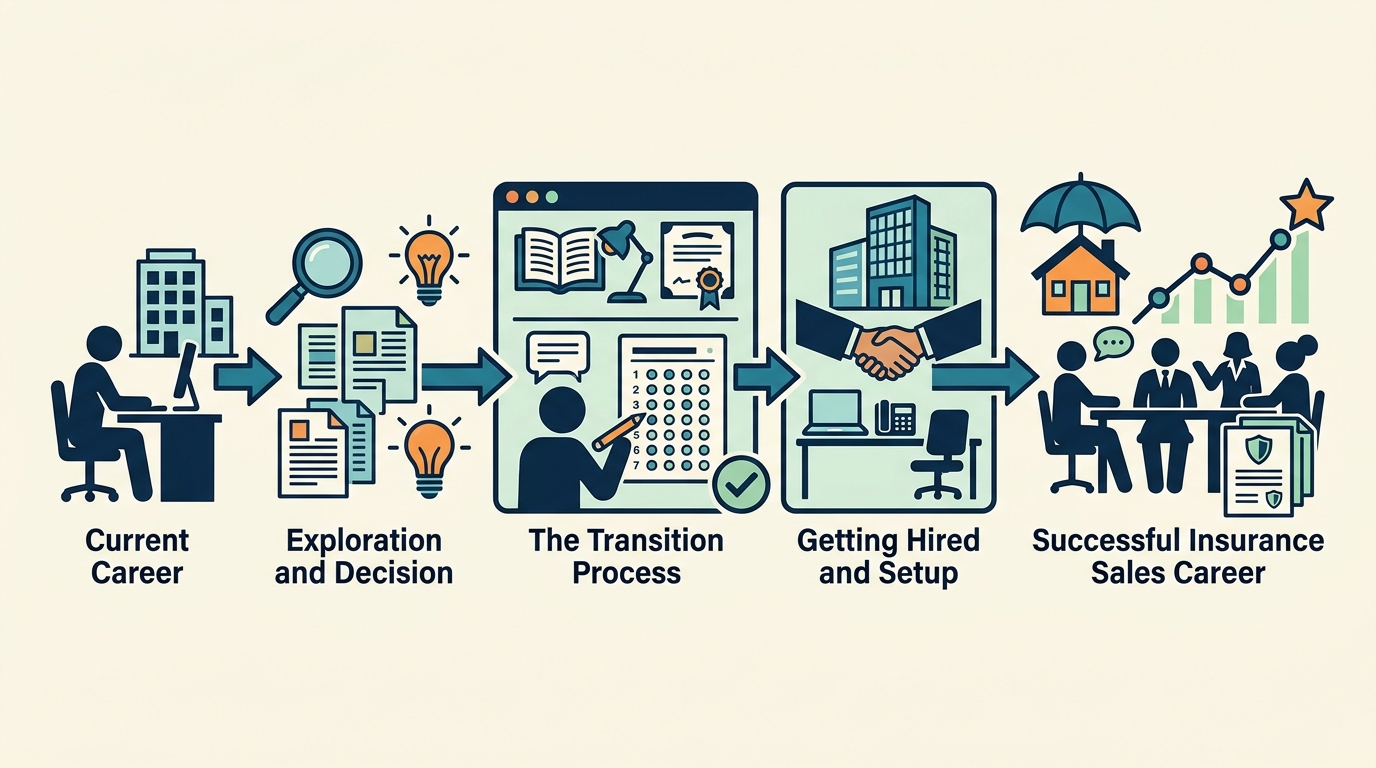
Six stages, assuming you stay in your current job until the license is in hand. Compress or stretch them to fit your state's rules and your savings.
- Months 1-2 — Still employed, researching. Decide which line of authority you want: Life, Accident and Health, or Property and Casualty, or both. Read your state department of insurance's candidate handbook and exam content outline. Confirm whether your state requires pre-licensing education at all — most do, but Texas, Arizona, Louisiana and South Carolina do not (Aceable).
- Months 2-3 — Pre-licensing education, evenings and weekends. Most states require 20 to 40 hours per line of authority (SmartChoice Agents). Done around a full-time job, that is usually two to four weeks of real calendar time.
- Months 3-4 — Exam, application, license issued. Sit the state exam; the passing score is typically 70% (SmartChoice Agents). Apply through the state's portal or, in most states, the National Insurance Producer Registry (NIPR) or Sircon (Insurance Exam Practice). Fingerprinting and a background check are usually part of the application.
- Months 4-6 — Interviews and appointments, still employed. Talk to captive carriers, independent agencies and brokerages. Ask directly how each one pays: commission only, salary only, salary plus commission, or salary plus bonus (U.S. Bureau of Labor Statistics, May 2025). Get a carrier appointment or a written offer before you resign.
- Months 6-9 — First 90 days in the new role. You leave the old job at the start of this stage. Expect product training, a prospecting quota, and your first policies written. Commission on new business often pays a month or more after the sale, so this is where the runway you saved gets spent.
- Months 9-18 — First full year and renewals. Your book starts generating renewal income, your pipeline stops being cold, and your first continuing education cycle begins: most states require 24 hours every two years, including an ethics component (Ritter Insurance Marketing). Designations like CPCU belong here, not earlier.
Total, realistically: 6 to 12 months from first research to a steady first year.
Step-by-Step Plan
- While employed — pick your line of authority. Life and health suits people who like long consultative conversations; property and casualty suits people who like volume and renewals. Your choice sets your pre-licensing hours, your exam, and which agencies will talk to you.
- While employed — download your state's candidate handbook. It is free on the department of insurance website and tells you the exam fee, the application fee, the fingerprinting requirement, and whether pre-licensing education applies. Some states require an occupational license with details that vary state to state (CareerOneStop).
- While employed — enroll in a state-approved pre-licensing course. Budget 20 to 40 hours per line of authority (SmartChoice Agents) and book the exam date before you start, so the course has a deadline.
- While employed — sit the exam and apply. Aim comfortably above the typical 70% pass mark (SmartChoice Agents). File through the state portal, NIPR or Sircon (Insurance Exam Practice) the same week you pass, because fingerprinting and background checks add days to weeks.
- While employed — translate your current job into agency language. A retail store manager has run a sales floor to a target. An elementary teacher has explained complicated rules to anxious people all day. A restaurant general manager has handled scheduling, payroll and angry customers. A bank teller, a nurse, a military logistics NCO — all of these carry something an agency owner recognizes. Write two or three concrete examples before your first interview.
- While employed — interview and compare pay structures in writing. Ask every agency for the structure, the draw if any, the chargeback rules, and who owns the book if you leave. BLS (May 2025) notes independent agents may be commission only, while agency or carrier employees may be on salary, salary plus commission, or salary plus bonus — those are very different risks.
- Before you resign — accept an offer and confirm your carrier appointment. A license alone does not let you sell a specific carrier's products; the appointment does. Do not give notice until that is confirmed.
- After leaving — treat the first 90 days as training plus prospecting. Block calling time daily. Tell former colleagues, neighbors and community groups what you now do; warm contacts are the fastest first policies for a career changer.
- After leaving — add a second line of authority if your market needs it. A life agent adding property and casualty, or the reverse, widens what you can quote without another job change.
- After leaving, month 9 onward — start continuing education and consider a designation. CE is mandatory: 24 hours every two years including ethics in most states (Ritter Insurance Marketing). CPCU is optional and long.
Before You Quit Your Job Checklist
Each item is a yes or no. If any answer is no, you are not ready to give notice.
- [ ] You have at least 6 months of fixed expenses saved in cash, and you have written down the monthly number. Commission-only pay (U.S. Bureau of Labor Statistics, May 2025) means new-business income can lag the sale by weeks.
- [ ] Your state license has been issued, not just applied for, and you have the license number.
- [ ] You have confirmed every state where you intend to sell requires a license and you hold it there — BLS (2025) is explicit that agents must be licensed in the states where they work, and CareerOneStop notes details vary by state.
- [ ] Your fingerprinting and background check are cleared and closed out, not pending.
- [ ] You have a signed offer that states the pay structure in writing: salary, salary plus commission, salary plus bonus, or commission only.
- [ ] Your carrier appointment is confirmed by the agency or carrier, in writing.
- [ ] You know your continuing education obligation and renewal date — in most states, 24 hours every two years with an ethics component (Ritter Insurance Marketing).
- [ ] You have a backup income plan you could start within two weeks: part-time work in your old field, contract work, or a spouse's coverage of fixed costs for 6 months.
- [ ] Health insurance for your household is arranged from your start date, not your end date.
- [ ] You have listed 50 warm contacts by name. If you cannot reach 50, your first 90 days will be colder than you expect.
Certifications and Costs
Fees are set by your state, the exam vendor, and the course provider, so check current amounts before you enroll rather than budgeting from an estimate.
| Requirement | Provider or Path | Cost | Time to Complete |
|---|---|---|---|
| Candidate handbook and exam content outline | Your state department of insurance website | Free | 1-2 hours to read |
| Pre-licensing education, 20-40 hours per line of authority (SmartChoice Agents) | State-approved online or classroom provider; not required in Texas, Arizona, Louisiana or South Carolina (Aceable) | Set by provider; some carriers cover or reimburse it for new hires | 2-4 weeks part-time around a job |
| State licensing exam, e.g. Life, Accident and Health, or Property and Casualty | State's contracted exam vendor | Exam fee set by the state; ranges by state (SmartChoice Agents) | One sitting; pass mark typically 70% |
| License application, fingerprinting and background check | State portal, NIPR or Sircon (Insurance Exam Practice) | Application fee plus fingerprint vendor fee — one of four cost items for a life and health license (PracticeTestGeeks) | Days to a few weeks after passing |
| Continuing education, 24 hours every two years including ethics (Ritter Insurance Marketing) | State-approved CE providers | Priced per hour or as a bundle; varies by state | 24 hours per 2-year cycle |
| CPCU designation — eight courses and exams plus an ethics requirement (QuoteSweep) | Self-study while working full time | Exam fees, study materials and a one-time matriculation fee (QuoteSweep) | 18-24 months part-time; three years of qualifying experience required to receive the designation (AB Training Center) |
| Series 7, the main FINRA license for general securities sales representatives (Apprenticeship.com) | FINRA, through a sponsoring firm | Exam fee set by FINRA | Months of study, usually after you are established |
Frequently asked questions
Can I get licensed without quitting my current job?
Yes, and you should. The Months 2-3 stage — 20 to 40 hours of pre-licensing education per line of authority (SmartChoice Agents) — is designed to be done evenings and weekends, and people commonly go from standing start to licensed in 4 to 8 weeks (Xcel Solutions). Keep your paycheck until the checklist item "license issued, not applied for" is a yes.
I'm 55. Will agencies actually hire a career changer my age?
The honest concern for the 50-64 range is that a hiring manager assumes you will not prospect hard or will retire in three years, so answer both in the Months 4-6 interview stage before they ask. Name the specific book of relationships you bring — 20 years as a retail manager, a teacher known to several hundred local families, a nurse trusted by colleagues — and say plainly how long you intend to work. Insurance sales rewards an existing local network more than most entry paths, and the U.S. Bureau of Labor Statistics (2025) publishes a 2025-35 employment projection for the occupation that is worth checking before you commit.
How long until commission replaces my old paycheck?
Plan on the Months 6-18 stretch, not the first quarter. New-business commission typically pays weeks after a policy is written, and renewal income only becomes meaningful once you have a year of policies behind you — which is why the checklist asks for at least 6 months of fixed expenses in cash and a backup income plan you could start within two weeks. Ask any agency you interview whether the role is commission only or salary plus commission (U.S. Bureau of Labor Statistics, May 2025), because that single answer changes your runway requirement.
Do I need CPCU or a Series 7 to get started?
No. The license is the requirement (U.S. Bureau of Labor Statistics, 2025); the designations come later. CPCU takes eight courses and exams plus an ethics requirement, 18 to 24 months of part-time study while working full time (QuoteSweep), and three years of qualifying insurance experience before the designation is awarded (AB Training Center). The Series 7, the main FINRA license for general securities sales representatives, is most common among life agents who later sell variable annuities and mutual funds (Apprenticeship.com) and usually requires firm sponsorship.
Sources
- U.S. Bureau of Labor Statistics — Insurance Sales Agents : Occupational Outlook Handbook (2025)
- U.S. Bureau of Labor Statistics — Insurance Sales Agents : Occupational Outlook Handbook (2025-05)

Written by
Marisol steers Jobladderhq's coverage of hiring trends and the strange rituals of modern recruiting. She's drawn to the gap between what job ads promise and what the work actually feels like. Her editing hand favors clarity over jargon, always.