How to Switch to a Career in Pharmacy Technology, Step by Step
A month-by-month plan for moving into pharmacy work from another job, covering state rules, PTCB eligibility pathways and what to settle before you resign.
Quick answer
- Expect 6 to 18 months end to end: up to 12 months for a postsecondary certificate (BLS, 2026-08-27) or under 12 months of on-the-job training, plus 1 to 3 months of applying and up to 3 weeks for official PTCE results (PTCB, 2026-09-30).
- Budget for tuition plus the PTCB application and exam fee listed on PTCB's site (PTCB, 2026-09-30), state registration fees, and the CPhT recertification fee due every 2 years (PTCB, undated) — and ask whether your employer will cover the exam, as some do (BLS, 2026-08-27).
- Biggest risk: starting at entry-level pay after years of seniority elsewhere, with a 1 to 3 month income gap. Hold 4 to 6 months of expenses before you resign.
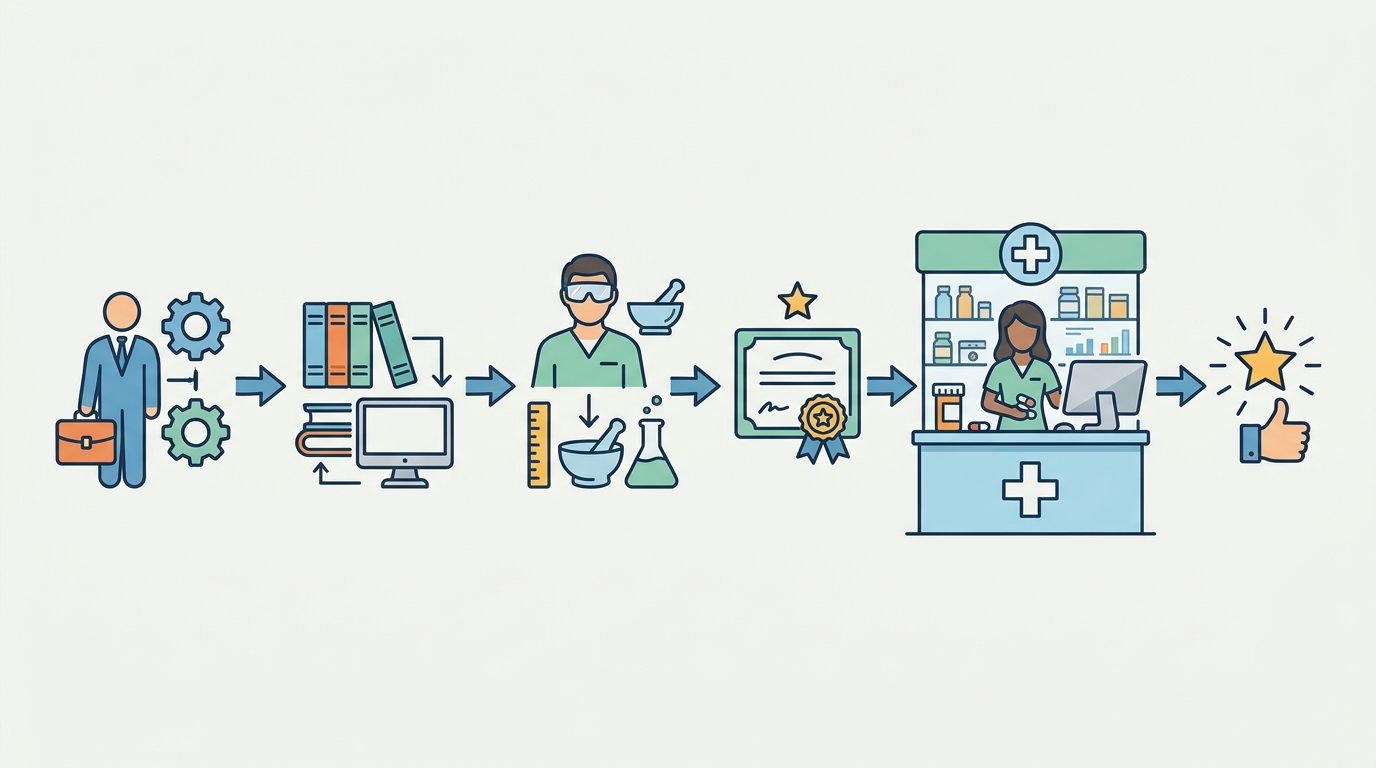
Switching into pharmacy technology usually takes somewhere between 6 and 18 months from first research to a steady first job, depending on whether you train on the job or complete a postsecondary program. The U.S. Bureau of Labor Statistics (2026-08-27) says pharmacy technicians typically need a high school diploma or equivalent and learn through on-the-job training lasting less than a year, or complete a pharmacy technology education program, which often awards a certificate in a year or less (BLS, 2026-08-27).
The hard parts are not the coursework. They are the state rules, which vary and often include an exam, fees, continuing education and a criminal background check (BLS, 2026-08-27), and the income gap while you move from a job you already know to an entry-level role in a new field.
The Transition Timeline
Treat this as a planning template, not a promise. Most career changers who stay employed through the training phase land somewhere in the 9 to 18 month range; people who already work in a pharmacy-adjacent job and train on the job can be faster.
Months 1-2: Still employed, researching. You look up your own state's rules. Most states regulate pharmacy technicians in some way, and requirements typically include some or all of a high school diploma or equivalent, a formal training program, an exam, fees, continuing education, a criminal background check and a minimum age (BLS, 2026-08-27). CareerOneStop's license finder is the tool BLS points readers to, because requirements vary by state (BLS, 2026-08-27). You also read the O*NET OnLine summary for Pharmacy Technicians, SOC 29-2052.00 (BLS, 2026-08-27), to check the daily work against what you actually want.
Months 2-4: Choosing your route. There are two realistic doors. One is a postsecondary pharmacy technology program at a vocational school or community college, often a certificate in a year or less, sometimes an associate's degree (BLS, 2026-08-27). The other is on-the-job training with an employer, typically under a year (BLS, 2026-08-27). Your state's rules may close one of these doors, so check first.
Months 3-12: Training, still employed if possible. Evening and weekend sections exist at many community colleges. If you train on the job, this stage is your new job already.
Months 9-14: Certification. If you went through a PTCB-Recognized Education/Training Program, you qualify under Pathway 1 — you can apply within 60 days of completing it (PTCB, 2026-09-30). If you trained on the job instead, Pathway 2 lets you qualify with a minimum of 500 hours of equivalent work experience, complete at the time you apply (PTCB, 2026-09-30).
Months 10-15: Applying. Employment of pharmacy technicians is projected to grow 6 percent from 2025 to 2035, faster than the average for all occupations, with about 44,700 openings projected each year on average over the decade (BLS, 2026-08-27). Retail, hospital, long-term care and mail-order settings hire on different cycles.
Months 12-18: Resignation and start date. Give notice only when you have a written offer and a start date, and when your state registration is active or clearly in progress.
Months 13-30: First year in the new role. You learn the specific dispensing system, the insurance side and the pace. Your first recertification cycle starts here: CPhT recertification is required every two years and requires continuing education (PTCB, undated).
Step-by-Step Plan
- While still employed (Months 1-2): Run your state through CareerOneStop's license finder, which BLS directs readers to because requirements vary by state (BLS, 2026-08-27). Write down the exact list: exam, fees, continuing education, background check, minimum age. Do not rely on what a friend in another state did.
- While still employed (Months 1-2): Deal with the background check question early and honestly. Most states include a criminal background check among their requirements (BLS, 2026-08-27). If you have anything in your record, find out what your state board does with it before you spend money on tuition.
- While still employed (Months 2-4): Pick your route. If your state requires a formal education or training program, enrol in one at a vocational school or community college — these often award a certificate in a year or less (BLS, 2026-08-27). If on-the-job training is permitted and you can find an employer willing to train, that path takes under a year (BLS, 2026-08-27) and pays you while you learn.
- While still employed (Months 2-4): Check whether the program you are considering is PTCB-Recognized. That determines whether you can use Pathway 1 for the Pharmacy Technician Certification Exam, which allows application within 60 days of completing the program (PTCB, 2026-09-30).
- While still employed (Months 3-12): Keep your current income. Ask about evening, weekend or part-time sections before you assume you have to quit to study.
- While still employed (Months 9-12): Get the 500 hours banked if you are going the experience route. Pathway 2 requires a minimum of 500 hours of equivalent work experience as a pharmacy technician, complete at the time of application (PTCB, 2026-09-30). A part-time pharmacy job alongside your current work is the usual way people do this.
- While still employed (Months 9-14): Book and sit the PTCE. It is a computer-based exam of 90 multiple-choice questions — 80 scored, 10 unscored — and you should plan on 2 hours total: a 5-minute tutorial, 1 hour 50 minutes of exam, and a 5-minute survey (PTCB, 2026-09-30). It is given in person at more than 1,400 Pearson Test Centers nationwide, including more than 100 military bases, and official results post to your PTCB account within three weeks (PTCB, 2026-09-30). Factor that three weeks into your resignation planning.
- While still employed (Months 10-15): Apply broadly across settings. Some states and employers require certification, and even where it is not required it may make it easier to get a job (BLS, 2026-08-27) — say plainly on your application whether you hold it or when you expect to.
- After you leave (Months 12-18): Complete state registration paperwork and any employer onboarding. Confirm in writing whether your new employer covers the certification exam fee, since employers may pay for employees to take it (BLS, 2026-08-27).
- After you leave (Months 13-30): Start tracking continuing education from week one. CPhT recertification comes every two years (PTCB, undated), and it is easier to collect hours as you go than to scramble at renewal.
Before You Quit Your Job Checklist
Every item here is a yes or no. If any answer is no, you are not ready to give notice.
- Savings runway: You have 4 to 6 months of full living expenses in cash, separate from retirement accounts. Four months is the floor if you have a signed offer; six if you do not.
- State requirements confirmed in writing: You have a printed or saved copy of your state's pharmacy technician requirements from CareerOneStop's license finder (BLS, 2026-08-27), not a forum post.
- Background check cleared or resolved: You know your state's position on your record, because a criminal background check is a typical requirement (BLS, 2026-08-27).
- Education or training status settled: You have either completed a postsecondary pharmacy technology program (BLS, 2026-08-27) or secured an employer offering on-the-job training.
- PTCE eligibility pathway identified: You can name which one applies to you — Pathway 1 through a PTCB-Recognized Education/Training Program, with application allowed within 60 days of completion, or Pathway 2 with a minimum of 500 completed hours of work experience (PTCB, 2026-09-30).
- Exam booked or passed: You have a scheduled date at a Pearson Test Center, or results already in your PTCB account — remembering official results post within three weeks (PTCB, 2026-09-30).
- Fees budgeted: You have checked the current CPhT application and exam fee on PTCB's site (PTCB, 2026-09-30) and the current recertification fees in PTCB's published fee table (PTCB, undated), plus your state's fees, and the total is set aside.
- Employer reimbursement question asked: You have asked prospective employers whether they pay for the certification exam, since some do (BLS, 2026-08-27).
- Backup income plan named: You have a specific fallback — per-diem shifts in your current field, part-time retail hours, or a return-to-work arrangement — not a vague intention.
- Written offer with a start date: You hold it. Verbal does not count.
- Current pay compared to the new role: You have looked up current pharmacy technician wage data for your state and metro on the BLS Occupational Employment and Wage Statistics pages and written down the monthly difference against your present pay. Assume a cut and plan the household budget around it.
Certifications and Costs
Costs change, so check each provider directly before you commit. The point of this table is the shape of the spending, not a quote.
| Requirement | Provider or Path | Cost | Time to Complete |
|---|---|---|---|
| State registration or license (most states regulate technicians in some way) | Your state board of pharmacy; find it through CareerOneStop's license finder, which BLS points readers to (BLS, 2026-08-27) | State fee, varies by state — check your board's current schedule | Weeks, depending on the board and background check |
| Postsecondary pharmacy technology program | Vocational school or community college; often a certificate, some lead to an associate's degree (BLS, 2026-08-27) | Tuition varies widely by school and state; community college in-district rates are usually lowest | 1 year or less for a certificate, longer for an associate's (BLS, 2026-08-27) |
| On-the-job training (alternative to a program, where the state allows) | An employing pharmacy | Free — you are paid while training | Typically less than 1 year (BLS, 2026-08-27) |
| CPhT certification via the PTCE | Pharmacy Technician Certification Board, delivered at Pearson Test Centers (PTCB, 2026-09-30) | Application and exam fee is published on PTCB's site; some employers pay it for employees (BLS, 2026-08-27) | 2 hours on exam day; results within three weeks (PTCB, 2026-09-30) |
| 500 hours of work experience (PTCE Pathway 2) | Paid pharmacy technician work, where your state permits it (PTCB, 2026-09-30) | No fee — paid hours | Roughly 3-6 months full time, longer part time |
| CPhT recertification | PTCB continuing education and renewal (PTCB, undated) | Recertification application fee per PTCB's published fee table; a separate reinstatement fee applies if you lapse (PTCB, undated) | Every 2 years (PTCB, undated) |
| Occupation research before you spend anything | O*NET OnLine, Pharmacy Technicians, SOC 29-2052.00 (BLS, 2026-08-27) | Free | An afternoon |
The free or near-free options are real: O*NET and CareerOneStop cost nothing, and on-the-job training pays you rather than charging you. If money is tight, build the plan around those first and treat tuition as the option you take only if your state requires a formal program.
Frequently asked questions
I'm 52. Will employers rule me out for an entry-level pharmacy role?
Age bias is a real concern for career changers in the 45 to 60 range, and the usual form it takes is an assumption that you will not stay, or that you will struggle with the dispensing software. Counter it at the Months 10-15 applying stage by leading with your completed training and your PTCE result, not your years in a previous field. The occupation is hiring at scale — about 44,700 openings are projected each year on average from 2025 to 2035 (BLS, 2026-08-27) — and retail and hospital pharmacies fill those from a wide pool.
What does my experience as a retail manager, medical receptionist or restaurant supervisor actually transfer?
Inventory control, cash handling, scheduling, insurance paperwork and handling a queue of frustrated people under time pressure all map directly onto pharmacy technician work. A former elementary teacher or bank teller brings accuracy habits and comfort explaining the same thing fifty times. None of that substitutes for your state's requirements, which typically include a training program, exam, fees and a background check (BLS, 2026-08-27), so start with the Months 1-2 research stage regardless of your background.
Can I avoid tuition entirely?
Sometimes. If your state permits on-the-job training, you can learn the role in under a year while being paid (BLS, 2026-08-27), then qualify for the PTCE through Pathway 2 with a minimum of 500 completed hours of work experience (PTCB, 2026-09-30). You still pay the PTCB application and exam fee and your state's fees, though some employers pay for employees to take the exam (BLS, 2026-08-27) — ask before you assume.
How long will my income dip?
Plan for a gap of 1 to 3 months between leaving your current job and your first full pharmacy paycheck, which is why the checklist sets a 4 to 6 month savings floor. Remember that official PTCE results take up to three weeks to post (PTCB, 2026-09-30), so sitting the exam the week you resign leaves you waiting. Look up current pharmacy technician wages for your state on the BLS Occupational Employment and Wage Statistics pages and budget for a pay cut in year one.
Sources
- U.S. Bureau of Labor Statistics — Pharmacy Technicians : Occupational Outlook Handbook (2026-08-27)
- Pharmacy Technician Certification Board (PTCB) — Become a Certified Pharmacy Technician (CPhT) | PTCB Certification (2026-09-30)

Written by
Wyatt covers work outside the office: construction, logistics, repair, and the people who keep things running. He's skeptical of career advice that assumes everyone sits at a desk.