Is Becoming a Bookkeeper a Good Career Change?
What the job looks like after a career in retail, teaching or healthcare admin, what you need to learn first, and the money tradeoffs to plan for.
Quick answer
- Typical entry-level education is a high school diploma, with no related work experience required and moderate-term on-the-job training (U.S. Bureau of Labor Statistics, 2025) — a lower barrier than most career changes.
- Employers generally prefer candidates who have completed college courses in accounting (U.S. Bureau of Labor Statistics, 2025); part time, that usually means 2 to 4 semesters at a community college.
- Plan 6 to 12 months from your first accounting course to first paid work, and budget for 3 to 9 months of lower earnings if you start in an entry-level clerk role.
Bookkeeping is one of the more realistic mid-career switches available, because the typical entry requirement is a high school diploma with moderate-term on-the-job training rather than a new degree, and no prior experience in a related occupation is normally expected (U.S. Bureau of Labor Statistics, 2025). The catch is the outlook: BLS projects employment for bookkeeping, accounting and auditing clerks to decline between 2025 and 2035 as routine tasks are automated, with most openings coming from workers leaving the occupation rather than new positions (U.S. Bureau of Labor Statistics, 2025).
That makes it a good change for people who want to move toward the analytical and advisory side of the work — reconciling, explaining and advising — and a poor one for anyone hoping to key in invoices quietly until retirement.
What the Work Actually Involves
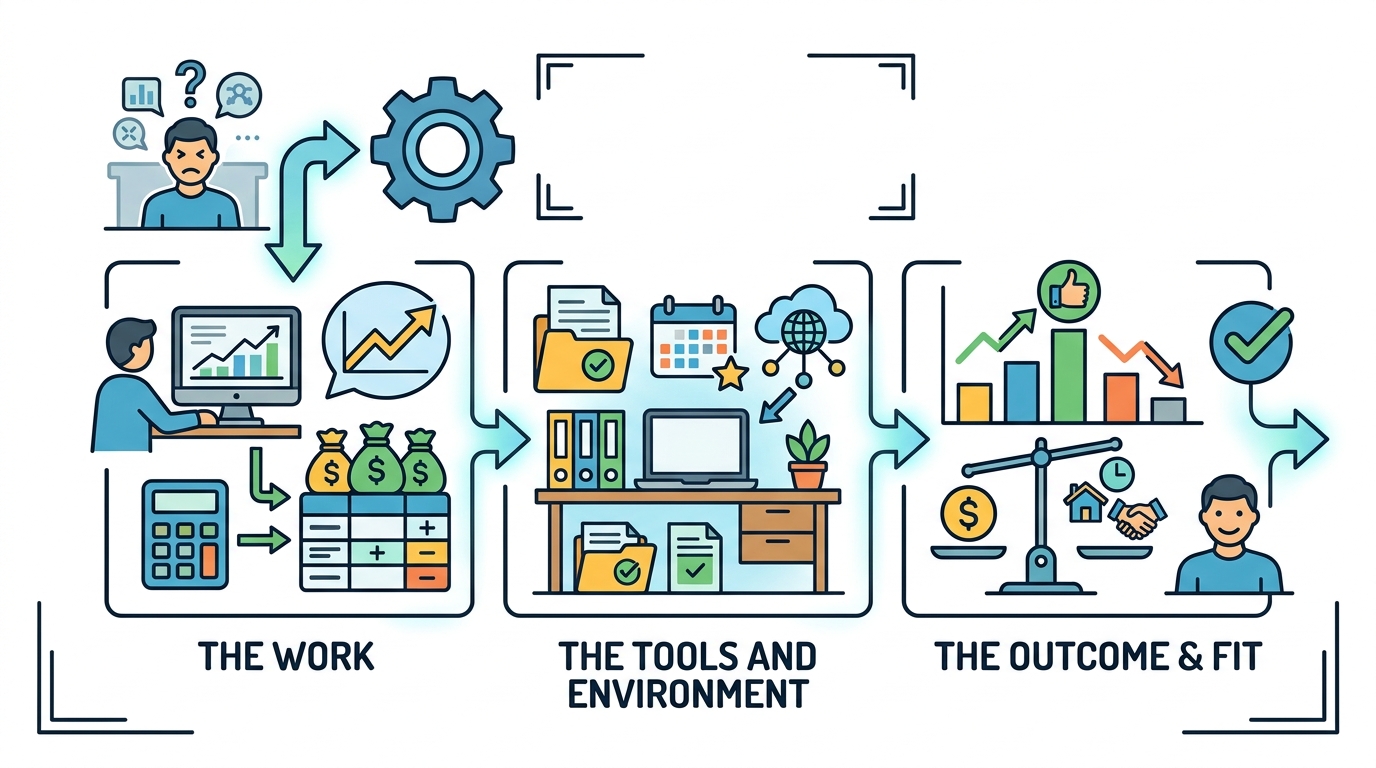
A normal weekday in a small-business or in-house bookkeeping job is mostly transaction work and checking. Expect 1 to 2 hours posting financial transactions into bookkeeping software, spreadsheets or databases; 30 to 60 minutes receiving and recording cash, checks and vouchers, and matching them to invoices; and another 30 minutes or so chasing figures that do not agree. BLS lists checking figures, postings and documents for accuracy and reconciling discrepancies among the core duties of the occupation (U.S. Bureau of Labor Statistics, 2025), and in practice that reconciliation work is what fills your afternoon when something does not tie out.
The week has a shape. Early in the week tends to be data entry and bank feeds; midweek is accounts payable runs and customer statements; Friday is often payroll input and a quick review of the aged receivables list. Month-end is different — set aside 2 to 3 full days to reconcile bank and credit card accounts and produce reports such as balance sheets and income statements for an owner or controller (U.S. Bureau of Labor Statistics, 2025).
Most clerks in this occupation work full time, and extra hours are common at fiscal year-end, during tax season and when an audit is running (U.S. Bureau of Labor Statistics, 2025). If you work for multiple small clients instead of one employer, the same peaks apply — they just arrive from several directions at once.
The qualities BLS identifies for the work are worth taking at face value: integrity, attention to detail, computer skills and math skills (U.S. Bureau of Labor Statistics, 2025). The job rewards people who find it satisfying to make two numbers agree, and frustrates people who want variety every hour.
Who This Career Change Suits
- Retail store managers who closed registers, balanced a safe and investigated till shortages. That is cash receipting and discrepancy resolution, two of the occupation's listed duties, done under time pressure.
- Bank tellers and credit union member service staff, who already handle cash, checks and vouchers accurately and have been trained to treat a five-cent difference as a problem worth solving.
- Dental and medical practice administrators who ran billing, insurance claims and patient accounts. You have been doing accounts receivable under a different name.
- Restaurant, salon or trades business owners who filed sales tax and ran payroll for a handful of staff. You know what an owner actually needs to see in a monthly report.
- Elementary and secondary teachers, who are used to recording hundreds of small data points accurately, meeting hard deadlines and explaining numbers to people who are anxious about them.
- Military supply and logistics personnel, who kept inventory and property records that had to survive an audit. Audit-ready documentation habits are difficult to teach and highly valued.
- Paralegals and legal assistants, especially anyone who touched client trust accounts, where the reconciliation rules are stricter than most commercial bookkeeping.
- Insurance claims adjusters and processors, who are comfortable reading supporting documents, checking figures against them and pushing back when something does not match.
It suits you less well if you need constant human contact, dislike repetitive checking, or want a field where demand is expanding — BLS projects declining employment for the occupation through 2035 (U.S. Bureau of Labor Statistics, 2025).
Transferable Skills That Carry Over
| Prior Career | Skill | How It Applies Here |
|---|---|---|
| Retail store manager | Daily cash reconciliation and shrink investigation | Directly matches receiving and recording cash, checks and vouchers, and reconciling discrepancies |
| Medical or dental office administrator | Insurance billing, claim follow-up, patient statements | Becomes accounts receivable, collections and revenue posting with almost no retraining |
| Elementary teacher | Record-keeping accuracy and deadline discipline | Supports the attention to detail BLS names as a key quality, and the month-end close calendar |
| Military supply or logistics specialist | Property accountability and audit preparation | Maps to documentation standards needed during accounting audits and year-end |
| Restaurant or trades business owner | Payroll, sales tax filing, reading a P&L | Full-cycle bookkeeping experience plus the ability to explain reports to owners |
| Paralegal | Trust account reconciliation and document verification | Transfers to bank reconciliation and checking postings against source documents |
| Bank teller | Balancing to the cent, cash handling controls | Shortens on-the-job training on receipting, deposits and discrepancy escalation |
How to Get Started
- Read the BLS Occupational Outlook Handbook entry for bookkeeping, accounting and auditing clerks end to end — duties, the 2025-35 projection, and which industries employ the most clerks. Decide in writing whether a declining-employment occupation still fits your plan.
- Audit your current job for the accounting work you already do: deposits, invoices, purchase orders, expense reports, payroll input. Write each one as a resume bullet now, while you can still remember the volumes and systems.
- Enroll in introductory financial accounting at a community college, then a second course in payroll, cost accounting or computerized accounting. Employers generally prefer candidates with completed college courses in accounting (U.S. Bureau of Labor Statistics, 2025). Part time, this is usually 2 to 4 semesters.
- Build software fluency alongside the coursework: Microsoft Excel to a working level (pivot tables, lookup functions, filtering), plus hands-on time in QuickBooks Online and Xero, both of which offer their own free online training for new users.
- Get a real set of books to practice on. Volunteering as treasurer for a nonprofit, HOA, booster club or faith group for 3 to 6 months gives you monthly bank reconciliations, a balance sheet you prepared, and a reference who can speak to your accuracy.
- Check CareerOneStop for certification options, which is where BLS directs readers for certification information (U.S. Bureau of Labor Statistics, 2025). Certification is not usually required, so treat it as a credibility signal if you are changing fields with no accounting job history.
- Apply into the industries that employ the most clerks — professional, scientific and technical services, retail trade, wholesale trade, healthcare and finance are among the largest (U.S. Bureau of Labor Statistics, 2025). Entry titles to search include accounts payable clerk, accounts receivable clerk, billing clerk and bookkeeper.
- Take first paid work in whatever form arrives first: a full-time clerk role with moderate-term on-the-job training, or 1 to 2 small business clients at 5 to 10 hours a month each while you keep your current income.
Costs and Time Commitment
Exact dollar figures depend on your state, your community college district and whether you qualify for in-district tuition, so price your own options before committing. Check current wage figures in the BLS Occupational Outlook Handbook, which publishes a median annual wage for the occupation as of May 2025 along with the 10th and 90th percentile earnings (U.S. Bureau of Labor Statistics, 2025).
| Item | Typical Cost | Typical Time |
|---|---|---|
| Introductory accounting courses at a community college | Per-credit tuition set by your college district; check in-district rates | 2 to 4 semesters part time (8 to 16 months) |
| Accounting software training and subscriptions | Vendor training is often free; subscriptions billed monthly | 10 to 30 hours to reach working speed |
| Professional certification (optional) | Exam and membership fees vary by certifying body; check CareerOneStop | 3 to 6 months of study alongside work |
| Volunteer treasurer role for a portfolio | No cost beyond your time | 3 to 6 months, roughly 4 to 8 hours a month |
| Income gap or pay cut | Compare an entry-level clerk offer against your current pay before resigning | Plan for 3 to 9 months at reduced earnings |
| Job search after training | Resume and interview preparation time | 2 to 5 months of applications |
| Seasonal overtime | Usually paid, sometimes unpaid if salaried | Extra hours at fiscal year-end, tax time and audits |
A realistic total transition is 6 to 12 months if you study part time while employed and move into a clerk role, and 18 to 24 months if you are also working toward accountant or auditor duties later.
Frequently asked questions
Am I too old to start bookkeeping at 50 or 55?
Hiring bias against candidates in the 50 to 64 range is real in office roles, and you should plan for it rather than hope it away. The structural argument in your favor is that this occupation typically requires only a high school diploma, no prior experience in a related occupation, and moderate-term on-the-job training (U.S. Bureau of Labor Statistics, 2025) — so your 20 or 30 years of handling money, deadlines and documentation is the differentiator, not a liability. Keep your resume to the last 15 years, lead with the accounting tasks from your current job, and name the software you use.
Will automation make this a dead end?
BLS expects technological change, including automation of routine bookkeeping tasks, to reduce demand and push remaining workers toward a more analytical and advisory role over the 2025-35 decade (U.S. Bureau of Labor Statistics, 2025). Despite the projected decline, openings are still expected each year, mostly from workers leaving the occupation. Build toward the analytical end from day one: reconciliations, variance explanations and report commentary, not data entry speed.
How much will I actually earn compared with my current job?
BLS publishes a median annual wage for bookkeeping, accounting and auditing clerks as of May 2025, along with what the lowest-paid 10 percent and highest-paid 10 percent earned (U.S. Bureau of Labor Statistics, 2025) — look those up and compare them against your current salary before you give notice. Pay varied by industry in May 2025, with construction the highest of the industries BLS listed. If the entry-level number is lower than you earn now, assume 3 to 9 months before experience moves you up.
Do I need a degree or a certification to get hired?
Neither is typically required. The typical entry-level education is a high school diploma, though employers generally prefer candidates who have completed college courses in accounting, and some candidates choose a bachelor's degree (U.S. Bureau of Labor Statistics, 2025). Certification is not usually required but some workers earn it to show competency; BLS points to CareerOneStop for details. Two accounting courses plus 10 to 30 hours of software practice is a reasonable minimum before you apply.
Can this lead anywhere, or is bookkeeping the ceiling?
With appropriate experience and additional education, some clerks advance into accountant or auditor roles (U.S. Bureau of Labor Statistics, 2025). That path normally means a bachelor's degree in accounting, which part time adds roughly 3 to 4 years on top of your initial 6 to 12 month transition. Many career changers instead widen sideways, taking on payroll, sales tax or multi-client work for higher-paying industries.
Sources
- U.S. Bureau of Labor Statistics — Bookkeeping, Accounting, and Auditing Clerks : Occupational Outlook Handbook (2025)

Written by
Desmond writes about the mechanics of job searching: resumes, interviews, the long silence after applying. He's fascinated by how much of getting hired depends on luck dressed up as skill.