
Nursing Interview Questions: What to Expect and How to Prepare
From rotating panel rounds with the nurse manager to the STAR story about a patient who deteriorated on your shift, here's how nursing interviews actually run.
Quick answer
- Write five STAR stories before the interview — a patient who deteriorated, an angry family member, a mistake you made, conflict with a coworker, a time you led — and cut each to about 90 seconds.
- Expect a panel, not one interviewer: residency first rounds often put four to five candidates in rotation before two to four panelists such as a nurse manager, unit educator and charge nurse (RegisteredNursing.org, 2026).
- Know your paperwork out loud: licence status, expiry dates on CPR, basic life support or advanced cardiac life support cards, and any association certification (U.S. Bureau of Labor Statistics, 2025).
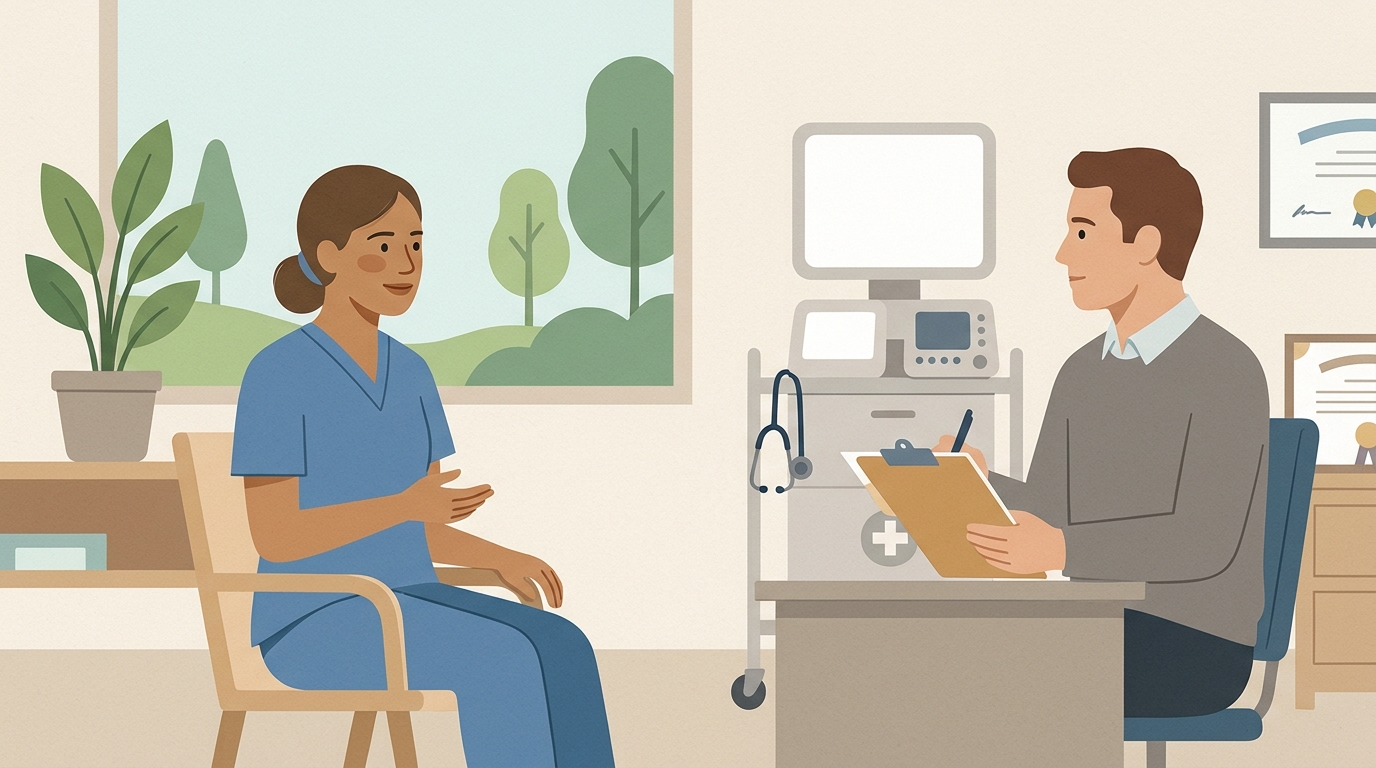
Nursing interviews turn on two things: behavioral stories that show how you treat people under pressure, and clinical judgment questions that show how you spot and act on a change in a patient's condition. Most use a panel rather than a single manager, a scoring rubric, and a short list of predictable themes you can prepare in advance.
Below is the usual format, seven questions with worked sample answers, and the patterns that get candidates scored down.
What This Interview Usually Covers
Expect a recruiter screening call first, covering licence status, graduation date, shift availability and whether you hold CPR, basic life support or advanced cardiac life support certification, since registered nursing positions may require them (U.S. Bureau of Labor Statistics, 2025). Background check requirements vary by state (U.S. Bureau of Labor Statistics, 2025), so the recruiter may ask about that step too.
The hiring interview itself is usually a panel. Nurse residency interviews typically involve two rounds, and large health systems may use two to four depending on the program; the first round is often a panel in which four to five candidates interview together in rotation, facing two to four panelists such as a nurse manager, unit educator and charge nurse (RegisteredNursing.org, 2026). Plan for about 60 minutes, though some formats run 30 to 45, and assume each answer is scored on a rubric (RegisteredNursing.org, 2026).
Content skews behavioral. Residency panels evaluate character and coachability rather than clinical knowledge (RegisteredNursing.org, 2026), and common themes include why you chose that hospital or unit, how you handle feedback or conflict, a challenging patient situation, and your goals for the residency and beyond (RegisteredNursing.org, 2026). Experienced-hire interviews add prioritisation and escalation scenarios.
Common Questions and Sample Answers
Structure every behavioral answer as Situation, Task, Action, Result (RegisteredNursing.org, 2026), and put one real number, tool or unit into each.
Why did you choose nursing?
Sample answer
Before nursing school I spent two years as a nursing assistant on a 32-bed medical-surgical floor, doing vitals and turns. The moment that decided it was watching a nurse sketch an insulin schedule on the back of a meal tray card for a newly diagnosed patient. My task was to decide whether to stay in support work. I shadowed her twice a month, then enrolled in an associate degree program while working nights. I graduated in May and passed the licensing exam on the first attempt.
Tell me about a time you noticed a change in a patient's condition.
This tests critical thinking, because nurses must assess changes in health status and decide when to take corrective action (U.S. Bureau of Labor Statistics, 2025).
Sample answer
On a telemetry rotation I took 0400 vitals on a post-operative hip patient. His blood pressure had fallen from 128/76 to 96/58 across two sets and he said he felt foggy. My task was to decide whether that was normal post-op variation or bleeding. I rechecked manually, pulled his drain output and found 180 mL more than the previous shift, then escalated to the charge nurse within five minutes with an SBAR handoff. He went back to the OR that morning.
How do you handle a difficult patient or family member?
Communication counts here, since nurses must understand concerns and explain instructions clearly (U.S. Bureau of Labor Statistics, 2025).
Sample answer
A patient's daughter blocked the doorway on day three and said nobody had told her anything. The problem was a discharge planning gap; my task was to de-escalate without promising what I could not deliver. I moved her to the family room, wrote down her three questions and said I would return by 1400 with answers. I confirmed two with the hospitalist and arranged a five-minute bedside update. She thanked me at discharge, and I now use that written-questions method with every complaint.
Describe a mistake you made and how you handled it.
Sample answer
On an evening shift I scanned and gave a scheduled antihypertensive to a patient whose systolic had dropped to 94 an hour earlier. The hold parameter was on the order and I had missed it. My task was to report it straight away. I told the charge nurse within ten minutes, filed the safety report myself, and we checked vitals every 15 minutes for two hours; he stayed stable. I now read hold parameters aloud at the bedside before every cardiac medication.
How do you respond to feedback or conflict with a colleague?
Sample answer
In week six of orientation my preceptor said my shift report ran long and buried the important changes. My task was to fix it rather than defend it. I asked her to time my next three reports and mark where she lost the thread, then rebuilt my handoff on a strict SBAR template written on my brain sheet. Report dropped from about nine minutes to under four, and the night nurse stopped calling me back with questions.
Why this hospital and this unit?
Sample answer
I applied after a six-week oncology rotation where I followed the same four patients through their chemotherapy cycles. My task was to work out which population suited me. I tracked which shifts I left energised by, and they were all the long-stay, teaching-heavy ones. I then read this unit's residency structure, its preceptor pairing model and the certification support listed in the posting. I want continuity and bedside teaching to be the norm, and that matches what I saw here.
How do you stay current with the nursing profession?
Name the courses, workshops and associations you actually follow (Nurse.com).
Sample answer
After graduation I wanted a system rather than ad hoc reading, and my task was one I could sustain on nights. I joined a specialty nursing association, set aside 30 minutes each Sunday for its journal, and finished a 12-hour wound care workshop last fall. I keep CPR and basic life support renewal dates in a calendar reminder 90 days out. Certification through professional associations is voluntary for most roles but required by some employers (U.S. Bureau of Labor Statistics, 2025), so I am working toward one next year.
Mistakes That Cost Candidates the Job
- Criticising a former manager, preceptor or coworker when asked why you left. Focus on what you are moving toward, not what you are leaving (Nurse.com).
- Answering every clinical scenario with "I'd call the charge nurse" and stopping there. Say what you assessed, what you found, then who you escalated to.
- Telling a "mistake" story where the error was actually someone else's, or picking one with no consequence, such as arriving late once.
- Describing a difficult patient or family in mocking language. Panels score how you talk about people who are not in the room.
- Giving a "why this hospital" answer that would fit any employer. Tie it to a rotation, a patient population, or a named feature of the residency structure.
- Running long in a rotating panel round. With four or five candidates sharing the room, a four-minute answer takes someone else's turn; keep each story near 90 seconds.
- Asking only about scheduling and pay in the first round. Save compensation for the recruiter and ask the panel about preceptor assignment and the first 90 days.
Frequently asked questions
What should I wear to a nursing interview?
Wear business attire — a suit or blazer with closed-toe shoes — not scrubs, unless the recruiter says the day includes a unit shadow. For video rounds, use a solid colour top, plain background, camera at eye level, and test your audio 15 minutes beforehand.
When should I bring up pay?
Let the recruiter raise it on the screening call, then ask for the posted range plus shift and weekend differentials for that specific unit. For a benchmark, check the registered nurses page of the Bureau of Labor Statistics Occupational Outlook Handbook, which published a median annual wage for May 2025 (U.S. Bureau of Labor Statistics, 2025).
Should I send a thank-you note?
Yes — send one within 24 hours and make it specific (RegisteredNursing.org, 2026). Email each panelist separately, reference one thing they said, and name the unit. Collect business cards or ask the recruiter for the panel's names and titles before you leave.
What should I bring with me?
Bring four printed copies of your resume, your licence information or proof of exam eligibility, your CPR, basic life support or advanced cardiac life support cards, any association certification, and a reference list with current phone numbers. For state licensing requirements, use the CareerOneStop find-licenses tool (U.S. Bureau of Labor Statistics, 2025).
How do I follow up if I hear nothing?
Before you leave, ask: "What's your timeline for decisions, and who should I contact?" Then wait two business days past that date and send one short email to the recruiter restating your interest in the specific unit. One follow-up, not three.
Sources
- U.S. Bureau of Labor Statistics — Registered Nurses : Occupational Outlook Handbook (2025)
- RegisteredNursing.org — Nurse Residency Interview Questions & Tips for New Grads (2026) (2026)

Written by
Noor writes personal essays and interviews about career changes, burnout, and starting over. She's interested in the stories people tell themselves about what a job is supposed to mean.