So You Want to Become a Solar Installer After 30
Most people enter solar from roofing, electrical or warehouse work rather than a classroom — here is what the switch costs in time and earnings.
Quick answer
- Budget 1 to 3 months of living expenses for the gap between your last paycheck and your first full installer paycheck, and expect helper pay below the 2025 median for the occupation published by the U.S. Bureau of Labor Statistics.
- Certification is not required for employment, but some states require it for projects to qualify for solar-related subsidies (U.S. Bureau of Labor Statistics, 2025) — check your own state's rules before paying for training.
- If you have worked as an electrician, roofer, carpenter or laborer, BLS (2025) says that experience may shorten your training time, so lead with it on the application.
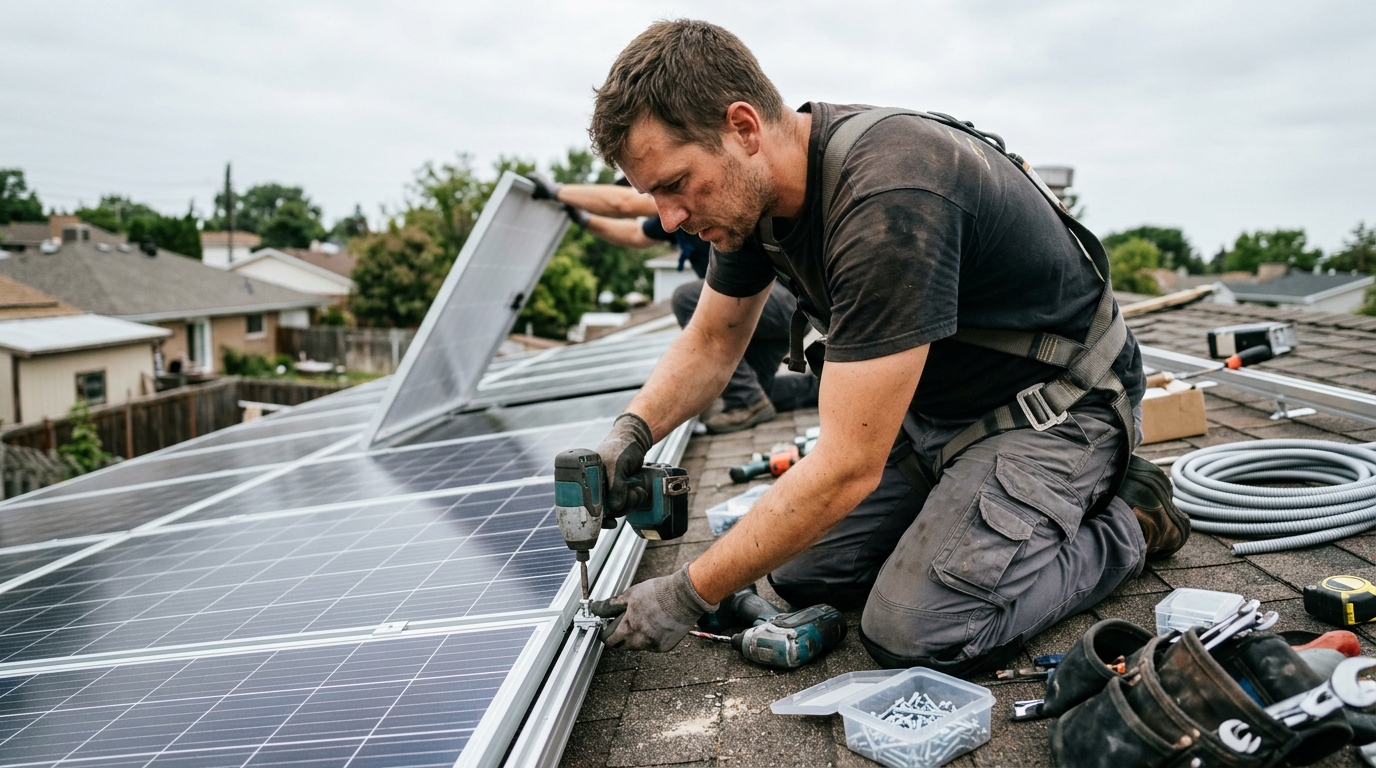
Becoming a solar photovoltaic installer after 30 is one of the more accessible trade switches, because the job is mostly learned on a crew rather than in a degree program. The U.S. Bureau of Labor Statistics (2025) lists a modest typical entry-level education level and on-the-job training alongside experienced installers as the usual route in, and notes that people coming from electrician, roofer, carpenter or laborer work already perform basic construction duties, which may shorten training time.
A realistic plan is 3 to 9 months from first research to your first paid day on a crew, and 2 to 4 years before you are running installs, holding certification, or moving into supervision or sales. The tradeoff is an income gap of roughly 1 to 3 months and, for many people, a step down from a current salaried wage.
What the Work Actually Involves
A residential install day usually starts at the yard: 30 to 45 minutes loading modules, racking, rails and fasteners and checking the plan set against what is on the pallet, then 30 to 90 minutes of drive time depending on how far your employer travels.
On site, the morning is layout and structure. BLS (2025) describes the core duties as planning system configurations, measuring, cutting and assembling support structures, installing modules and panels, connecting panels to the electrical system, applying weather sealant, and activating and testing the system. In practice that means 1 to 2 hours finding rafters, setting flashings and mounts, and torquing rails to spec — on a pitched roof, in a harness, often in direct sun.
The middle of the day is modules: 2 to 3 hours carrying panels up, setting them on rail, clamping and bonding them, and dressing wire. Alongside that, somebody runs conduit and works at the service panel, which in many states must be done or signed off by a licensed electrician. That rule varies by state, so ask at interview who is allowed to make the final connections.
The last stretch is 45 to 90 minutes of sealing penetrations, labeling and cleaning up offcuts, plus 30 to 60 minutes of commissioning and testing before the system goes for inspection.
Across a week, expect 4 to 5 install days, some of them rained out, plus service calls on older systems. Commercial and ground-mount work means fewer, longer jobs, more trenching and steel, less ladder time. Pay structure differs by employer — hourly with overtime is common, sometimes with travel pay or production bonuses. Check the current median for the occupation in the BLS Occupational Outlook Handbook (2025) rather than a recruiter's number.
Who This Career Change Suits
- Roofers. You already know flashing, penetrations and moving on a pitched surface — BLS (2025) lists roofing as one of the backgrounds that may shorten training time.
- Electricians and apprentice electricians. Panels have to be tied into the building's electrical system; terminations and code knowledge put you on the wiring side of the crew quickly.
- Carpenters and framers. Measuring, cutting and assembling support structures is a listed core duty, and ground-mount frames are built the way you already build.
- HVAC service technicians. You are used to rooftop work, commissioning equipment and explaining it to a homeowner afterwards.
- Warehouse and forklift workers. Staging, lifting and material accuracy are daily crew tasks, and short-shipped racking stops a job cold.
- People who are genuinely fine with heights and heat. Not "willing to try" — fine with it, for 6 to 8 hours, repeatedly. Test that before you spend money on training.
- Anyone aiming at supervision or self-employment later. BLS (2025) notes installers may advance to project supervisor or project manager, move into sales, or start their own PV installation business.
- Career changers aged 30 to 55 who want a trade with a short runway. The entry path is on-the-job training, not a multi-year degree, so the lost-income window is shorter than most mid-life retraining.
Transferable Skills That Carry Over
| Prior Career | Skill | How It Applies Here |
|---|---|---|
| Roofer | Flashing, sealing and working on pitched surfaces | Every mount is a hole in someone's roof; weather sealing is a listed core duty and the main source of callbacks |
| Residential electrician or apprentice | Terminations, conduit, reading one-line diagrams | Connecting panels to the electrical system and passing inspection |
| Carpenter or framer | Measuring, cutting, assembling structures to a drawing | Racking layout, rail cuts and ground-mount frames |
| HVAC service technician | Rooftop equipment work and commissioning | Activating and testing the system, then walking the customer through it |
| Warehouse or forklift operator | Load planning, safe lifting, inventory accuracy | Staging modules and racking so a crew is not sent back to the yard mid-day |
| Retail or restaurant manager | Crew scheduling and handling an unhappy customer face to face | Maps onto the crew lead and project coordinator roles installers advance into |
| Auto mechanic | Torque specs, diagnostics, fixed service sequences | Fastener torque, string troubleshooting and commissioning checklists |
How to Get Started
- Read the two free occupational profiles. The BLS Occupational Outlook Handbook entry for solar photovoltaic installers (2025) gives median pay, typical entry-level education, related work experience needed, the on-the-job training category, jobs held in 2025, and projected 2025–35 growth and average annual openings. The O*NET OnLine profile (U.S. Department of Labor, 2026) gives the Job Zone and task list.
- Check your state before you spend anything. Certification is not required for employment, but some states require it for projects to qualify for solar-related subsidies (BLS, 2025), and electrical licensing rules differ by state. Confirm with your state licensing board or energy office, not a training provider's sales page.
- Test the physical side. Spend a day helping on a roof, or a full shift in a harness. Heights, heat and ladder carries are why people quit in month two. Confirm you hold a valid driver's license in good standing — crews drive company trucks.
- Pick a training route. Community colleges and technical schools run PV courses (BLS, 2025 — check the currently listed course length). If you meet the eligibility requirements, GRID Alternatives runs Installation Basics Training (IBT 200) at no cost to participants (GRID Alternatives, 2026); read their eligibility criteria and published graduate outcome before applying.
- Apply for helper and entry-crew roles while you train. Put your prior trade in the first line of the résumé; BLS (2025) names electrician, roofer, carpenter and laborer experience as shortening training time, and hiring managers read for it.
- Learn the trade on site. BLS (2025) describes new installers learning alongside experienced installers for a set period — look up the current stated duration. Keep your own log of installs, system sizes and tasks performed.
- Work toward NABCEP PV Installation Professional (PVIP) Board Certification. The program includes 58 hours of advanced PV training plus experience requirements (Midwest Renewable Energy Association, 2025). Start the hours after you have field time, not before.
- Choose a direction at the 2 to 4 year mark. Project supervisor, project manager, sales, or your own PV installation business are the routes BLS (2025) names.
Costs and Time Commitment
| Item | Typical Cost | Typical Time |
|---|---|---|
| Community college or technical school PV course | Tuition varies by school and state — check the college's published rate | Course length is listed in the BLS Occupational Outlook Handbook (2025); confirm with the program |
| GRID Alternatives Installation Basics Training (IBT 200) | No cost to participants (GRID Alternatives, 2026) | Program length and eligibility are on the program page; apply before intake closes |
| NABCEP PVIP advanced training | Course and exam fees vary by accredited provider — request a current fee schedule | 58 hours of advanced PV training plus the experience requirement (Midwest Renewable Energy Association, 2025) |
| Boots, harness, hand tools, site safety training | Varies — many employers supply fall protection and some tools; ask what you must buy | Before day one |
| Income gap, last paycheck to first full installer paycheck | Budget 1 to 3 months of living expenses | 1 to 3 months |
| Pay step-down in year one | Compare your current hourly rate with the 2025 median for the occupation (U.S. Bureau of Labor Statistics); helpers usually start below it | Roughly the first 12 months |
| Whole transition, research to first paid crew day | Mostly opportunity cost | 3 to 9 months |
| Research to crew lead or certified installer | — | 2 to 4 years |
Frequently asked questions
Am I too old to start this at 38 or 45?
In the 30 to 55 range the real constraints are knees and shoulders, not hiring attitudes — crews care whether you can carry modules up a ladder for 6 to 8 hours. Where age helps is the exit ramp: BLS (2025) says installers may advance to project supervisor or project manager, move into sales, or start their own PV installation business, and prior management or customer-facing work speeds that move. Many people plan on 5 to 10 years of full field work and aim for a supervisory role before 55.
Do I need NABCEP certification to get hired?
No. BLS (2025) states certification is not required for employment, although some states require it for projects to qualify for solar-related subsidies, so your state matters more than any national rule. NABCEP PV Installation Professional (PVIP) Board Certification includes 58 hours of advanced PV training plus experience requirements (Midwest Renewable Energy Association, 2025), which most people complete after a year or two on crews.
How long before I earn a full installer wage rather than helper pay?
Most career changers spend roughly 12 months as a helper or entry crew member while learning alongside experienced installers, the arrangement BLS (2025) describes in its on-the-job training entry. Arriving from roofing, electrical, carpentry or general labor can compress that window. Treat the 2025 median pay in the Occupational Outlook Handbook as a mid-career figure, not a starting one.
Is there enough work to justify the switch?
Check two BLS (2025) figures first: projected employment growth for solar photovoltaic installers from 2025 to 2035, and projected average annual openings over that decade. Then check demand locally, because install volume is driven by state incentive programs and utility rules that differ sharply between states. Two 30-minute calls to local installers about their hiring plans tell you more about your market than any national projection.
Sources
- U.S. Bureau of Labor Statistics — Solar Photovoltaic Installers : Occupational Outlook Handbook (2025)
- O*NET OnLine (U.S. Department of Labor) — 47-2231.00 - Solar Photovoltaic Installers (2026)

Written by
Noor writes personal essays and interviews about career changes, burnout, and starting over. She's interested in the stories people tell themselves about what a job is supposed to mean.