Solar Installer Career Change Roadmap for Working Adults
What the move from a steady paycheck to rooftop solar work really takes: training length, licence checks, savings runway, and the order to do it in.
Quick answer
- Total timeline: roughly 6 to 18 months — a certificate of 12 weeks to less than 1 year (CareerOneStop) plus the 1 to 12 months of on-the-job training entrants typically receive (CareerOneStop). The slower, paid alternative is a two-year no-cost apprenticeship that includes full-time employment with a solar installation company (St. Petersburg College with UCF's Florida Solar Energy Center).
- Total cost: training can be $0 — St. Louis Community College runs a free five-week solar installer program and GRID Alternatives' Installation Basics Training is 200 hours over a minimum of five weeks at no cost. The main out-of-pocket cost comes later: a $125 application fee plus a $375 exam fee for the NABCEP PV Installation Professional (Indiana Department of Workforce Development), and $275 if you need a retake (Midwest Renewable Energy Association).
- Biggest risk: the unpaid gap during full-time training, which runs from the five-week minimum of GRID Alternatives' Installation Basics Training to the 16 weeks of a free pre-apprenticeship (Holyoke Community College), followed by helper-level pay through 1 to 12 months of on-the-job training (CareerOneStop). Bank cash for that whole stretch before you give notice.
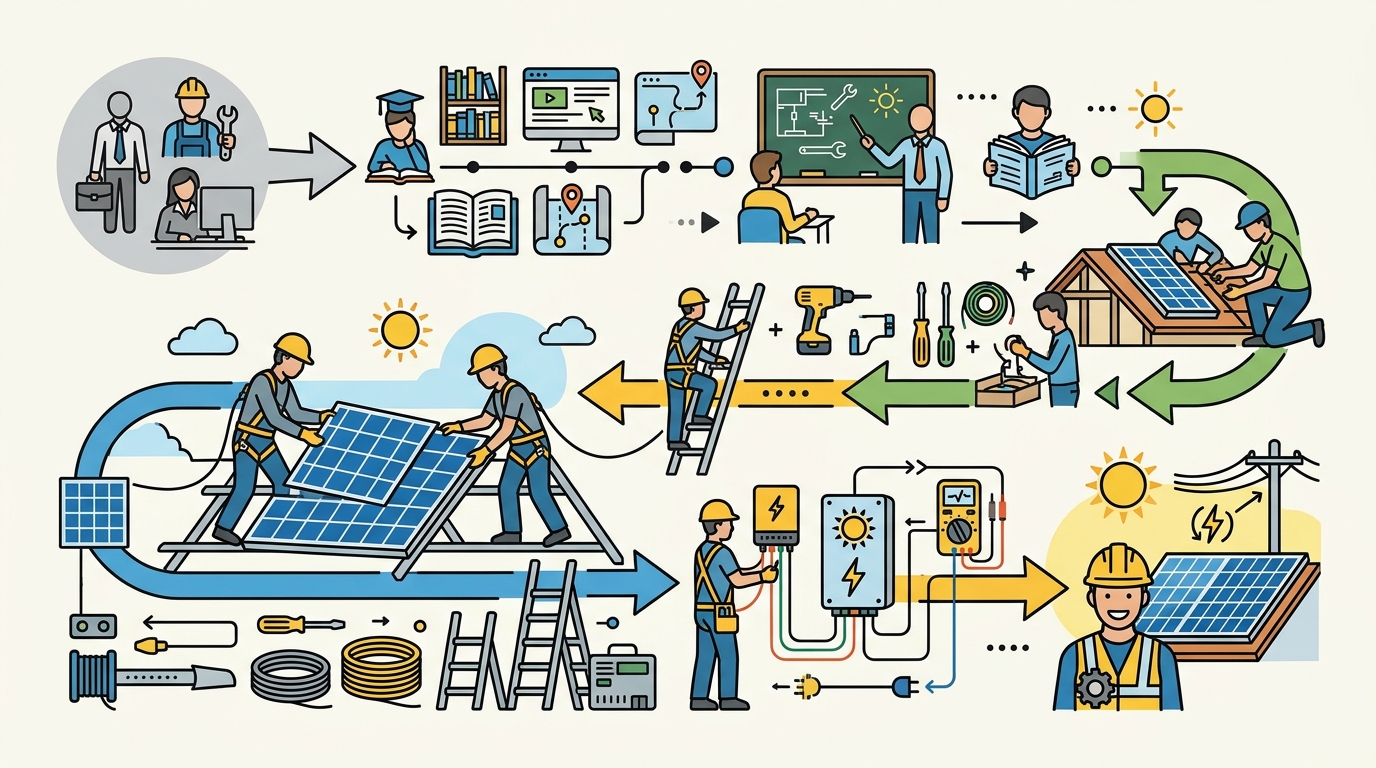
Moving into solar PV installation from another job usually takes somewhere between 6 and 18 months from first research to a steady crew role — a certificate program of 12 weeks to less than 1 year (CareerOneStop) followed by the 1 to 12 months of on-the-job training most entrants go through (CareerOneStop). The alternative is a registered apprenticeship: the Solar Energy Technician Apprenticeship at St. Petersburg College with UCF's Florida Solar Energy Center runs two years at no cost and includes full-time employment with a solar installation company.
The entry bar is low on paper. People starting in this career usually have a high school diploma or equivalent and no prior work experience (CareerOneStop), and most photovoltaic installers learn on the job working with experienced installers (U.S. Bureau of Labor Statistics, 2025). The hard part is the income gap between your last paycheck and your first crew paycheck, plus the physical reality of roof work — both of which you can test and budget for before you resign.
The Transition Timeline
Treat the first half of this as something you do around your current shifts. Nothing before the hand-off stage requires you to leave a job.
- Months 1-2 — Still employed, researching. Read the occupational data: about 31,100 solar photovoltaic installer jobs in 2025, with employment projected to grow 37 percent from 2025 to 2035 (U.S. Bureau of Labor Statistics, 2025). Look up what your state's electrical or contractor licensing board requires, and search the 184 training programs listed for Solar Photovoltaic Installers in the United States (CareerOneStop). Write down three local installation companies and what roles they post.
- Months 2-4 — Still employed, testing and choosing. Spend a weekend on ladder, roof and heat work so you know the job is physically survivable for you. The occupation sits in ONET's Realistic interest group and is classified Job Zone 2, Some Preparation Needed (ONET Center). Then pick a route: a free short-term program, a certificate of 12 weeks to less than 1 year (CareerOneStop), or a two-year paid apprenticeship.
- Months 3-6 — Still employed, training in the margins. Complete OSHA 10, start evening or weekend coursework, and build your cash runway toward six months of essential expenses. This is the stage where people quietly quit and shouldn't — stay on payroll as long as the class schedule allows.
- Months 5-8 — The hand-off. Full-time programs force the issue. GRID Alternatives' Installation Basics Training runs 200 hours over a minimum of five weeks and is free, with some regions providing a stipend, and a free pre-apprenticeship combining 160 hours of in-person training with 30-plus hours of online OSHA 30 Construction Safety training runs 16 weeks (Holyoke Community College). Time your notice to a confirmed start date, not a hoped-for one.
- Months 6-12 — First crew job, entry level. You start as a helper or apprentice carrying panels, setting racking and learning layout. Civic Works' Baltimore program is a useful model of the shape of this stage: 46 hours of job readiness instruction, two 40-hour classroom weeks, 88 hours of hands-on training and up to 320 hours of on-the-job training, about three months of calendar time start to finish (Maryland Department of Labor EARN program).
- Months 12-18 — Credentialing off your own hours. At least six months of full-time-equivalent work directly involved with photovoltaics qualifies you for the NABCEP PV Associate credential through the Experience Pathway (NABCEP).
- Months 18-24 — First full year in the role. You are running sections of installs, possibly leading them. If you want the NABCEP PV Installation Professional, you now stack the required 58 hours of advanced training, OSHA 10 and documented installation experience (Midwest Renewable Energy Association).
Step-by-Step Plan
- While still employed: get your state's electrical and contractor licensing rules in writing. Requirements differ sharply by state — some reserve the electrical interconnection for a licensed electrician while leaving mechanical mounting open to unlicensed crew. Call the board; do not rely on a forum.
- While still employed: audit what you already bring. Roofers, HVAC technicians, auto mechanics, warehouse supervisors and electrician's helpers transfer fastest — candidates with electrician or construction experience are often considered qualified with only on-the-job training (CareerOneStop). Retail managers, elementary teachers and restaurant shift leads bring crew coordination, customer-facing composure and safety-rule discipline, which matter on residential sites where the homeowner is watching from the driveway.
- While still employed: do a physical trial. One full Saturday on a ladder in summer heat tells you more than any brochure, and it is the cheapest way to find out this is not for you.
- While still employed: pick your route and apply. Options include a free five-week short-term program (St. Louis Community College), a free pre-apprenticeship (Holyoke Community College), a community college or trade school certificate of 12 weeks to less than 1 year (CareerOneStop), or a two-year no-cost apprenticeship that includes full-time employment with a solar installation company (St. Petersburg College with UCF's Florida Solar Energy Center).
- While still employed: complete OSHA 10 and bank savings. OSHA 10 is a stated prerequisite for the NABCEP PV Installation Professional certification (Midwest Renewable Energy Association), and most employers expect it before you set foot on a roof.
- While still employed: apply to installers in the final weeks of your program, not after it ends. Ask specifically for helper, apprentice or ground-crew openings — about 4,200 openings for solar photovoltaic installers are projected each year, on average, over the decade (U.S. Bureau of Labor Statistics, 2025), and most of them are entry level.
- At the hand-off: give notice only once you have a written start date for training or work. If your program is full-time and unpaid, you are deliberately choosing an income gap of five to sixteen weeks (GRID Alternatives; Holyoke Community College) — fund it first.
- After leaving: take the helper job even if the hourly rate is below your old one, and log every photovoltaic hour. At least six months of full-time-equivalent PV work opens the NABCEP PV Associate Experience Pathway (NABCEP).
- After leaving, months 12-24: add advanced training toward the PV Installation Professional. Budget the $125 application fee and $375 exam fee (Indiana Department of Workforce Development), and know the re-exam fee is $275 if you retake it (Midwest Renewable Energy Association).
On pay: solar installer pay is usually hourly, sometimes with production or per-install bonuses, and it varies by state, by employer and by whether you are a helper, a lead installer or the licensed electrician doing the interconnection. Check the current Occupational Employment and Wage Statistics figures for solar photovoltaic installers from the U.S. Bureau of Labor Statistics, and your state workforce agency's figures, before you build a household budget around it.
Before You Quit Your Job Checklist
Every item here is either done or not done. If more than two are unticked, you are not ready to give notice.
- Six months of essential expenses held in cash. Not credit, not retirement funds. Verify it by looking at one account balance.
- Written start date for training or a job. An email or letter with a date on it, not a verbal "come see us in the spring."
- High school diploma or equivalent located. Entrants usually have a high school diploma or equivalent (CareerOneStop); you need the document, not the memory of it.
- OSHA 10 card in hand, or enrolled with a date. Required for the NABCEP PV Installation Professional path (Midwest Renewable Energy Association) and expected by most employers.
- State licensing answer in writing. You have a note recording what your state's board said about who may perform mounting versus electrical interconnection, and whether an electrical apprentice registration is needed.
- Driver's licence and driving record checked. Many installers put crews in company trucks and run a record check before hire.
- Health coverage plan with a date. You know the exact day your current coverage ends and what replaces it.
- Physical trial completed. You have spent at least one full day on ladders and a roof since deciding, and you still want this.
- Backup income identified. A named part-time, per-diem or shift role you could start quickly if training is delayed or the first job falls through.
- Three local installers contacted. You have spoken with three companies about entry-level crew openings and know what each one requires.
Certifications and Costs
The costs below are the ones published by the named bodies. Course fees at community colleges and trade schools vary by state and by school — confirm current tuition with the provider before you commit.
| Requirement | Provider or Path | Cost | Time to Complete |
|---|---|---|---|
| Entry-level solar installer training | St. Louis Community College short-term program | Free | 5 weeks |
| Installation Basics Training (IBT 200) | GRID Alternatives | Free; some regions provide a stipend | 200 hours over a minimum of 5 weeks |
| Solar installer/electrical pre-apprenticeship with OSHA 30 Construction Safety | Holyoke Community College | Free | 16 weeks (160 in-person hours plus 30-plus online hours) |
| Entry-level solar installer training with on-the-job hours | Civic Works, Baltimore (Maryland Department of Labor EARN program) | Free | About 3 months (46 hours job readiness, two 40-hour classroom weeks, 88 hands-on hours, up to 320 hours on the job) |
| Community college or trade school certificate | One of 184 training programs listed for Solar Photovoltaic Installers (CareerOneStop) | Varies by school and state — check tuition directly | 12 weeks to less than 1 year |
| NABCEP PV Associate, Education Pathway | NABCEP Associate Registered Training Provider; one provider requires seven courses (PV 101, PV 150, PV 201, PV 202, PV 215, PV 216, PV 217) | Course fees vary by provider; exam fee set by NABCEP | Varies by the provider's course schedule |
| NABCEP PV Associate, Experience Pathway | At least 6 months of full-time-equivalent work directly involved with photovoltaics (NABCEP) | Exam fee set by NABCEP | 6 months of qualifying work |
| NABCEP PV Associate renewal | NABCEP-accepted continuing education | Varies by provider | 12 hours of continuing education per 3-year credential period |
| NABCEP PV Installation Professional (PVIP) | NABCEP; requires at least 58 hours of advanced training, OSHA 10, documented installation experience, minimum age 18 | $125 application fee plus $375 exam fee (Indiana Department of Workforce Development); $275 re-exam fee (Midwest Renewable Energy Association) | 58-plus training hours plus documented install experience |
| Solar Energy Technician Apprenticeship | St. Petersburg College with UCF's Florida Solar Energy Center | No cost; includes full-time employment with a solar installation company | 2 years |
Other national certifications exist if an employer asks for them. O*NET OnLine lists eight for this occupation, including the UL Photovoltaic System Installation Certification, ETA International's Photovoltaic Installer/Designer, and the Electrical Training Alliance's Solar PV Certification (U.S. Department of Labor, Employment and Training Administration).
Frequently asked questions
I'm 52 and I've managed a retail store. Will crews hire someone my age?
Age bias is real on physical crews, and workers in their 50s and 60s get read as a stamina or safety risk before anyone asks about their experience — so answer it before it is asked. The published requirements set no upper limit: the NABCEP PV Installation Professional specifies only that candidates be at least 18 years old (Midwest Renewable Energy Association), and most photovoltaic installers learn on the job working with experienced installers whatever their entry age (U.S. Bureau of Labor Statistics, 2025). Do the months 2-4 physical trial on the timeline, then say in interviews that you have already spent a full day on a roof, and bring your scheduling and crew-coordination record from the store. With about 4,200 openings projected each year on average over the decade (U.S. Bureau of Labor Statistics, 2025), employers in growing markets are filling entry seats.
Can I make this switch without ever having an unpaid gap?
Yes, through the apprenticeship route — the Solar Energy Technician Apprenticeship at St. Petersburg College with UCF's Florida Solar Energy Center is a two-year, no-cost program that includes full-time employment with a solar installation company. Outside that model, the months 3-6 stage is designed to keep you on payroll: finish OSHA 10 and evening coursework before you resign. If your program is full-time, such as the 200 hours over a minimum of five weeks in GRID Alternatives' Installation Basics Training, plan for a gap of five to sixteen weeks and fund it from the six-month cash runway on the checklist.
What will this actually cost me out of pocket?
Training can be $0 if you use a free option: St. Louis Community College's five-week program, GRID Alternatives' Installation Basics Training, a free 16-week pre-apprenticeship (Holyoke Community College), or the roughly three-month Baltimore program run by Civic Works under the Maryland Department of Labor EARN program. The main unavoidable money comes at the months 18-24 stage — a $125 application fee plus a $375 exam fee for the NABCEP PV Installation Professional (Indiana Department of Workforce Development), and $275 more if you retake it (Midwest Renewable Energy Association). The bigger tradeoff is not tuition but the step down to helper-level hourly pay through 1 to 12 months of on-the-job training (CareerOneStop).
Do I have to become a licensed electrician first?
Not to enter the field: people starting in this career usually have a high school diploma or equivalent, no work experience, and 1 to 12 months of on-the-job training (CareerOneStop). What you are allowed to connect varies by state, which is why the licensing item sits on the checklist as something you confirm in writing with your state board during months 1-2. If you already have electrician or construction experience, CareerOneStop notes you may be considered qualified with only on-the-job training, which pushes you toward the short end of the 6-to-18-month range rather than the long end.
Sources
- U.S. Bureau of Labor Statistics — Solar Photovoltaic Installers : Occupational Outlook Handbook (2025)
- CareerOneStop — Occupation Profile for Solar Photovoltaic Installers

Written by
Priya tracks wages, layoffs, and the slow shifts in what counts as a stable job. She writes for readers trying to make sense of numbers that rarely match their own experience.