Web Developer vs. Data Analyst: Which Career Change Is Right for You
Two desk-based tech switches with very different front doors: one rewards a portfolio you build yourself, the other usually wants a degree first.
Quick answer
- Faster entry: web development, because BLS notes web developers and digital designers may not need specific education credentials if they can show ability through prior work or projects (U.S. Bureau of Labor Statistics, 2025).
- Lower formal education bar: web development again — O*NET places Web Developers in Job Zone Three, while data scientists typically need at least a bachelor's and often a master's (U.S. Bureau of Labor Statistics, 2025).
- Pay: don't guess. Compare the 2025 median wages for web developers, for web and digital interface designers, and for data scientists in the BLS Occupational Outlook Handbook before committing a year of evenings.
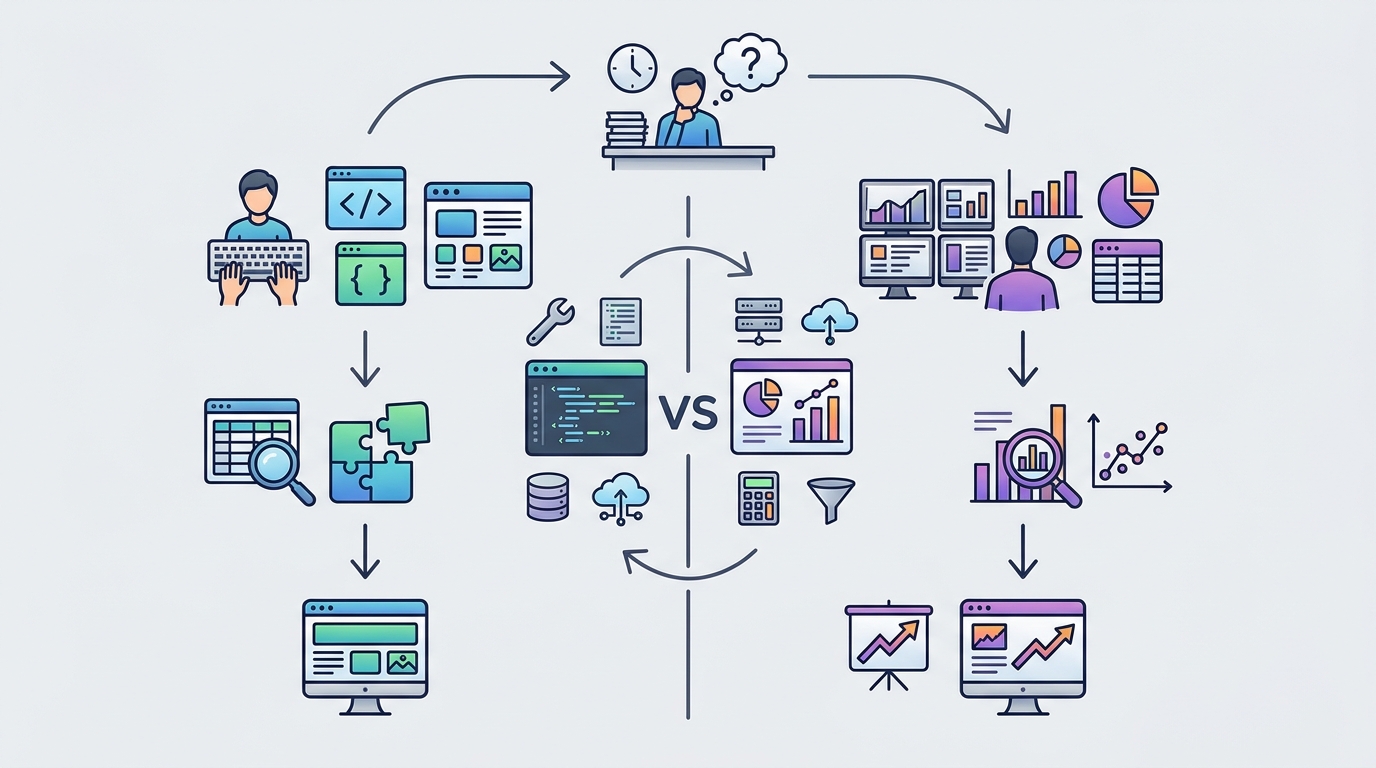
Web development and data analysis both let you leave physical or shift-based work for a desk, but they ask different things at the door. Web developers and digital designers may not need specific education credentials if they can demonstrate their abilities through prior work or projects (U.S. Bureau of Labor Statistics, 2025), while the closest occupation the government tracks for analytics work — data scientist — typically needs at least a bachelor's degree in mathematics, statistics, computer science or a related field, with some employers requiring or preferring a master's or doctorate (U.S. Bureau of Labor Statistics, 2025).
If you already hold a quantitative degree, data work is the shorter road. If you don't, web development usually gets you to a first paid project faster — commonly 9 to 24 months of part-time study and portfolio building rather than 2 to 4 years of tuition.
Side-by-Side Comparison
"Data analyst" is an employer title, not a federal occupation. The closest occupation the U.S. Bureau of Labor Statistics publishes a full profile for is data scientist, so that is the benchmark here. Duties and pay vary by employer and by state; outside the US, check your own national statistics agency.
| Dimension | Web developer | Data analyst (benchmarked to data scientist) |
|---|---|---|
| Realistic transition time | 9 to 24 months of part-time study plus 3 to 5 portfolio projects | 12 to 36 months if you already hold a bachelor's; 2 to 4 years of tuition if you need the degree first |
| Typical entry education | Requirements vary by employer; credentials may be skippable if you can demonstrate ability through prior work or projects (U.S. Bureau of Labor Statistics, 2025) | At least a bachelor's in mathematics, statistics, computer science or a related field; some employers require or prefer a master's or doctoral degree (U.S. Bureau of Labor Statistics, 2025) |
| Preparation level | ONET lists Web Developers as Job Zone Three, with its stated education and on-the-job training pattern (ONET OnLine, undated) | Degree-led; most training happens on the job after hire |
| Median pay | Look up the 2025 median annual wage for web developers, and separately for web and digital interface designers, in the BLS Occupational Outlook Handbook (U.S. Bureau of Labor Statistics, 2025); O*NET also publishes a 2025 median for Web Developers | Look up the 2025 median pay for data scientists in the same handbook (U.S. Bureau of Labor Statistics, 2025); analyst titles usually sit below scientist titles at the same employer |
| Outlook | BLS publishes 2025–35 projected growth and projected annual openings (U.S. Bureau of Labor Statistics, 2025) | BLS publishes employment and projected 2025–35 growth for data scientists (U.S. Bureau of Labor Statistics, 2025) |
| Physical and schedule demands | Desk-based; freelance and contract work allows part-time entry while you keep your job | Desk-based; data scientists typically work in an office setting and most work full time (U.S. Bureau of Labor Statistics, 2025) |
| Starting age | Neither field sets one. Web development is friendlier for switchers aged 45 to 60, because a portfolio is evidence an employer can check in ten minutes | Degree recency matters more, so a recent named credential helps |
What Each Job Looks Like Day to Day
A web developer's week is built around other people's requirements and your own code. BLS describes the core duties as meeting with clients to discuss site needs, writing code using languages such as HTML or XML, and integrating graphics, audio and video into websites (U.S. Bureau of Labor Statistics, 2025). In practice that means a morning call where a client says their booking form confuses people, an afternoon rewriting that form's markup and testing it on a phone screen, then fixing something that broke when a browser updated. The work is visible — you can show a stakeholder the result before lunch. On small teams you may also handle hosting and accessibility checks.
A data role is built around questions rather than screens. BLS describes data scientists as determining which data are available and useful, collecting, categorising and analysing that data, creating and testing algorithms and models, and using data visualisation software to present findings (U.S. Bureau of Labor Statistics, 2025). In an analyst seat that often means spending a morning working out why two systems report different customer counts, writing SQL to reconcile them, then building a chart a department head can act on without reading the query. Most of the job is full time and office-based, and much of it is cleaning data that arrived messy.
Which Fits Your Background
- Retail or restaurant manager: web development is the faster fit. You already run requirements conversations with people who change their minds — that is the client meeting BLS lists as a core duty.
- Elementary or high school teacher: data analysis. You already read assessment data and defend a conclusion to parents and administrators. Add SQL and a visualisation tool.
- Graphic designer or print production artist: web development, specifically the digital designer side — BLS tracks web and digital interface designers separately, and your layout and typography work transfers.
- Bookkeeper, accounts payable clerk or claims adjuster: data analysis. Heavy spreadsheet users with reconciliation habits convert fast, because you already distrust a number that doesn't tie out.
- Registered nurse or medical technologist leaving shift work: data analysis in a clinical or payer setting. Domain knowledge is worth more than a second degree, and the move gets you off nights.
- Military logistics or supply NCO transitioning out: data analysis if you held a clearance — contractor analyst hiring paths are well-worn.
- Changing at 50 to 60 after a long career: web development, because BLS allows for proving ability through prior work or projects rather than credentials.
How to Decide and Test the Waters
- Spend four weekends on each, not one. Build a one-page site with HTML and CSS, then take a public dataset and answer one question with a pivot table and a chart. You are testing which one makes you lose track of time.
- Shadow someone for a day in each field. Ask inside your current employer first — many organisations have both a web team and a reporting team, and an internal request costs you nothing.
- Check the job ads before paying for anything large. For data, confirm whether your target employers require a bachelor's in mathematics, statistics or computer science, since BLS says that is typical and some prefer a master's. That check can save you 2 to 4 years of tuition.
- Do one piece of real work cheaply. Rebuild a site for a community group, or volunteer to clean and chart its membership data. A finished artefact beats a certificate in a portfolio review.
- Price the gap. Plan for 6 to 12 months of reduced or no income if you study full time, and expect a first job below your current pay in either field. Keep your current job through the portfolio stage.
- Set a decision date. Give yourself 90 days of parallel testing, then pick one and go deep for 12 months. Splitting effort is the most common reason a two-year transition becomes a four-year one.
Frequently asked questions
Which one can I switch into faster?
Web development, in most cases. BLS notes that web developers and digital designers may not need specific education credentials if they can demonstrate ability through prior work or projects (U.S. Bureau of Labor Statistics, 2025), which supports a 9 to 24 month part-time route. Data roles benchmark against data scientists, who typically need at least a bachelor's and sometimes a master's — so without a quantitative degree, add 2 to 4 years.
Which pays more?
Check three separate 2025 BLS figures rather than one: the median annual wage for web developers, the median for web and digital interface designers, and the median pay for data scientists (U.S. Bureau of Labor Statistics, 2025). Analyst titles usually sit below scientist titles at the same employer, and both fields vary by state, so compare national medians first, then your metro area.
I'm 52. Will anyone hire me into either field?
Age bias bites hardest in the 45 to 60 band, where a long résumé reads as expensive. Web development gives the better counter, because BLS recognises prior work and projects as evidence of ability — a reviewer can open 3 live sites you built in the last 12 months. For data roles, the equivalent is a recent degree or named credential plus one domain you know well.
Can I test either part time while keeping my job?
Web development, yes — freelance site work lets you bill a client while still employed. Data analysis is harder to test that way, since BLS notes data scientists typically work in an office setting and most work full time (U.S. Bureau of Labor Statistics, 2025); the realistic route is volunteer reporting work for a nonprofit, 3 to 5 hours a week.
Sources
- U.S. Bureau of Labor Statistics — Web Developers and Digital Designers : Occupational Outlook Handbook (2025)
- O*NET OnLine (National Center for O*NET Development) — 15-1254.00 - Web Developers (Summary Report)

Written by
Desmond writes about the mechanics of job searching: resumes, interviews, the long silence after applying. He's fascinated by how much of getting hired depends on luck dressed up as skill.